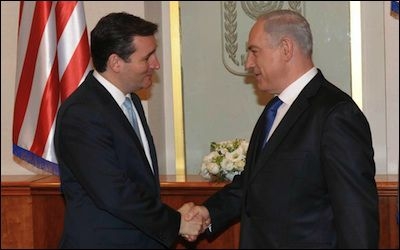
Texas senator Ted Cruz meets with Israeli prime minister Binyamin Netanyahu in Israel, January 11, 2013. A week after taking office, Cruz traveled to Israel on a congressional delegation trip, led by Senate minority leader Mitch McConnell.
|
When, in the midst of the 2014 Hamas-Israel war, the U.S. Federal Aviation Administration briefly banned American carriers from flying to Israel, Sen. Ted Cruz (Republican of Texas) accused Barack Obama of using a federal regulatory agency "to launch an economic boycott on Israel, in order to try to force our ally to comply with his foreign policy demands."[1] In so doing, Cruz made an accusation no Israeli leader would dare express.
This is hardly unique: Over the years, other American political figures, both Republican (Dan Burton, Jesse Helms, Condoleezza Rice, Arlen Specter) and Democrat (Charles Schumer), have adopted tougher, and sometimes more Zionist, stances than the Israeli government. This pattern in turn points to a larger phenomenon: The Arab-Israeli conflict tends to generate more intense partisanship among Americans than among Middle Easterners. The latter may die from the conflict but the former experience it with greater passion.

