Showing posts with label Egypt Protests. Show all posts

Friday, July 12, 2013

Why Now Is The Time To Complete The Defeat of The Muslim Brotherhood In Egypt

The following by Raymond Stock is reposted here with permission of Middle East Forum:

Complete the Islamists' Defeat


by Raymond Stock
Foreign Policy Research Institute
July 2013


On July 8, the Obama administration finally did the right thing in Egypt—by not calling what Mohamed Mursi's historically huge opposition rightly hails as its "corrective revolution" a coup. Thus it prevented the automatic cutoff of America's $1.6 billion of mostly military aid, without which our connection to the largest Arab state (and perhaps the Suez Canal) would be lost. But it would be a grave mistake if the U.S. should insist that the aid would continue only if everyone –the deposed Muslim Brotherhood (and other Islamists) among them—is included in the now-rebooted "transition to democracy." Nor should the Egyptians want to go to this route. Such would be an historic error that will sabotage whatever good might come from the already diminished influence which that aid buys – as well as from the heroic actions of the Egyptians themselves.

In addition to Egypt's probable lack of enough secular and civil society to create a genuine democracy, the seemingly imminent civil war would not permit that transition to happen, at least not now—and perhaps not ever. With Monday's opening clash in front of the Ministry of Defense that left roughly fifty Islamists dead and one soldier slain, after numerous other killings over the year of MB rule, and culminating in scenes such as the murder of opposition teens by throwing them off of an Alexandria rooftop last week, the much-feared Algeria 1992 redux may already have begun.

Yet as tragic—and even heartless—as this might seem, it would be better to have that civil conflict now then to wait until the Islamists are better armed and prepared, especially having been invited back into power to share the running of the state. That will give only them both renewed legitimacy and access to material resources that they do not deserve—and which the last year shows they will only abuse.

Wednesday, July 10, 2013

Mideast Media Sampler 7/10/13: New York Times Whitewashes Muslim Brotherhood And Pushes Its Version Of The Bloodshed

by David Gerstman, contributing blogger at Legal Insurrection

Who shot first?


Yesterday's New York Times ran an editorial, Bloodshed in Egypt:
It has been all downhill for Egypt since the military ousted President Mohamed Morsi last week On Monday, according to reports in The Times, Egyptian soldiers fired on hundreds of Mr. Morsi’s supporters as they were praying outside the facility where he was believed to be detained. At least 51 civilians were killed and more than 300 were wounded. . The military claimed its soldiers fired in response to an attack by gunmen from an unnamed “terrorist group.” But other evidence — bullet casings with the army stamp, indications that the gunfire came from the top of a nearby building — suggest a military all too willing to use excessive force.
While it places political blame on ex-President Morsi and the Muslim Brotherhood for the events Monday , the violence is blamed on the army.

Mideast Media Sampler 7/9/13: Do You Remember The Muslim Brotherhood's Coup Back in November?

by David Gerstman, contributing blogger at Legal Insurrection


1. The Brotherhood's Coup

While violence in Egypt has been increasing, it's important to remember that there was a coup in Egypt prior to the June 30th protests. That coup occurred November 22, 2012. That's when President Morsi attempted to seize power for himself by fiat.

Here's how Eric Trager later characterized the events:
The Brotherhood's most blatantly undemocratic act, however, was Morsy's Nov. 22 "constitutional declaration," through which he placed his presidential edicts above judicial scrutiny and asserted the far-reaching power to "take the necessary actions and measures to protect the country and the goals of the revolution." When this power grab catalyzed mass protests, Morsy responded by ramming a new constitution through the Islamist-dominated Constituent Assembly, and the Brotherhood later mobilized its cadres to attack the anti-Morsy protesters, and subsequently extract confessions from their captured fellow citizens. So much for promises of "consultation."

Protests in Egypt: A War Of Propaganda As Well As Bullets

"A bullet may kill a man, a lying camera kills a nation"
From a flyer dropped near Al Jazeera's offices in Egypt

After finally holding the reins of power after patiently waiting and planning for decades, the Muslim Brotherhood suddenly finds itself once again on the outside looking in.

But while Morsi has been removed from office, the Muslim Brotherhood is not going to take this lying down. After all, they also know how to organize and take to the streets.

They also know how to capitalize on opportunities.

And the Egyptian army may have handed them a major propaganda coup, as 51 pro-Morsi demonstrators have apparently been killed by the army.

Wendell Steavenson writes in The New Yorker After The Shooting in Cairo:

Tuesday, July 09, 2013

David P. Goldman: Islam's Civil War Moves to Egypt

The following by David P. Goldman is reposted here with permission of Middle East Forum:

Islam's Civil War Moves to Egypt


by David P. Goldman
Asia Times
July 8, 2013

The vicious crosswind ripping through Egyptian politics comes from the great Sunni-Shi'ite civil war now enveloping the Muslim world from the Hindu Kush to the Mediterranean.

It took just two days for the interim government installed last week by Egypt's military to announce that Saudi Arabia and other Gulf States would provide emergency financing for the bankrupt Egyptian state. Egypt may not yet have a prime minister, but it does not really need a prime minister. It has a finance minister, though, and it badly needs a finance minister, especially one with a Rolodex in Riyadh.

As the World Bulletin website reported July 6:

Monday, July 08, 2013

Arlene Kushner on Egypt Going Into The Sinai and Kerry's New Demands for Israeli Concessions

From Arlene Kushner:
July 8, 2013

Ugly


There's a lot of "ugly" here in the Middle East. And while I intend to move on to matters other than Egypt, I begin with the latest in that place of violence and turmoil.  The Brotherhood -- calling for an uprising across the country -- is determined that matters will be as difficult as possible.  There great reason to worry about Egypt:
This morning, Brotherhood people stormed the Republican Guard headquarters where Morsi is being held.  The military, saying that terrorists had tried to storm the building, fired upon the crowd.  Reports are that some 43 have been killed and hundreds wounded.
Egypt protests
Credit: AFP

Egyptian protest casualties
Credit: Reuters
The casualties are likely to further inflame Brotherhood anger.
~~~~~~~~~~
Meanwhile, turmoil grows in the Sinai, which is rife with radicals and terrorists.
The crossing between the Sinai and Gaza at Rafah is being kept closed and some 40 tunnels have been destroyed in the last couple of days; this to preclude Hamas involvement in what is taking place. 
Terrorists have fired on the police station near the crossing and at three military checkpoints in the Sinai.  On Saturday a Coptic priest was shot dead by a gunman.
Additionally, yesterday a pipeline that supplied gas to Jordan was blown up by Islamic militants south of El Arish in the Sinai.
~~~~~~~~~~
Reports are surfacing about a major operation in the Sinai planned by the military.  According to the Maan (Palestinian Arab) News Agency:
"...coordination is ongoing between the Egyptians and the Israelis to bring military vehicles, troops and jets into Sinai to fight terror.

"'The Egyptian military activity in the Sinai is coordinated with Israeli security elements and authorized at the most senior levels in Israel, in order to contend with security threats in the Sinai that pose a threat to both Israel and Egypt,' the army said in a statement."
~~~~~~~~~~
The nature and the quantity of military equipment that Egyptian officials want to bring into the Sinai must be cleared by Israeli officials, for they transcend what is permitted by the Israeli-Egyptian peace treaty, which mandates demilitarized areas in the Sinai.
This bridge was crossed before during the Morsi administration, although I believe even more equipment -- particularly with regard to plane -- is planned for use in the Sinai this time.  Many here in Israel are opposed to the granting of such permission and vastly uneasy about the potential repercussions of this change in the status quo down the road.  Questions are raised regarding whether all the equipment being brought in is truly of the sort needed to battle local radicals.
I don't see that Israel has much option in the matter, however.  It would be exceedingly impolitic in the current situation to refuse to allow the military to bring in equipment it says it needs to take out terrorists and radicals in the Sinai. What is more, it truly is to Israel's benefit that battle should be done with them.  During the Morsi administration, a great show was made of acting against them, while in fact not much was done.  This time, it might be different.  Might.
~~~~~~~~~~
Now as to Kerry's continuing efforts:
Two days ago, Al Hayat (London) reported that Kerry's plan for generating "peace talks" includes cessation of all building in Judea and Samaria outside the major settlement blocs and the release of 103 prisoners arrested before Oslo.
Perhaps worst of all, according to this report, Israel would be required to allow the Palestinian Arabs to build in Area C.
Required?  Area C, according to the Oslo Accords, is fully under Israeli control, both civil and security.  As it is, Israeli authorities are looking the other way or conferring quiet blessings on Palestinian Arab projects in Area C.  But to make it part of a concession formally?  An outrage and an infringement of our rights that should not be permitted.
According to Times of Israel:
"Other sources in the report were quoted as saying that the plan includes a pledge by Prime Minister Benjamin Netanyahu to publicly commit to negotiations using the model laid out by US President Barack Obama during his visit to the region: two states living side by side, on the basis of the 1967 lines with land swaps, as well as Palestinian recognition of Israel as a Jewish state."
This is vile.  Seeking a pledge by the prime minister to negotiate on the basis of the 1967 armistice line -- because that's what Abbas demands. 
The talks would continue for a period of six to nine months, and be broken into three phases, during which time final status issues would be discussed.  Work towards stimulating $4 billion in investments would proceed at the same time.
Netanyahu's office has had no comment on this "plan."
While Israel Hayom reported yesterday that:
"A senior Israeli official said on Saturday that Prime Minister Benjamin Netanyahu has no intention of caving to Palestinian demands ahead of talks..."

Netanyahu is seeking "an assurance that negotiations will be held over a long period of time and will cover all the issues.

"[He] wants to avoid a situation whereby Palestinian Authority President Mahmoud Abbas will try stepping away from the negotiating table after a few meetings and turn to the United Nations in September under the premise that Israel is to blame for the failure of the talks."
At the same time, Abbas continues to make it clear that he intends to make no concessions and is proud of this. 
~~~~~~~~~~
The concern here is not that Israeli concessions will result in a "Palestinian state," but that they will weaken the Israeli position by establishing precedents and facts on the ground.
~~~~~~~~~~
I have just read a statement in a news source that Kerry will ask Netanyahu to commit to negotiating on the basis of the 1967 line because in 2009, during his talk at Bar Ilan University, the prime minister already committed to a Palestinian state on that line.
Lest some of my readers also see this statement and believe it, I provide a correction here.  Netanyahu spoke about two states living side-by-side.  Unfortunate enough. But no where does he speak about the borders between those states being defined by the 1967 line (an armistice line).  In fact, he says that Jews have ancient rights to Judea and Samaria -- and makes it clear that the settlements are not the cause of tension between Israel and the PA. 
How fast and loose people play with the facts.
~~~~~~~~~~
Right now, Kerry's wife is very ill, and his personal situation may delay his next visit here.  Maybe he'll have time to rethink his entire preposterous position.
Barry Rubin --  in his article, "Chaos in Middle East Grows as the U.S. Focuses on [Harassing] Israel" -- sums up the situation well (emphasis added). 
Playing on a NYTimes headline, Rubin has coined his own:  "Kerry Shuttles as the Middle East Burns."
"Once again the United States is too busy trying to get the Holy Grail of Arab-Israeli peace while every country is in turmoil. Egypt, Syria, Turkey, Iran, etc., are in dangerous crises. Yet the White House stays wake at night not about Benghazi but about fantasizing on dream-boundaries in Jerusalem. Once again, U.S. policy is trying to free Palestinian terrorists convicted of murder while tens of thousands of innocent people are being killed or imprisoned.

Not only is peace unobtainable because of Palestinian intransigence, but the powerful Islamist and nationalist forces don’t want peace. Peace with Israel would stir up more unrest and violence. Any Arab leaders who made peace would face overthrow and assassination. Everyone in the Middle East knows this; it often seems that nobody in Washington does. And Tony Blair, the negotiator for the Quartet–U.S., EU, UN, Russia–has been to Jerusalem 75 times in a decade with nothing to show for it."
~~~~~~~~~~
Please, also see a significant piece by Dore Gold, president of the Jerusalem Center for Public Affairs, on "Kerry and the struggle over the Jordan Valley" (emphasis added):
Gold makes the case, both historically and with regard to current security needs, for Israel to retain the Jordan Valley, which Kerry would have us relinquish.  (The Valley is a part of Area C, it must be noted.) 
Not only is there concern about movement of enemy forces coming from the east -- should Jordan fall to Islamists, for example. There is this issue as well:
"Second, Israeli control of the Jordan Valley is... needed also for neutralizing the growing threat from advanced weapons that can be smuggled to terrorist organizations.  Israel learned the hard way that when it left the Philadelphi Route at the outer perimeter of the Gaza Strip, the scale of weapons smuggling, particularly from Iran, surged, and Gaza became a strategic threat to Israeli cities.
Military strategists are aware how important this factor is in winning counter-insurgency wars of the future. After spending ten years hosted by U.S. commanders in Iraq and Afghanistan, Max Boot just published a 600-page book on the history of guerrilla warfare. He suggests that there are five factors behind the success of insurgency forces; the fourth is their ability to obtain reinforcements in the form of weapons or even manpower.
"When Boot looks at Israel's success in halting the wave of terror attacks in its cities in 2002, he cites the "IDF's success in sealing off the West Bank" from resupply as a key component of its strategy. Boot's analysis makes sense. In Gaza, where Israel no longer could control of the outer perimeter of the territory at the Philadelphi Corridor, it lost its counter-insurgency war with Hamas and other groups and withdrew. But in the West Bank, it defeated terrorism by fulfilling this essential precondition for winning a counter-insurgency campaign by retaining the Jordan Valley."
What Gold points out is that
"Western diplomats...have been predisposed to accepting the Palestinian narrative on territory and the Israeli narrative on security. This struggle has direct implications for the future of the Jordan Valley.

"...Israel is many times inundated with suggestions that it replace the IDF with international forces,,,For Israel, relying on international peacekeepers in the Jordan Valley would be far too great a risk for any responsible Israeli government to take.

"Currently, in order to back up Secretary of State Kerry's shuttle diplomacy, the U.S. has begun a quiet dialogue with Israel over how it might have its security protected should it withdraw the IDF from the West Bank." 
That is, the US proposes international forces in the Jordan Valley to protect us when we pull back. 
This is the stuff of nightmares and cannot be allowed to happen. Gold does not believe it will.
~~~~~~~~~~
There was a massive explosion in an arms depot in the Syrian port city of Latakia, a couple of days ago, with some 10 to 20 Syrian soldiers killed.  But there is no consensus as to what caused it -- bombs from foreign aircraft, cruise missiles fired from warships, or something else.  Syrian officials are saying that it was caused "by a terrorist group aligned with al-Qaida."   Israel is "studying the situation."
Latakia is historically an Alawite center.
~~~~~~~~~~
Hezbollah may begin to play a lesser role in the civil war in Syria. Two different factors play into this.
First, Lebanese Shiite supporters of Hezbollah and family members -- particularly in the Ba'albek region -- alarmed by the number of Hezbollah fighters, including senior commanders, who have been lost in Syria, are petitioning Hezbollah leaders for a pullback in the deployment of Hezbollah men into Syria. 
The opinion expressed by those seeking a pullback is that "their children had fought Israel in 2006 and other wars, 'in response to the call for resistance against Israel.'
"However, they said their men's participation in the fight against the Syrian rebels, in defense of the Syrian government, was 'shameful' and that it was 'unacceptable' to embroil their men in a war in which they 'had no interest at all.'
It is hoped that a delegation can be sent to Iran, to explain that Hezbollah cannot continue to bear the burden it currently carries without assistance, and to seek the deployment of Iranian troops to join the fighting. 
This was reported by Asharq Al-Awsat.
~~~~~~~~~~
And then, at a Gulf Cooperation Council meeting on Friday, it was decided that sanctions against Hezbollah would be instituted because of its involvement in fighting with Assad.
"The meeting was convened 'to develop mechanisms to monitor movements, financial transactions and business operations of Hezbollah.'
The "decision to impose sanctions was taken 'after the discovery in GCC states of several terrorist cells linked to the group."
The Council consists of Saudi Arabia, Kuwait, the United Arab Emirates, Qatar, Bahrain, and Oman.  
~~~~~~~~~~
We cannot afford to lose sight of Iran, no matter what else is going on.  I'm picking up different stories about the rate of nuclear development there, how Israel can handle matters, etc.
I will not belabor all of this here, but wish to make several significant points.
Israel has stood alone in her concern about the implications of a nuclear Iran.  It's a very lonely place to be. If I believe that Netanyahu is serious about anything, it is his concern about this, which goes back several years unremittingly.
I myself had thought we would have hit Iranian nuclear installations by now.  But I clearly have no inside information and lack the capacity to explain why we haven't, and what ramifications and considerations he is dealing with.  I don't know what is being done behind the scenes or what understandings are in play with other nations.
What I do believe -- or strongly suspect -- is that there have been two red lines.  One is the line our prime minister drew on a chart at the UN last year.  This one has to do with how close to developing that bomb Iran is.  (Presumably Iran is very close to the line but has not yet crossed it.) 
~~~~~~~~~~
But there is another line, in terms of our ability to hit those installations, which are being buried way underground.  We may have passed the time when we any longer have the capacity to hit directly because we lack the equipment -- the 30,000 pound bunker busters that the US possesses and refuses to sell to us (and obviously has not used).
Admittedly, there is other sorts of damage we might do, but a direct hit may be possible only via the US at this point. And the prospects of this happening are probably just about nil.
~~~~~~~~~~
I am deeply unhappy to have to write this...
and disturbed, to boot, by the perception being embraced in many quarters (particularly at the White House) that the Iranian president-elect, Hassan Rohani, is a "moderate," and that renewing negotiations might be in order.
Please see Joseph Klein's piece on this (emphasis added):
"The Obama administration is using the election of Iran’s new president-elect, Hassan Rohani, as an excuse to consider resuming negotiations with Iran over its nuclear program. Iran is cleverly running the clock, using the election of the moderate-appearing Rohani as bait to lure the Obama administration and its European allies into another round of useless talks while Iran forges ahead to develop a nuclear arms arsenal.

"Rohani, a cleric, had served as the Supreme National Security Council chairman under Presidents Ali-Akbar Hashemi Rafsanjani (1989-1997) and Mohammad Khatami (1997-2005), and was Iran’s chief nuclear negotiator from 2003 to 2005.  He is perceived as a 'moderate' compared with the other candidates who ran for president against him. However, everything is relative. Hundreds of reformist and pragmatic candidates, and all women, were barred from running. Rohani was the last so-called 'reform' candidate standing...

"...Rohani is an insider. He is reported to be very close to Khamenei...

"'Dr. Rohani is absolutely in the pro-regime camp. He is loyal to the Ayatollah Khamenei and is committed to obeying his wishes and orders,' the Iranian Christian leader, Dr. Hormoz Shariat" is reported to have said.

In terms of demeanor and rhetoric, Rohani is expected to project a far more reasonable image than the outgoing President Mahmoud Ahmadinejad. Indeed, Rohani was highly critical of Ahmadinejad and refused to serve in his administration. However, a shift in style does not mean a shift in substance.

"Rohani sees negotiations as merely a tactic to buy time in advancing Iran’s nuclear program. It is worth noting that Ayatollah Khamenei had specifically requested his appointment as Iran’s chief nuclear negotiator in 2003, a post he retained until Ahmadinejad came to power...

"Even if Iran’s new president-elect Hassan Rohani wanted to steer Iran’s nuclear policies in a fundamentally different direction, which is hardly likely, he will have no power to do so. Hardliner Ayatollah Khamenei will continue to be in charge, which means no real change."
~~~~~~~~~~

© Arlene Kushner. This material is produced by Arlene Kushner, functioning as an independent journalist. Permission is granted for it to be reproduced only with proper attribution. 
If it is reproduced and emphasis is added, the fact that it has been added must be noted.

-----
If you found this post interesting or informative, please it below. Thanks!


Technorati Tag: and and and .

Sunday, July 07, 2013

Arlene Kushner on Egypt After Morsi -- The Failure To Understand The Coup And What Comes Next

From Arlene Kushner
July 7, 2013

It's Not Over


In Egypt, that is.  Nor should we be terribly surprised:  The Brotherhood had threatened that they were going to generate all the unrest they could.  Over the weekend there was considerable violence, with over 30 more dead.
An announcement had been made that ElBaradei -- who had been a political rival of Morsi's -- had been appointed interim prime minister. But then several sources carried the story that this appointment had been put on hold because of Islamic outrage over it. 
In fact, there have apparently been calls by ElBaradei for the Brotherhood to share in rule.  The Brotherhood is being placated at some level, and this may provide a hint as to where things are going.
~~~~~~~~~~

Daniel Pipes: Intricacies of Egypt's Coup d'état Explained

The following by Daniel Pipes is reposted here with permission:

Intricacies of Egypt's Coup d'état Explained


by Daniel Pipes
National Review Online
July 5, 2013


Events in Egypt this week prompt many responses. Here are some thirteen (complementing my article suggesting that Morsi was removed from power too soon to discredit Islamism as much as he should have).

Was Morsi the democratically elected president of Egypt? Every press account affirms he was but that is wrong. I co-authored three articles on this topic with Cynthia Farahat, looking at the first round of parliamentary elections ("Egypt's Sham Election"), the second round ("Don't Ignore Electoral Fraud in Egypt"), and the presidential elections ("Egypt's Real Ruler: Mohamed Tantawi"). In them, we documented the extensive manipulation of the 2011-12 elections, which we saw as "a ploy by the ruling military leadership to remain in power." I remain puzzled and frustrated why these elections, with their don't-pass-the-laugh-test results, continue to be portrayed as legitimately democratic. That they were not skewers the whole business about the military overthrowing a legitimate leader.

Mideast Media Sampler 7/05/13: The New York Times Debates Pros and Cons of Egypt's Coup

by David Gerstman, contributing blogger at Legal Insurrection

1) Debating the coup at the New York Times

Much of the editorial opinion and some of the reporting in the mainstream media has opposed the Egyptian military's forcible removal of Mohammed Morsi as President of Egypt. Actually, surprisingly, there's a debate about it on the opinion pages of the New York Times. It's surprising because the reporting of the New York Times has been skeptical of the Tamarod, the protest movement that sought Morsi's resignation. It's doubly surprising because the New York Times isn't usually known for offering a diversity of opinion.

Friday, July 05, 2013

David P. Goldman: Dismiss the Egyptian People and Elect a New One

The following by David P. Goldman is reposted here with permission of Middle East Forum:

Dismiss the Egyptian People and Elect a New One


by David P. Goldman
PJ Media
July 4, 2013


As Communist writer Bertolt Brecht offered after East German workers rose against their Moscow-backed masters in 1953, perhaps the Egyptian government should dismiss the people and elect a new one.
Don't laugh. Mexico did this after the debt crisis of the early 1980s: it dismissed the fifth of its population that moved to the United States. China has dismissed its rural population and recreated a new urban population, by 2020 shifting the equivalent of twice the American population from countryside to city.

Egypt's problem is that it has no practical way of acting on Brecht's advice. The Egyptian people are dying; the question is whether they will die slower or faster. I prefer slower, so I am pleased by this turn of events.

Thursday, July 04, 2013

Arlene Kushner On Deposing Morsi and the Implications For Egypt, Muslim Brotherhood, and Israel

From Arlene Kushner
July 4, 2013

Bye, Bye, Morsi

It's been rather amazing to witness:
The enormous crowds of millions and millions in Tahrir Square and elsewhere in Egypt -- some say this was the biggest demonstration in history.  Filled with fury at Morsi and his regime.  Close to 50 people died in the violence that ensued with those demonstrations.
And then, when the army moved in, the way in which the rage turned to cheers of jubilation, partying and the setting off of fireworks.

Daniel Pipes on Egypt After Morsi

The following by Daniel Pipes is reposted here with permission:

Egypt after Morsi: Joy and Worry


by Daniel Pipes
National Post
July 4, 2013

National Post headline: "Morsi's departure leaves legacy of danger"

The overthrow of Mohamed Morsi in Egypt delights and worries me.

Delight is easy to explain. What appears to have been the largest political demonstration in history uprooted the arrogant Islamists of Egypt who ruled with near-total disregard for anything other than consolidating their own power. Islamism, the drive to apply a medieval Islamic law and the only vibrant radical utopian movement in the world today, experienced an unprecedented repudiation. Egyptians showed an inspiring spirit.

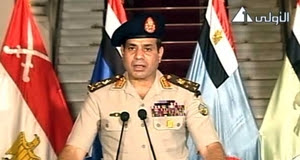
Abdul Fatah Al-Sisi
Abdul Fatah Al-Sisi announcing Morsi's removal from office.
If it took 18 days to overthrow Husni Mubarak in 2011, just four were needed to overthrow Morsi this past week. The number of deaths commensurately went down from about 850 to 40. Western governments (notably the Obama administration) thinking they had sided with history byhelping the Muslim Brotherhood regime found themselves appropriately embarrassed.


My worry is more complex.

Wednesday, July 03, 2013

Don't Expect The Egyptian Coup To Be Anything Like The Honduran One

Remember the Honduran coup in 2009?

Here is a quick recap by Hot Air of what happened in Honduras:
In a nutshell, Zelaya wanted another term as president so he decided to hold a popular referendum on whether he should be eligible. Minor problem: The Honduran constitution can’t be amended by popular referendum so the country’s supreme court ordered the vote canceled. Zelaya tried to go ahead with it anyway. Literally every other arm of the Honduran government — judiciary, legislature, military — was against him, to the point where the troops who arrested him this morning were evidently acting on a court order. Why such strong, unified opposition? According to one retired Honduran general cited by Fausta, it’s because Zelaya’s a Chavez stooge and him staying on would mean “Chavez would eventually be running Honduras by proxy.”
The Obama administration, barely 6 months into its first term came down hard on Honduras:

Mideast Media Sampler 7/02/13: This Time, New York Times Not So Enthralled By Egyptian Protests

by David Gerstman, contributing blogger at Legal Insurrection

Inspired, not

Inspired by the massive outpouring of popular opposition, the Tamarod, to the regime of President Mohammed Morsi of Egypt, the editors of the New York Times issued a call for the President hailing from the Muslim Brotherhood to take heed:
Mr. Morsi is put on notice

We sympathize with the frustration and anger that is drawing tens of thousands of Egyptians into the streets of Cairo and other cities this week, the country’s largest demonstrations since those that helped force the previous president, Hosni Mubarak from power, nearly two and a half years ago. Citizens of one of the Arab world’s great nations, they struggle with poverty — hunger and poverty rates have risen over the past three years — rising food prices, unemployment and political repression.

Inspired by so-called Arab Spring, they are demanding a government that respects its citizens’ voices and is truly committed to improving their lives. A lesson of the Arab Spring should be a warning to all rulers who cling to power for too long and ignore their people’s demands. President Mohammed Morsi of Egypt clearly hasn’t figured that out.

Monday, July 01, 2013

Arlene Kushner on Results of Kerry's Trip To Israel and Analysis of Egyptian Protest

From Arlene Kushner:
July 1, 2013

Temporary Reprieve


I would like to begin with a link to a Youtube that provides an audio news broadcast about Muslim Brotherhood leader Qaradawi and Obama's connection to him.


It well worth listening to and sharing.  People sometimes receive audio information better than the written word.  And this information is pure dynamite. (With thanks to Salomon Benzimra of the Canadians for Israel's Legal Rights.)
~~~~~~~~~~
As to that reprieve...I am referring, of course, to the fact that Secretary of State John Kerry left the area yesterday without having been able to achieve a "breakthrough" that brought the Israelis and the PA to the negotiating table.

Mideast Media Sampler 7/01/13: As Protests in Egypt Mount, New York Times Defends Morsi Regime

by David Gerstman, contributing blogger at Legal Insurrection

Taken by Surprise

Perhaps the biggest protest in the Arab world took place yesterday in Cairo (and elsewhere in Egypt.) The group, Tamarod ("rebel" in Arabic), claimed to have gathered. 22 million signatures, calling for the resignation of President Morsi, on the anniversary of his election. The goal of Tamarod was to obtain more signatures than the 13 million who voted for Morsi last June 30.


David Kirkpatrick and two other reporters for the New York Times reported on yesterday's events, By the Millions, Egyptians Seek Morsi’s Ouster

So they didn't downplay the numbers.


However there appear to be some troubling aspects to their coverage.

Conference Call on Egyptian Protest With Shimrit Meir of The Israel Project

This morning, The Israeli Project held a conference call following yesterday's massive protest in Egypt. Shimrit Meir is the director of The Israel Project's Arabic Media Program and the Editor-in-Chief of Al Masdar (The Source), an online Arabic-language newspaper which will be debuting later this summer.

The Protest


Meir starting off noting that last nights protest in Egypt against the Morsi regime was the largest protest ever in Egypt -- numbering in the millions. It was planned for months in advance by the opposition and has engendered hopes for a new dawn in the country.

Egyptian protest in 2011
A big banner with the Arabic word "Leave" in reference to Mubarak in Midan
 El-Tahrir during the 2011 Egyptian protests. This time Egyptians insist that
Morsi leave. Credit: Wiki Commons

The people of Egypt simply do not want to be like Iran following their protests and their revolution. That means that now the leaders of the opposition are going to have to find a way to leverage their successful opposition into obtaining their goals -- Morsi's resignation and new elections. They threatening that if their demands are not met they will call for a strike or some other form of civil disobedience.

The negative view of the Egyptian people extends to how they feel about Hamas, in part because the people believe that Hamas is helping the Muslim Brotherhood.

While there were reports of attacks on the Muslim Brotherhood headquarters, this was a random attack and not part of protest nor called for by the leadership.

Reaction to the Protest


A sign of the impact of the protests is that a few hours ago, 5 of Morsi's ministers indicated they would be resigning their positions and joining the opposition. However, there was reports that there were efforts by the government to convince the ministers to stay.

There are 3 elements in the current situation:
  • The Opposition
  • The Muslim Brotherhood
  • The Egyptian Army
The Muslim Brotherhood was caught off-guard by the size of the protests and is still trying to assess situation the situation and how they should react. They want to keep their options open. The Muslim Brotherhood has, after all, worked for decades to get to this point, with many of its members -- including Morsi -- having been imprisoned by Mubarak and tortured.

The key problem for the Muslim Brotherhood is that Morsi simply is not presidential material. For example, he gave a speech which went on for 2 1/2 hour speech, which was absurdly long odd. It was a passive/aggressive speech that did nothing to help his position.

As for the Egyptian Army, it was announced that they will issue statement tonight. The Egyptian Army is a game-changer, and their reaction will be important. Army has the respect and support -- even love of the people.

For now, the Egyptian people are waiting for tomorrow to see the reaction from each of these 3 elements: the opposition, the Muslim Brotherhood and the Egyptian Army.

Just as they see Iran and do not want to follow in their footsteps, the people see what is happening in Syria and are afraid. They do not want the chaos that is happening in Syria to happen in Egypt. The various elements will be more careful and cautious, but each of them means business.

Role of Women in the Egyptian Protest


Women have had a role in the protests due to their active role in Social Media and in secular groups in the universities. However, women do not have a leadership role, neither in the opposition nor in the Muslim Brotherhood. The treatment of minorities is one of the issues underlying the protests.

Israel's Reaction to the Protest


From the Israeli perspective, the Israeli government has consistently had a wait and see attitude without interference towards the events going on around it -- with the exception of when there is an immediate, military threat, as was seen in Syria.

Currently, the protest in Egypt is seen as positive development.

The current regime has a negative attitude towards Israel. They will not take a phone call from Netanyahu. Morsi, when younger, participated in anti-Jewish protests. While there is coordination today between the Israeli army and the army under Muslim Brotherhood influence, this coordination is not to the extent it used to be. The Muslim Brotherhood, for its part, is consistent in its opposition to the peace treaty with Israel, though it will not try to abrogate it all at once.

The Egyptian Army


During the conference call, Shimrit Meir noted that Al Jazeera announced that the Egyptian army will shortly come out with a statement and that the army said it will not take power and it is necessary to listen to the voice of the Egyptian people.

The Egyptian Army naturally wants to sustain its power and continue receiving the support it currently gets from the US. They do not want the responsibility for the current economic situation and impending collapse of the country, but they will take power if they have to.

The Muslim Brotherhood does have influence in the army with Abdul Fatah Al-Sisi, the commander in chief of the Egyptian armed forces, whom they appointed.

UPDATE: According to Al Ahram, Egyptian military gives 48 hour ultimatum to Brotherhood, political forces:
The armed forces are giving all political forces 48 hours as a last chance to solve the ongoing problems, or else the armed forces will have to announce a new roadmap for the future, and will enforce certain measures with the help of all factions including the youth, without excluding anyone.

The statement was read out on Egyptian state TV.

-----
If you found this post interesting or informative, please it below. Thanks!


Technorati Tag: and .

Wednesday, November 28, 2012

Who Is Coming Out To Protest Against Morsi In Tahrir Square?

Mr. Collinson President Morsi yesterday appeared to have stuck by his emergency declaration after the meeting with the Egyptian judiciary. Does that deepen the concerns about what’s going on in Egypt that you spoke about yesterday?

Carney: ...We believe firmly that this has to -- that this needs to be resolved internally as part of a transition to democracy and the building of institutions that create checks and balances in an Egypt that will be -- that will have, as a government, an entity that is more responsive to the will of the people in Egypt and more democratic. And where we have concerns we raise them, but we also understand that this is an internal Egyptian process.
Press Briefing by Press Secretary Jay Carney, 11/27/2012


Putting aside the excuses for the US once again standing on the sidelines, Morsi has gotten himself in hot water, just as he and Egypt became the force behind the enforcement of the Israel - Hamas ceasefire.

Apparently, this is a renewal of the same democratic forces in Egypt looking for for something different than the Mubarak regime before and the Morsi regime of today as Egypt mass protests challenge Islamist president

Tuesday, August 23, 2011

Video: Ehud Yaari on Iran's Gaza Missile Gambit, Iron Dome and Cairo Protests Against Israel

Interview by Rabbi Abraham Cooper of the Wiesenthal Center interviews Middle East Analyst Ehud Yaari, who gives analysis on the main reason behind Iran's Gaza Missile Gambit, Why Hezbollah is quiet (so far), the Post-Tahrir Sq trouble in Cairo--with over 100 groups urging the government to sever ties with Israel and Iron Dome's surprising- and promising results.