Monday, January 30, 2006

Why Must Israel Take The Lead?

Pity. Israel Matzav sounded so on the money when he wrote:
In everything that has happened in the US dealings with the PA since 1993, it has been Israel taking the lead. The US has dealt with the PA because Israel wanted it to. If Rabin and Slimy Shimon had not brought the PA back from Tunis in 1993, the US would have left them to rot there. The reason the US has dealt with the PA for the last 12.5 years is that Israel's position on dealing with the PA has been ambiguous. Every time Arafat would say something that was inconsistent with 'recognizing Israel's 'right to exist,' the Israelis would choose to ignore it and the Americans would play along.

With Hamas, there is no such ambiguity. Israelis across the spectrum (well, nearly across the spectrum - see below) will not deal with a group of terrorists that makes statements to the media like "recognizing Israel is not on our agenda." If Israel doesn't deal with them, the US won't press Israel to deal with them - and won't deal with them itself - because W would look like a huge hypocrite and because Congress will rise up against him. Congress has already spoken regarding Hamas.[emphasis added]
How could something apparently so straightforward be so unclear? Arutz Sheva reports:
Israel's government held its weekly Cabinet meeting today, the first since the surprise Hamas victory in the Palestinian Authority elections. However, no decision was taken to cancel this week's scheduled transfer of tax funds to the Palestinian Authority.

Minister Tzachi HaNegbi said, "Israel will not conduct any negotiations with a PA government led by Hamas or in which Hamas is a member." Regarding the transfer of the tax funds to the PA, however, he said it's too early to decide: "We must wait and see how the Palestinian Authority stabilizes."
In leaving the door open, there seems to be some confusion within the Israeli government in distinguishing between Hamas, the PA, and Abbas:
Acting PM Olmert said that he and Foreign Minister Tzippy Livny had talked to a long list of world leaders, and "they all supported us and the positions that we expressed, namely that unless Hamas clearly abandons terrorism, annuls its charter, and fully recognizes Israel and the PA's prior commitments, Israel will not have any contacts with the Palestinian Authority."

Minister Livny said that Israel must "switch diskettes and must begin relating immediately to the Hamas victory... We have to make sure that the world does not recognize Hamas and does not talk with it in some guise or another."
One of these "guises" is something that Israel will have trouble protesting: transferring funds not directly to a Hamas government, but to Mahmoud Abbas of Fatah, who remains PA Chairman. [emphasis added]
This has all the makings of a political shell game designed to ease the path towards allowing funds--and who knows what else--to Hamas.

True, Arutz Sheva admits that it is unclear whether the US and Europe--despite the strong rhetoric--can hold out for long against sending aid on humanitarian grounds:
However, it is not clear whether the strong stance currently expressed by the EU and US will last for long. In order not to cause a political crisis in the Middle East and possibly a humanitarian financial crisis in the PA areas, it could very well be that the West will find ways to help the Hamas-led Palestinian Authority.
But why must Israel make it easy for the super-powers to back out of statements, made just days ago, that appeared for the moment at least to apply some kind of pressure on Hamas?

Technorati Tags: and .

Sunday, January 29, 2006

Olmert on the Day Before the Election

How can Israel project an image of strength?

Step 1: Don't talk like Ehud Olmert.

On Tuesday, January 24th at the 6th Annual Herzliya Conference, Ehud Olmert spoke. Two years earlier at the same conference, Sharon unveiled his plans for the Disengagement. Keeping in mind that this was just one day before the Palestinian Arab elections and Hamas was expected--and exceeded expectations--to do well, what kind of message did Olmert send?

The existence of a Jewish majority in the State of Israel cannot be maintained with the continued control over the Palestinian population in Judea, Samaria and the Gaza Strip. We firmly stand by the historic right of the people of Israel to the entire Land of Israel. Every hill in Samaria and every valley in Judea is part of our historic homeland. We do not forget this, not even for one moment. However, the choice between the desire to allow every Jew to live anywhere in the Land of Israel to the existence of the State of Israel as a Jewish country - obligates relinquishing parts of the Land of Israel. This is not a relinquishing of the Zionist idea, rather the essential realization of the Zionist goal - ensuring the existence of a Jewish and democratic state in the Land of Israel.

In order to ensure the existence of a Jewish national homeland, we will not be able to continue ruling over the territories in which the majority of the Palestinian population lives. We must create a clear boundary as soon as possible, one which will reflect the demographic reality on the ground. Israel will maintain control over the security zones, the Jewish settlement blocs, and those places which have supreme national importance to the Jewish people, first and foremost a united Jerusalem under Israeli sovereignty. There can be no Jewish state without the capital of Jerusalem at its center.

If Olmert, and Israel, is going to continue insisting on being the nice guys and express their willingness to make concessions and actually follow through--without ever getting anything in return, what is accomplished in such a speech except to highlight over and over that there has been no penalty and no political cost paid by the Palestinians for the route they have taken up to this point?

Olmert does address the following day's elections:

On the eve of elections in the institutions of the Palestinian Authority, I say here, on behalf of the Government of Israel, that we will uphold all the obligations we have taken upon ourselves in the framework of the Roadmap, and we demand that the leadership in Ramallah do likewise.

Israel has already proven, including through the Disengagement, that it is prepared to advance peace. It will continue to act so in relation to the commitments it has taken upon itself, in exchange for Palestinian commitments. This includes: limiting construction in the settlements, improving the quality of life of the Palestinian population, and dismantling unauthorized outposts.

The Government of Israel will not be deterred by the threats of a minority of lawbreakers. The unauthorized outposts will be dismantled, and I have already given the appropriate instructions in this regard to our security forces and those entrusted with upholding the law. We will forcefully defend the values of the rule of law, even when attacked from within.

...The Palestinians, headed by Chairman Mahmoud Abbas have committed themselves to implementing a series of concrete steps, which will abrogate the capability to threaten Israel and the political process with terror. Among them is the dismantling of all terror organizations starting with the Hamas, confiscating illegal weapons, enforcing law and order in their territory, implementing government, security and financial reforms, and ceasing the incitement and education of hatred against Israel. [emphasis added]
Does this do anything to discourage terrorism or encourage the Palestinian Arabs to do anything more to keep their part of the Roadmap than they already have--namely nothing? Is that best that Olmert can do is "demand" compliance when the only attack worth noting seems to be the "attack from within"?

But don't worry--Olmert is on the case:
I am following the Palestinian elections closely. We have made important decisions whose purpose is to allow the existence of free and orderly elections. I hope that the results will allow the elected government under the leadership of Mahmoud Abbas to move forward towards a settlement.

I am not a partner to all the doomsayers who are already telling us how hard and horrible it will be here after the elections in the Authority. Israel will know how to operate and act in any circumstance, faced with any scenario, in order to preserve its security and political horizons, and advance the hopes for a changed reality.
Now that the results are in, what is Olmert's reaction? More talk:
Speaking during an emergency meeting of the security cabinet in Jerusalem to discuss Israel’s policy towards the Palestinian Authority after Hamas’ sweeping victory , Olmert said, “Should a government be established in the Palestinian Authority with Hamas leading or participating, the PA will become a sponsor of terror. The world and Israel will ignore it and it will become irrelevant.”
Feeling better? Assasinating the heads of terrorist organizations like Hamas is unfortunately only a short term solution. The long term solution is to take real action instead of just offering talk. If Israel cannot, will not, or is just not 'allowed' to take any action, such as really halting all withdrawls and concessions--painful or otherwise--until the Palestinian leadership actually fulfills some of its share of the Roadmap, if it cannot back up all those "demands" and "warnings", why should the Palestinian Arabs in general or Hamas in particular take Israel seriously?

Unfortunately, the all those world leaders who claim to demand reform from Hamas are likely to settle for a worthless statement implying moderation instead of real action. Israel should have to settle for that.

Technorati Tag: and and .

Innovative Palestinian Politics

Whatever else we may say about the Palestinian Arab elections on January 25, they do seem to have innovated on the process in a timesaving measure. According to the Jerusalem Post:

When the new Palestinian Legislative Council meets for the first time, 11% of the members are likely to be absent from the proceedings.

Fourteen security prisoners in Israeli jails are believed to have been elected to the 132-seat parliament, while one inmate of a Palestinian prison was also successful, said Butheina Dukmak, director-general of the Mandela Institute for Human Rights, a prisoner advocacy group.

Imagine. Instead of electing politicians and then later having to indict them, hold hearings and send them to jail--just save time by electing people who are already in jail!

Who says Islam and Democracy is incompatible?


Technorati Tag: and and .

Friday, January 27, 2006

When You Gotta Blog

As I mentioned before, we're here in Cincinnati visiting my wife's family.
Driving here for 12 hours with a bored 6 year old was the easy part.

When we got here, I found out I couldn't get online.
As the story unfolded we learned:

1. They have a computer with AOL, but
2. They turned off their AOL account, but
3. They have an Internet account with their phone company, but
4. Their computer is 12 years old. It does have Windows95, but
5. The software requires Windows98, and a relative who traded computers with them has their original computer which might take Windows98, but
6. She already gave that computer away.

By Tuesday I couldn't resist--we finally installed their software on our laptop.

Wednesday, at my suggestion, we bought them a new computer as a gift so they could get online.

At least that's what my wife and I told them...

Thursday, January 26, 2006

Hamas in Power: The Taming of the Shrew?

Who wooed in haste, and means to wed at leisure.
The Taming of the Shrew Quote Act iii. Scene 2

In today's The Best of the Web, James Taranto has a great post, "Democratically Elected Terrorists" covering Hamas and their election victory.

One point he makes up front is the history of Hamas' terrorist attacks and murder of Israelis. He gives a link to an Arutz Sheva article, History of Hamas Murderous Attacks:

Hamas has set the destruction of Israel as its goal. Between September 2000 and April 2004, Hamas perpetrated 425 terrorist attacks against Israel and murd1ered 377 Israelis - nine every month.

...Hamas is responsible for 24 murders before the Oslo Accords, 156 more before the Oslo War began in September 2000, and at least another 377 since then - a total of at least 557.


The article highlights a number of attacks and links to IMRA, which provides A Chronology of Terrorist Attacks Carried out by Hamas Since September 2000

The key question addressed by the articles Taranto links to is what direction Hamas will take: will it continue as a terrorist organization or be tamed by the political system?

Emanuele Ottolenghi, who teaches Israel studies at Oxford University, writes an article for The National Review that advocates the view that in victory, Hamas has gotten more than it bargained for:

Hamas’s favored outcome was not victory, but a strong showing that would leave Hamas with the best of both worlds: It would remain in opposition (or would be invited to join a coalition as a junior partner) but would impose severe limitations on the Fatah-led government on how to manage its relations with Israel. Hamas could thus claim to reject Oslo, decline to recognize the Palestinian Authority and its commitments under the Oslo accords and the roadmap, and continue to use its rising political clout and its military strength to sabotage any effort to revive the moribund peace process.

What victory does to Hamas is to put the movement into an impossible position. As preliminary reports emerge, Hamas has already asked Fatah to form a coalition and got a negative response. Prime Minister Abu Ala has resigned with his cabinet, and president Abu Mazen will now appoint Hamas to form the next government. From the shadows of ambiguity, where Hamas could afford — thanks to the moral and intellectual hypocrisy of those in the Western world who dismissed its incendiary rhetoric as tactics — to have the cake and eat it too. Now, no more. Had they won 30-35 percent of the seats, they could have stayed out of power but put enormous limits on the Palestinian Authority’s room to maneuver. By winning, they have to govern, which means they have to tell the world, very soon, a number of things.

They will have to show their true face now: No more masks, no more veils, no more double-speak. If the cooptation theory — favored by the International Crisis Group and by the former British MI-6 turned talking head, Alistair Crooke — were true, this is the time for Hamas to show what hides behind its veil.

As the government of the Palestinian Authority, now they will have to say whether they accept the roadmap.

They will have to take control over security and decide whether they use it to uphold the roadmap or to wage war.

There will be no excuses or ambiguities when Hamas fires rockets on Israel and launches suicide attacks against civilian targets. Until Tuesday, the PA could hide behind the excuse that they were not directly responsible and they could not rein in the "militants." Now the "militants" are the militia of the ruling party. They are one and the same with the Palestinian Authority. If they bomb Israel from Gaza — not under occupation anymore, and is therefore, technically, part of the Palestinian state the PLO proclaimed in Algiers in 1988, but never bothered to take responsibility for — that is an act of war, which can be responded to in kind, under the full cover of the internationally recognized right of self-defense. No more excuses that the Palestinians live under occupation, that the PA is too weak to disarm Hamas, that violence is not the policy of the PA. Hamas and the PA will be the same: What Hamas does is what the PA will stand for.


If this analysis is to be believed, in its haste to enter the government, Hamas thought it would have the time to further manipulate the political situation towards its own prefered ends but now will be reigned in by political responsibility.

But as much as one would like to think that the spotlight will be on Hamas, for Ottolenghi's analysis to become a reality the real spotlight will have to be on the US and Europe.

Just where is this pressure on Hamas to act responsibly supposed to come from?

The world has been content to refer to murderous terrorists as "freedom fighters" and to put pressure on Israel to make concessions without requiring reciprocity on the Palestinian Arabs to respond in kind. It has failed to insist on enforcing the Palestinian requirements of the Roadmap--and even the media has glossed over the fact that disarming and ending terror were primary requirements of the PA, independent of any measures taken by Israel.

Instead, the only Palestinian issue that really seems to have upset the PA's financial backers in the West is the waste of money--not that fact that it was used for terror, but that it was used to line the pockets of corrupt officials.

Fighting corruption was the main issue of yesterday's election. What is going to keep Hamas from thinking that ending corruption and providing accountability is all it will take to satisfy the West? It will have to be more than talk--public statements making demands are likely to have as much effect on Hamas as they have had thus far on Iran.

Since the US has taken a hands-off approach towards creating democracy in the PA as opposed to its involvement in Iraq, Hamas can easily point to unwelcome steps by the US as interference in their internal affairs, while with-holding of aid and money can be labeled the same way.

Meanwhile, what is to keep Hamas from continuing the excuses that served Abbas so well. Further suicide attacks or the firing of artillery into Israel from Gaza can just be blamed on splinter groups and demands for crackdowns can be responded to with claims that action will cause civil war.

Why should the West now be taken seriously by Hamas? But if the West does not now step up to the plate, any talk about Hamas and its inevitable moderation (whatever that means in the Middle East) will be nothing more than wishful thinking and punditry.

He that knows better how to tame a shrew,
Now let him speak; ‘tis charity to shew.”
Act 4, Sc. 2, Lines 188-211

Crossposted at Israpundit

Technorati Tags: and and .

Killing You With Moderation

Haaretz seems a bit confused.

In their article Does Hamas still want you dead?, Haaretz wonders out loud:

With the Islamic Jihad, you know where you stand.

They want you dead.

It's part of a worldwide movement of wanting you dead. They take orders from people in Damascus who want you dead, people in Tehran who want you dead, people south of Beirut who want you dead.

With Hamas, knowing where you stand is less cut and dried. With infinitely more support, personnel, sitzfleisch, than the Jihad, with more ideological independence, and a network of free medical clinics and free schools, it almost makes you wonder about the Death to Israel and Death to America and the second graders they dress up and parade around in fatigues and miniature M-16's and garlands of plastic grenades. [emphasis added]

Now as Hamas prepares to enter the Palestinian parliament, and perhaps the cabinet, it's time to ask - Will the real Hamas please stand up?
But what is it that Haaretz is confused about?

Are they really unsure of where Hamas stands and what their ultimate goals are? Or is Haaretz just unsure of which kind of rhetoric Hamas will be using now that they have the kind of political cover--and legitimization--that Hizbollah has?

Should Israel now expect that with Hamas having the opportunity to join the government--that Hamas will turn all warm and fuzzy?

Should Israel now expect a Palestinian Arab government that will start to abide by the Road Map--with disarmament and a toning down of rhetoric for starters?
Should Israel now expect a Palestinian Arab government that will offer compromises at the negotiating table?
Should Israel now expect Hamas to stop firing artillery at Israeli cities?

Let's assume that Hamas drops their rhetoric of destroying Israel and adopts instead the rhetoric of...Abbas.

Just what would be gained for Israel?
Just what would Hamas lose?

Technorati Tag: and .

Tuesday, January 24, 2006

US and Hamas: If You Can't Beat'em...

In a post back in October (Oh, THAT Hamas), I quoted IMRA, which carried an article from Geostrategy-Direct, on the implications of a Hamas victory in the election:

Of course, US concerns about Hamas go beyond concerns just about Israel:

The prospect of a Hamas takeover of a Western-funded PA has alarmed Congress. Members of the House subcommittee on the Middle East and Central Asia, who have been receiving frequent closed-door briefings on the decline of the PA, warned that Hamas could eventually use Western funding and weapons to fight the United States.

And then of course there is the sticking point that if Hamas were to be in control, the US would be unable to deal with them:

Under U.S. law, Washington would be unable to deal with any foreign government controlled by groups deemed by the State Department to be terrorists.

Hamas and Islamic Jihad have been designated terrorist organizations,and the former intends to run in elections for the Palestinian Legislative Council in January 2006.


"Hamas has already been in government in the Palestinian Authority," [Assistant Secretary of State David ] Welch said. "Under American law, we can't deal with them. I don't see that law changing after January."

If Welch cannot imagine the US dealing with Hamas, maybe he just didn't try hard enough. If the US can utilize loopholes to avoid moving the embassy to Jerusalem or closing the PLO office, a little question of US law is not going to stop it.

According to Arutz Sheva, the US will use a sophisticated diplomatic technique for getting around the problem: giv'em the Silent Treatment:

The United States and the European Union both consider Hamas a terrorist
group, yet both are apparently willing to continue working with the Palestinian
Authority government even if it includes Hamas terrorists.

...The U.S. is likely to continue to have diplomatic relations with such a
government, minus direct contacts with Hamas ministers. "As a matter of policy,
we don't deal with Hamas," Stewart Tuttle, the U.S. Embassy spokesman in Tel
Aviv, said. "If Hamas members win seats... we are not going to deal with those
individuals."

Oh, yes--the US has no end of clever diplomatic negotiating tactics. That'll show them.

Of course, any analysis of the situation would not be complete if Israel cannot be blamed:

Some blame Israel for the fact that the international community now faces
this dilemma. Robert Satloff, Executive Director of the Washington Institute for
Near East Policy, told the Herzliya Conference yesterday that Israel's
contradictory policy on Hamas was "partly responsible for its already having
gained political legitimacy through the election process," The Jerusalem Post
reported.

Satloff said that Israel should have stood firm against Hamas participation
in the upcoming elections. He noted that the PLO was long unrecognized by the
Israel and the US because it did not renounce terrorism or recognize Israel's
right to exist - while today, no one requires either of these from Hamas.

Standing firm against US pressure: you're intrangient if you do and a wimp if you don't.
Can someone please mention that to Binyamin "Concessions Will be Necessary in Future Agreement" Netanyahu?

Crossposted at Israpundit


Technorati Tag: and .

Following the Palestinian Election

Looks like Oxblog is going to be blogging the election.

So far he has one post here (OFF TO RAMALLAH FOR ELECTION MADNESS)
and one here (AT THE OFFICE OF THE DIRECTOR OF THE ELECTIONS COMMISSION)

Meanwhile, if you want to be ready for the Israeli election, check out Israel Matzav's Israeli Election Update - a Primer.

I'm on vacation in Cincinnatti with my family and don't know what blogging I'm doing this week.

It took 3 days to get online, and even then it's on a dialup connection instead of DSL...

Driving to Cincy With Disney

This past Motzei Shabbos, we loading up the van and off we went to Cincinnati to visit family. We generally average about 12 hours drive time, so this time around we borrowed a portable DVD player from a friend to keep our 6 year old daughter "occupied". We brought along a selection of good wholesome DVD's for her to watch--mostly Disney.

On the road, my daughter watched Disney's Fantasia, the original 1940 version--twice.

Among my daughter's comments on the while watching the movie:

1. "Abba, look: a heffalump!"
Apparently, my daughter has never seen a dancing hippopotamus before.

2. "I know how an elbow sounds!"
Before turning around, I had an image of my daughter with one hand under her underarm, the other arm furiously pumping up and down and playing the tune to The Mickey Mouse Club.
In actuality, she simple mistook elbow for oboe.

3. We had the following conversation:
"Abba, I can't drop this CD on the floor, can I?"
"Why not?"
"It has HaShem in it."
"Oh, really?"
"Sure, it tells all about how Hashem created the world!"

She had just listened to the segment of Fantasia that illustrates Igor Stravinksy's "Rite of Spring". If you forgot what that segment looks like, Chernabog looks like this:

Clearly, I am going to have to have a long talk with my daughter before vacation is over.

Otherwise, I can just imagine getting a phone call from school:
Hello, this is the principal. I was just talking to your daughter's teacher and we were just wondering why it is that our daughter thinks HaShem has 2 horns...
I think the sooner we have that conversation, the better.

Thursday, January 19, 2006

The Dark Side of Dr. Seuss

Tunku Varadarajan wrote a piece this week for the Wall Street Journal on Dr. Seuss in general and "Green Eggs and Ham" in particular. Everyone has read Dr. Seuss, the man who saved us from "See Spot run. Run Spot run. Run, run, run." What is there not to like about Dr. Seuss, or his books? But Varadarajan has a colleague who suggested that Green Eggs and Ham has an overlooked dark undertone:
There are two ways to interpret "Green Eggs and Ham." The first--to which I do not subscribe--was suggested to me by a colleague with small children. It is as a terrifying torture-and-kidnap story: It begins, famously, with a question, "Do you like green eggs and ham?"--and a proffered platter. In spite of its unorthodox greenness, the ham looks rather succulent. Yet the offer is refused. The Protagonist--a typical Seussian creature with furry exterior and rumpled top-hat--then retreats grumpily to his house, where Sam-I-am harasses him, confronting him first with a rodent, and then with a smug-faced fox.

The Protagonist flees, Sam-I-am pursues him in a car, and then brings on a very forward goat, posing the question that has always amused the schoolboy in me: "Could you, would you, with a goat?" He then runs the car off the road, dumping the Protagonist (along with a bevy of innocent train passengers) into the sea. At this point, in self-defense, the victim adopts the worldview of his assailant and, Patty Hearst-like, becomes a propagandist for Sam-I-am's cause.
Hmmm...I don't know about "Green Eggs and Ham", but I have a bone to pick with Dr. Seuss on another point. I have not read a lot of his books, but I have read enough to have come to the conclusion that Dr. Seuss has definite issues with playing host to unwanted guests.

The "Cat in the Hat" is the sad tale of everyone's uninvited guest. If that was the only such book, that's one thing--but there was a sequel! "The Cat in the Hat Comes Back" (which Dr. Seuss probably thought flowed better than the more ominous: "The Return of the Cat in the Hat"). That's two. Now you can argue that in both cases there is a happy ending, all the mess is cleaned up, and the mother is no wiser.

But how about "Thidwick The Big-Hearted Moose"! Here is your typical nice guy moose who first let's a bug live in his antlers. One thing leads to another and before he knows it he has bugs, birds, and animals (including a bear) living in his antlers--all because he is much too nice to tell them to leave. His fellow moose desert him! Thidwick is left all alone (except for his unwanted guests) when the hunters come. With such a heavy burden on his antlers he cannot run and the hunters chase after him and corner him. They are all set to kill him, stuff him, and mount him on their wall. Thidwick is trapped!

[warning: spoiler!]

Then, he realizes that this time of year he can shed his antlers. The antlers come free and he tosses them--with the guests--at the hunters and makes his escape as he joins his fellow moose.

A happy ending.

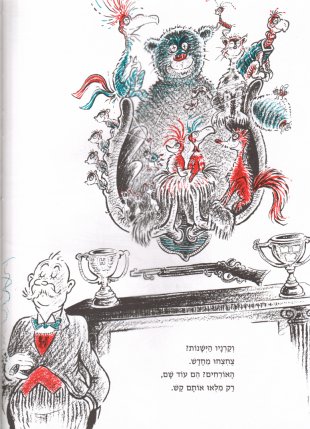
But then there is the last page:

There they are, the antlers on the wall with all of the guests--stuffed and mounted on the wall as trophies. And look at their eyes! (The horror! The horror!) I was honestly surprised to see the story end this way--I expected the guests in the end to come to Thidwick's rescue. I bought the book 2 years ago and when I read it to my daughter, I still end it with Thidwick rejoining his friends...without turning the last page.

After having read Varadarajan's piece, I now know I am not alone in having discerned the heart of darkness behind these books.

I may have to stick to "Curious George"--a metaphorical expose of America's capitalist exploitation of Third World Countries.

Update: Soccer Dad points out Sigmund Freud On Dr. Seuss

Technorati Tag: and .