Here I am in the hospital, after hurting my knee, and my roommate is a 92 year old retired professor of literature who can describe at length the background and details of the lives of past literary figures.
Like James Joyce.
Monday, March 21, 2016


Friday, March 18, 2016
Hamas Terrorists Exploits Arabs in the West Bank As Well As Those in Gaza
When Evelyn Gordon asks Are Palestinian Stabbings Ending?, she points out that the Palestinian stabbing attacks will continue only so long as the perceived reward outweighs the cost.
And the numbers indicate that a turnaround has begun. Thus:
And the numbers indicate that a turnaround has begun. Thus:
in a poll taken just three months ago, fully 67 percent of Palestinians supported the stabbing attacks, including 57 percent of West Bank residents. Yet in the latest poll, not only did overall support fall to 56 percent but, in the West Bank, 54 percent of respondents opposed the stabbings.Gordon explains that this cost of the stabbings -- to the West Bank Arabs -- is three-fold:
Tuesday, March 15, 2016
In Blooper, State Department Spokesman Claims Demolitions in Southern Israel Prevent A Two-State Solution
In southern Israel, the problem of the Bedouin homes there is a complex problem, combining the issue of Bedouin claims with the Western media's willingness to unquestioningly publish them and the European Union to honor them.
Legal Insurrection discusses Negev Bedouin problems – real and imagined and Akiva Bigman discusses in an article for The Tower why the Bedouin's claims to the Negev are outrageous.
A central claim of the Bedouin is that they are indigenous to the Negev, thus deserving of special consideration and rights under international law.
Legal Insurrection discusses Negev Bedouin problems – real and imagined and Akiva Bigman discusses in an article for The Tower why the Bedouin's claims to the Negev are outrageous.
A central claim of the Bedouin is that they are indigenous to the Negev, thus deserving of special consideration and rights under international law.
 |
| Bedouin village in the Negev. Photo: Nati Shohat / Flash90 |
Wednesday, March 09, 2016
The Three Ways Israel Faces Isolation -- Yet Succeeds In Making Friends and Influencing People
I'm unmoved by the hand-wringing over Israel's "isolation." When I came to the country 30 years ago, Israel had no relations with the USSR (and Eastern Europe), China, and India. There was no foreign investment and a UN General Assembly resolution still stood, condemning Zionism as racism. It will take more than a Cairo mob, a truculent Turk, and another UN resolution to make me feel "isolated."
Middle East expert Martin Kramer, quoted by Todd Warnick in The "Isolation" Canard
For decades, claims are periodically trotted out that Israel -- by virtue of its actions -- is being faced with the threat of being isolated.
In describing Jerusalem's Decreasing Isolation, Efraim Inbar delineates 3 ways to measure a county's isolation:
Tuesday, March 01, 2016
3 Examples Of The Growing Trend To Label Stories Of Campus Antisemtism As "Crying Wolf"
There seems to be a new trend developing in the face of the growing incidents of antisemitism reported on college campuses -- outright denial along with claims that such reports are mere exaggeration.
Take Vassar for example, where the president of Vassar, Catharine Hill claims social media misrepresents tensions as incidents of antisemitism.
What kind of "tensions"?
Legal Insurrection has been tracking the spread and increasing appearance of antisemitism on college campuses. At Vassar, here are some examples:
Take Vassar for example, where the president of Vassar, Catharine Hill claims social media misrepresents tensions as incidents of antisemitism.
What kind of "tensions"?
Legal Insurrection has been tracking the spread and increasing appearance of antisemitism on college campuses. At Vassar, here are some examples:
Sunday, February 28, 2016
The UN Resolution Equating Zionism With Racism Has Roots In The Cold War in 1965
Joel Fishman writes that UN Resolution 3379, claiming that Zionism is a form of racism, did not just appear out of nowhere. Though passed in 1975, the roots of the UN resolution equating Zionism with racism can be found in the UN in 1964. Back then, the UN Sub-Commission on the Prevention of Discrimination and the Protection of Minorities was engaged in discussions aimed at recognizing Antisemitism as a form of racism -- along with apartheid and Nazism.
At the time, the Jewish Telegraphic Agency had the story of what happened next:
At the time, the Jewish Telegraphic Agency had the story of what happened next:
Russia Asks U.N. to Condemn Zionism Along with Anti-semitism, Nazism
The Soviet Union called formally upon the United Nations today to condemn Zionism along with anti-Semitism, Nazism and neo-Nazism as a policy of “colonialism and race hatred.” The step was taken in the General Assembly’s Social, Humanitarian and Cultural Committee where a draft convention was being debated calling for the elimination of all forms of racial discrimination.
Wednesday, February 24, 2016
Steven Salaita's Academic Activism Against Israel Leaves No Stone Unturned
"Moreover, all journalism is a form of activism. Every journalistic choice necessarily embraces highly subjective assumptions — cultural, political or nationalistic — and serves the interests of one faction or another."
Glenn Greenwald, quoted in "Is Glenn Greenwald the Future of News?"
If the future of journalism really is that it will be reduced to emotional assumptions instead of fact-based assertions, we can also ask if that is the future of other formerly respected endeavors as well.
Take for instance Steven Salaita, described by Wikipedia as an American scholar, author and public speaker currently holding the Edward W. Said Chair of American Studies at the American University of Beirut.
Tuesday, February 23, 2016
MEQ: Efraim Karsh: Obama's Middle East Delusions
The following by Efraim Karsh is reposted here with the permission of The Middle East Forum:
As the only person to have won the Nobel Peace Prize on the basis of sheer hope rather than actual achievement, Barack Hussein Obama could be expected to do everything within his power to vindicate this unprecedented show of trust. Instead he has presided over a clueless foreign policy that has not only exacerbated ongoing regional conflicts but made the world a far more dangerous place. Nowhere has this phenomenon been more starkly demonstrated than in the Middle East where the Nobel laureate has abetted Tehran's drive for regional hegemony and brought the regime within a stone's throw of nuclear weapons; driven Iraq and Libya to the verge of disintegration; expedited the surge of Islamist terrorism; exacerbated the Syrian civil war and its attendant refugee problem; made the intractable Palestinian-Israeli conflict almost irresolvable; and plunged Washington's regional influence and prestige to unprecedented depths,[1] paving the road in grand style to Russia's resurgence.
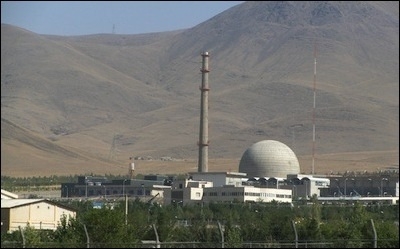
Iran's nuclear facility in Arak. Tehran's quest for nuclear weapons is, perhaps, the foremost threat to Middle Eastern stability, if not to world peace, in the foreseeable future. President Obama's policies have allowed Iran to move ever closer to producing nuclear weapons.
|
Saturday, February 20, 2016
The J Street Version of Israeli History -- Coming To a Jewish School Near You
J Street's activities extend from politics and advocacy -- to education:

J Street has a lesson plan to go along with the map. I embedded a copy of the lesson plan at the end of the post.
The introduction in the lesson plan introduces what they see as the issue behind maps of Israel today:
J Street University is circulating a map that restores the Green Line and working to get it into synagogues, Hebrew schools, and summer camps. Good for them. Of course, fighting (nonviolently) over maps is preferable to shooting over the borders of the territories they represent, but there’s no substitute for a one-map solution.Here is the map:

J Street has a lesson plan to go along with the map. I embedded a copy of the lesson plan at the end of the post.
The introduction in the lesson plan introduces what they see as the issue behind maps of Israel today:
Thursday, February 18, 2016
Obama Was Right: Time For Israel To Put "Daylight" Between Itself and US -- To Preserve Credibility and Security
Last year, in the midst of the Iran negotiations that Israel so strenuously opposed, Kerry came out with the claim that not only was the Iran deal actually in Israel's interest, but that continued Israeli opposition to the Iran deal would further isolate her. But increasingly, the more pressing question is not so much whether Israeli is really isolated from other countries, but rather whether the time has come for Israel to distance itself more from the United States.
Brett Stephens writes that Israel Looks Beyond America -- and is doing so very successfully:
Brett Stephens writes that Israel Looks Beyond America -- and is doing so very successfully:
Subscribe to:
Posts (Atom)