Showing posts with label Sderot. Show all posts

Monday, December 22, 2008

Video: Sderot Media Center Press Conference on Ceasefire


Noam Bedein, Sderot Media Center director, writes:
"No damage was done, and nobody was hurt" - The falsification of the
fictitious ceasefire: 377 missiles were launched towards Israel during
the "relaxation" period.

This Friday, the 19th of December, is the last day of the ceasefire
between Israel and the Hamas.

This is the second declared ceasefire in the past two years. It began
in June 19th 2008, and is destined to end in December 19th of this
year.

According to the IDF's spokesperson, approximately 377 missiles were
launched from Gaza towards Israel. More missiles than "just" the 315
that were fired during the first ceasefire, which lasted from the 26th
of November 2006 to the 15th of May 2007.
Read the whole thing.

Here is a report on the Sderot Media Center Press Conference on Ceasefire:
A day before the Hamas-Israel ceasefire officially ended, Sderot Media Center facilitated a press conference with a panel of Sderot officials who provided brief updates of the security situation and the impact of the ceasefire on the area residents to Israeli and international press.

Member of Knesset and Kadima party member, Shai Chermesh, who is a resident of Kfar Aza, a western Negev community under daily mortar shelling, participated in the panel. He stated that the ceasefire had yielded no positive results for Israel. "Gilad Schalit is still in Gaza and Sderot and western Negev residents are still under rocket fire. This is a reality that our government must deal with and as of now, the government of Israel has shown that it has little authority over what is happening to Sderot and the western Negev," MK Chermesh concluded.

"Hamas is the occupying power of Gaza and has treated its constituents terribly," he added. "Hamas must stop using their own Palestinian civilians as sacrificial offerings by employing rocket terror tactics against innocent Israelis."

Chermesh stated that he believed that disengaging from Gaza in 2005 was a positive move. "It was important that we left and it was too bad that we didn't leave earlier," he stated. "If the IDF re-enters Gaza, the attack must be planned carefully. The people of Gaza should not go hungry and we must limit civilian causalities as much as possible."

Batya Katar, representing the Parents Association for the security of Sderot, stated that Sderot residents feel that Sderot is a separate entity. "We don't have the right leaders to deal with the reality of the region," she said. "If this was happening in Tel Aviv, there would be a completely different reaction from the government."

"Only yesterday evening, a Palestinian rocket landed right outside a busy supermarket. People outside at the time barely escaped the rocket explosion," Katar added. "Thanks to the Tzeva Adom, they were able to make it inside, but the attack could have been deadly. How many more rocket attacks must Sderot experience, how many near-death experiences must Sderot residents endure--before the government of Israel acts?"

The president of Sderot's Small Businesses Association, Danny Dahan told the press that the rocket fire was economically crippling the region. Dahan, who owns Dahan's supermarket in Sderot, explained that the changed shopping patterns of his customers--"they rush in and rush out" has contributed to the decrease in sales. "People no longer linger around, taking their time to buy food. Everyone wants to go home as quickly as possible." Dahan also stated that due to the rocket fire, there were problems with shipments of goods coming into Sderot. "Some of our suppliers refuse to enter Sderot because of the rocket fire. Many times, I end up going to the junction in Ashkelon to pick up the goods for my supermarket."

Noam Bedein, Sderot Media Center director, highlighted that the over 2,500 Palestinian rockets fired at Sderot and the western Negev have caused a marked increase in psychological trauma among Sderot children. "Between 70-94% of Sderot children are suffering from signs of PTSD, according to a recent NATAL survey" Bedein stated.

Bedein also related that between 300-400 Palestinian rockets have been fired at Israel since the ceasefire began in June. Yehuda Ben Maman, the Sderot security officer, added that although many bomb shelters have emerged throughout Sderot in the recent year, most of the structures provide protection from rocket shrapnel only and not from direct Qassam rocket hits.
Technorati Tag: and .


Reblog this post [with Zemanta]

Monday, January 07, 2008

Sderot: Operation Purim

In an email, Connections Israel has a video of their work in helping Sderot celebrate Chanukah:
On the first day and second candle of Chanukah Connections Israel returned to Sderot. We were part of a gathering of Jews from all over Israel and the world. There were at least 20 buses from all over Israel with lots of different activities.

We traveled to a number of different neighborhoods on and open truck with a live band, passing out over 4000 sufganyot and 10 cases of chocolate coins. In addition, we distributed over 300 holiday gift baskets in some of the more economically depressed neighborhoods.
Here is a video:

Now, Connections Israel is working on their next project:
We are currently shifting our focus towards our annual Operation Purim. For the past 10 years we've be connecting with schools and communities abroad and encourage them to adopt units of the Tzahal (the IDF).

We have them write letters of Chizuk-support and Bracha-blessing, do some fund raising and the letters and Purim baskets are delivered to the soldiers. The schools/communities receive a thank you letter from the IDF and a large photo of the unit which received the Shalach Manot.

The soldiers receive a tremendous morale boost and the participants strengthen there connection to Israel and to the IDF soldiers.

We currently have over 100 schools participating and we'd like to double the amount - so, if you are connected or know educators in schools in your area, let us know and we can offer them to participate in this program.

If you'd personally like to sponsor a unit/soldier, click here.
Technorati Tag: and and .

Wednesday, November 15, 2006

Woman Killed in Sderot Rocket Attack

From Arutz Sheva:
Woman Killed in Sderot Rocket Attack

A woman was killed and a man lost his legs when two Kassam rockets landed in downtown Sderot. The Islamic Jihad and Iz A-Din El-Kassam terrorists claimed credit.
The rockets fell not far from the house of former Sderot Mayor Amir Peretz, Israel's Defense Minister.

Fatima Slutzker, 57, who was killed in the attack, and Maor (ben Dorit) Peretz, 24-year-old guard assigned to protect Peretz's house, were hit by the rockets' wildly-scattered deadly shrapnel. Both were taken to Barzilai Hospital in Ashkelon, where the woman died, leaving behind her husband and two sons. Peretz had both of his legs amputated. Six other people were treated for light injuries. Close to ten Kassams were fired at Sderot today.

Four other rockets were fired at the western Negev this morning (Wednesday), two volleys were fired into downtown Sderot last night, and yet another rocket landed near a children's nursery in a nearby kibbutz yesterday morning.

"People went into panic and began yelling when they heard the boom this morning," one eyewitness said.

Another resident told Arutz-7 that it is becoming impossible for many people to continue living in the city in the face of such fears and uncertainty.
Meanwhile, Olmert's dealing with Hamas does not seem to be any more coherent than the way he conducted the war with Hezbollah
MK Tzvi Hendel (National Union), commenting on the government's refusal to send in massive forces to enter Gaza, said bitterly, "Only a rocket on Tel Aviv will cause [Prime Minister] Olmert to take over Gaza."
Today's victim is the seventh victim of a Kassam attack.
Today's victim was Israel's seventh direct victim of a Kassam rocket, among the nearly 1,700 that have been fired since the withdrawal from Gaza. Mordechai Yosifov, 49, and Afik Zahavi, a 3.5 year old on his way to nursery, were killed in June 2004. Three months later, two young cousins - Dorit Aniso, 2, and Yuval Abebeh, 4 - were killed just before the onset of the Sukkot holiday. Four months later, Ella Abukasis, 17, was killed by a Kassam rocket as she was walking home; she jumped to protect her brother when the Red Dawn rocket warning alert sounded. In July 2005, Dana Gelkowitz, 22, was killed in a Kassam attack at Netiv HaAsarah - the only non-Sderot Kassam casualty among Israelis.

In addition, three foreign workers were killed in a Kassam attack in Gush Katif in 2005, and two Bedouin were killed when they moved a previously-unexploded Kassam in a field.
Meanwhile, in contrast to Israel's reaction when civilians are accidentally killed, Hamas is gloating:
Hamas Boasts: Kassam Has Defeated Israel

An official Hamas communique states, "The enemy, in his despair, has tried everything against our Kassams, but he knows that all his plans will fail."

Abu Obeideh, the spokesman of the Iz A-Din El-Kassam military wing of the Hamas terrorist organization, publicized this statement: "Everyone knows that the main purpose of all the Israeli military missions is to stop the Kassam rockets. The enemy, in his despair, has tried all means of pressure, instilling fear, killing and collective punishment, but he recognizes the fact that all his plans will fail with the launching of the first volley from between the columns of armor, and despite his planes and intelligence gathering."

The Hamas spokesman said, "Our fighters have dealt successfully with the military missions, and this has brought Israel to announce another plan indicating its despair, according to which it will no longer announce where the rockets fell, in the illusion that this will mislead the resistance." He said this will not disturb them from determining their targets "with precision and with new means." The proof of this, he said, is the high number of "accurate hits among the colonialists [Israeli citizens] and homes, and their running to the shelters, the sounding of rocket warning systems and street demonstrations by colonialists who have no security in their homes."

Israel must think carefully before considering conquering the Gaza Strip, the spokesman warns, because it will not fulfill its goal and will simply cause additional defeats for its army.
Olmert has claimed that Nasrallah does not have the appetite for another war with Israel--Actually it is Olmert who does not have the stomach to do what is necessary: neither against Hezbollah or Hamas.

Technorati Tag: and and and and .


Thursday, October 19, 2006

Kneeling, But Not In Prayer


When I first saw this picture on The Sunken Synagoue, for a moment I thought it was a picture of Moslems praying.

The actual AP caption
reads:
Schoolchildren from the western Negev town of Sderot during a kassam-rocket drill (AP)
It is part of a timeline put together by the Jerusalem Post of the Disengagement.

The Sunken Synagogue's post deals with the attempt by the residents of Sderot to make the MK's in the Knesset aware of what life in Sderot has been reduced to by the constant barrage of Kassam rockets.

He is not optimistic.

Technorati Tag: and and .


Friday, October 06, 2006

The New Neighbors in Sderot

With the dropping housing costs in Sderot combined with situation in Gaza, Palestinian families are moving into Sderot.

Israel At Level Ground has podcasts of the reaction by Eli Moyal, the mayor.

Technorati Tag: and .


Monday, July 31, 2006

Diary Of Rabbi Avi Weiss' Week Long Trip In Israel

WE ARE WITH YOU

By Rabbi Avi Weiss

An account of one American rabbi’s journey through northern and southern Israel during the war of July-August, 2006 in the hope of imparting an accurate picture of how Israelis are coping. Rabbi Weiss stayed in the north for a week visiting the wounded, bereaved and those living in bomb shelters. What follows is a close-up of what Israelis are going through in these difficult days.


Day 1: Arrival in Tsfat
Day 2: Shabbat in Tsfat
Day 3: Haifa
Day 4: Tiberias and Nahariya
Day 5: Tsfat and Raanana
Day 6: Sderot, Kiryat Gat and Jerusalem
Day 7: Haifa and The Shomron

Diary of Rabbi Avi Weiss' Return Trip To Israel--Following the Ceasefire


Rabbi Weiss is the founder and Dean of Yeshivat Chovevei Torah Rabbinical School. He is also Senior Rabbi of the Hebrew Institute of Riverdale and President of AMCHA: The Coalition for Jewish Concerns.

You can email Rabbi Weiss at aweiss@yctorah.org


Crossposted at Israpundit

Technorati Tag: .


What We Can Do To Help Israel

[updated 8/4]

Please Note: I have no connection or personal knowledge of any of the Tzedakahs listed below--if you are going to contribute money to any of them, please research them first.

Time Sensitive: Galilee Spirit: Voucher For Travel To Israel (program ends August 31; vouchers can be redeemed until June 30, 2007) [added 8/4]

***Take The Elder Tzedakah Challenge!***


Other Sources
J-Blogosphere: Live-Blogging the War & What We Can Do
View from a Height: If You're Looking to Help
Treppenwitz's 'Handy To-Do' List
Elder of Ziyon: What You Can Do
Israel At Level Ground: More Ways To Aid Israel
Crisis In Israel - How to Help [7/23]

Tefilla
Prayer Requests for Katyusha Rocket Victims in Tzfat

Shabbos
Make Shabbat For Families Hardest Hit In Israel [added 7/20]

Events

List of Israel Solidarity Rallies
Community Solidarity Gathering: July 23, 2006 [7/20]
StandWithUs: Signs For Rallies

Aid For Israel (General)
Town Crier: Hatzolah Israel
One Family Fund: An Urgent Appeal as Rockets Rain Down on Israel
Hatzalah of Yehuda and Shomron Need Your Help [added 7/17]
An Emergency Appeal from Hatzalah Israel [added 7/18]
NCSY: Israel Action Update June 18 2006 [added 7/18]
Magen David Adom On Code Red High Alert [added 7/19]
Israel Emergency Support Fund [added 7/21]

Aid for Northern Israel
Emergency Relief Fund For Tzefas and Northern Eretz Yisrael [added 7/21]
Help For Northern Israel and Beit Shemesh [7/23]
Operation Matok: Northern Israel and Sderot [7/23]
Donate Toys To The Children of Northern Israel [7/26]

Aid for Tzfat
American Friends of Tsfat Needs Your Help
Emergency Appeal For Tsfat (Nachal Novea Tsfat Fund) [7/19]
Emergency Relief Fund For Tzefas and Northern Eretz Yisrael [added 7/21]

Aid for Migdal Ohr
American Friends of Migdal Ohr Needs Your Help [7/19]

Aid for Beit Shemesh
Help For Northern Israel and Beit Shemesh [7/23]

Aid for Sderot
Operation Matok: Northern Israel and Sderot [7/23]

Help the IDF
Meryl Yourish: Pizza For IDF Soldiers
Help Israel Through "Table to Table" [added 7/19]
Send TLC Packages To The IDF [added 7/23]
Friends of the Israel Defense Forces [8/2]

From an email forwarded to me.

As the situation in Israel deteriorates...

As I write to you, the situation in Israel on the northern border continues to worsen. With katyushas raining down on Nahariya (killing one woman), the striking against Tzefat with katyushas and the threat by Hizzbullah to hit Haifa, the dozens injured...all of these add up to a very difficult time ahead for our fellow Jews in Israel. While we walk safely down our street, thousands of Jews spend this Shiva Asar B'Tammuz in bomb shelters protected (please G-d!) from katyushas.

At the same time, we can not forget that IDF forces are in Gaza attempting to rescue Gilad Shalit and are themselves in constant danger.

So, what course of action can WE take at this troubling time? I would suggest a number of things:

* For those of you with friends/relatives in Israel...call them! Tell them you are thinking about them and just be a source of comfort, at least via long distance.

* Whatever learning you would normally do, INCREASE the amount..no matter how small. If you learn a half hour, learn for 45 minutes, etc. The point is that if worldwide we can increase the amount of Torah learning, we can make a difference in Shamayim!

* When you learn, say out loud that you are learning for the Zechut (benefit) of those in danger in Israel.

* Say Tehillim! This is a long-standing action among Jews for centuries. The words of David HaMelech have helped us withstand calamity for 1000's of years.

* A special note to those shuls that do not recite the Mi Sheberach for the IDF: Whatever your reasons for not saying this Mi Sheberach...I urge you to look beyond politics! Take note of the fact that our soldiers (yes, they are OUR soldiers) are in grave danger. They need all of the Tefillot we can arrange for them. PLEASE...say this special Mi Sheberach! For those who daven where it is not said, URGE your rabbi to say it.

* For those who will be traveling to Israel in the near future, GIVE BLOOD at Magen David Adom

* In your tefillot, keep in mind Gilad ben Aviva Shalit and the two other soldiers whose names have just been released: Ehud Goldwasser, 31, from Nahariya and Eldad Regev, 26, from Kiryat Motzkin. (Their mothers' Hebrew names have not been published). [Their names are now known: Ehud ben Malka and Eldad ben Tova]

Share this email with others in order to encourage as many people to take whatever action that they may be able to take!

Finally, at Congregation KJBS, we will be saying an extended Tehillim today (Shiva Asar B'Tammuz) right after Mincha (which is at 8pm). Please make every attempt to be at KJBS (or any other place saying Tehillim) this evening.

Rabbi Zev M Shandalov
Cong KJBS
Chicago, IL

Technorati Tag: .

Friday, July 28, 2006

Day 1: Arrival in Tsfat

Arrival in Tsfat

Friday: July 21, 2006

I arrived in Israel to learn that five more soldiers were being buried today. I went to the funeral of one of them--Benjy Hillman, a 26 year old son of British immigrants who was married just three weeks ago. The rabbi of Pardes Hanna where Benjy had studied, noted that we would be soon welcoming the Shabbat bride. “Just three weeks ago Benjy said to Ayala, Bo-ee Kallah-Come, My Bride. Today it’s being said in heaven,” he sobbed.

We left the funeral to travel to Tsfat where I’m spending Shabbat with Aharon and Miriam Botzer, the founders of the extraordinary Livnot U'lehibanot program. I'm here with my colleagues, YCT student, Yonah Berman and Rabbi Adam Scheier and around 25 others who came to be with the Jews under attack in the north.

Tsfat is quite empty, and those who remain in the city that has sustained many, many Katyusha attacks over the past few days, are in bomb shelters.

When I look north, I can see the smoke of today's Katyushas. We have been warned that more Katyusha's are expected in the hours right before the start of Shabbat, and we're ready to go into the shelter when the siren sounds.

Miriam and Aharon note that many people from Tsfat have been offered housing in the communities of Ofra, Beit El and Gush Etzion--all over the Green Line.

Miriam reminded me as we prepared for Shabbat, that she experienced her first Yom Hashoah commemoration at the Bayit, in Riverdale.

May we all experience a Shabbat of peace.

Introduction: Diary Of Rabbi Avi Weiss' Week Long Trip In Israel
Day 1: Arrival in Tsfat
Day 2: Shabbat in Tsfat
Day 3: Haifa
Day 4: Tiberias and Nahariya
Day 5: Tsfat and Raanana
Day 6: Sderot, Kiryat Gat and Jerusalem
Day 7: Haifa and The Shomron

Diary of Rabbi Avi Weiss' Return Trip To Israel--Following the Ceasefire

Technorati Tag: .


Day 2: Shabbat in Tsfat

Shabbat in Tsfat

Shabbat: July 22, 2006

Shabbat in Tsfat filled me with mixed emotions. On one hand, the people who are still here are resilient. On the other, the vast majority of the citizens have left town. The main street, normally bustling after Shabbat, is deserted tonight.

We davened kabbalat Shabbat in the open, under the skies on the roof of the Livnot U’Lehibanot building. From there we went to the central square to join others who had come outside for Maariv. The Sephardic chief Rabbi Shmuel Mizrachi stopped by and there we were, on this difficult Shabbat, dancing in hope and prayer and belief that all would be well.

During the Friday night seuda, I met Devorah, an older woman who had miraculously escaped a katyusha hit on her home. She said that while she is a savta, she is still looking for the love of her mother & father and found it in Aharon and Miriam Botzer, Livnot founders and veteran Tsfat residents, who have taken her in.

As she served the many people at the Shabbat table, Devorah remarked that she feels like a child in her parent’s home, helping to serve the Shabbat meal.

After dinner we visited Mayor Yishai Mamon who was firmly ensconced in the Moked, the city’s central command post. Yishai survived the Maalot massacre of 1974 as a 17 year-old. He resolved to do all he can to keep Israel strong. He spoke to us in redemptive terms, convinced that we will soon be victorious. He pointed out that we are fortunate that Israel stepped into the battle now; had we waited any longer, the rockets may well have contained biological and chemical warheads.

After Shabbat morning tefillah, we sat with Cantor Uri Marton, a chazan in the IDF. He shared with us how he has learned different nusachot-- Ashkenazi, Sephardi and Persian so that he can officiate at all IDF funerals. He raised a cup of wine and using the Sephardi tune, recited a beracha. As he drank, we heard someone a few streets down echoing the blessing using the same Sephardic nusach and text. As if to emphasize our togetherness.

In the afternoon, we saw the site of the broken walls of the residence of the Mor family. In front of the house a small bicycle, a child’s coat and even a table with some unfinished food were all visible. One member of the Mor family was severely injured in the attack. As we walked through Tsfat, we stopped in at several bomb shelters. In one gloomy shelter, we were able to convince little Nechama and Eliezer to go outside for the first time in 9 days.

We walked on to one of the newer parts of the city. In front of one apartment building we saw a microcosm of Israeli society. We met Natan, a veteran of three wars, and standing near him was Sofia, who came from Russia 8 years ago and wants to return. Senedad, an 18 year-old Ethiopian who is soon going into the IDF, joined the conversation. Right there on the spot we gave her a new name--Tova, in the prayer all would be well. And we sang Am Yisrael Chai.

But the most difficult moments were those we spent visiting the Rebecca Sieff Hospital. Over the past few days, the hospital has sustained a few direct hits. In one section, shattered glass still lay around. What possesses a human being to lob rockets with the intent to hit hospitals?

As we moved through the hospital wards we met Nadav, an IDF tank driver, who was hit last Thursday and pulled from his tank into an empty house in Southern Lebanon. It took his IDF buddies almost 48 hours to extricate him as they came under Hizbollah fire.

After Shabbat we visited Nachshon, who was “lightly wounded,” but clearly despondent as he shared with me that he had lost two of his friends with whom he had served for the past three years.

In yet another room was Alex, a chayal from Kiryat Shmona wounded by fragments of a katyusha that entered his body close to his spine. Looking into his eyes, I could see his obvious concern over his future. His friend Gal, less severely injured, sat nearby, helping Alex drink water.

Claudine had just been brought in, after a rocket hit her home in the waning hours of Shabbat. Her mother, a nurse in the hospital, was more seriously hurt and was being treated downstairs in the ER.

We told all of them that we had come to stand with them and to thank them. I pray our visit brought some comfort.

We ended Shabbat with representatives from the Lev Ehad organization, whose mission is to bring joy to those confined to the bomb shelters, especially kids. It was inspiring to see young people so committed to helping those in need.

As I look over the hills surrounding Tsfat at night, there's now an eerie silence, a strange peacefulness that contrasts with the constant backdrop of booms and thuds from Katyushas and IDF retaliation that we heard all during Shabbat. The devastation being wrought on this holy city is palpable.

This is a real war. There's fear, uncertainty and yet within it all there is hope.

Several people have asked why I came during this difficult time. Perhaps Rabbi Adam Scheier of Shaare Shomayim in Montreal and Yonah Berman, a student at Yeshivat Chovevei Torah said it best. “We came because there is no choice.” At a time when Israel is under attack, everyone in their own way tries to do whatever they can to help. Although we all live in N. America, our souls are here, bound up with our people and land.

We're in the period of the Three Weeks coming closer and closer to Tisha B'Av. One message of the fast is that built in to the mourning are aspects of holiday. At the end of Tisha B'Av, we bless the New Moon. The same moon that wanes and disappears, reappears, and waxes full.

So too, God willing, in Tsfat, stressful as it is with Katyushas falling all around us, somehow we will overcome.

Introduction: Diary Of Rabbi Avi Weiss' Week Long Trip In Israel
Day 1: Arrival in Tsfat
Day 2: Shabbat in Tsfat
Day 3: Haifa
Day 4: Tiberias and Nahariya
Day 5: Tsfat and Raanana
Day 6: Sderot, Kiryat Gat and Jerusalem
Day 7: Haifa and The Shomron

Diary of Rabbi Avi Weiss' Return Trip To Israel--Following the Ceasefire

Technorati Tag: .


Day 3: Haifa

Haifa

Sunday: July 23, 2004

A stressful but meaningful day. As I left Tsfat with my traveling companion, Yeshivat Chovevei Torah student, Yonah Berman, we met Elliot Chodoff, a major in the IDF reserves, who had just received a Tsav 8 call up notice. He pointed out that Hezbollah is playing mind games with the IDF.

On the way to Haifa, we picked up two soldiers who turned out to be Druze. For a moment I wondered whether this was a set-up for a kidnapping. Such is the power of terrorism. It turns everyone into a suspect. It's almost as if everyone has lost their innocence.

As we approached Haifa, Dr. Jesse Lachter who was to meet me, called and told us the siren was sounding. “Pull over the car and hit the ground,” he said urgently. It wasn’t long till we found out that someone was killed in Haifa today by a direct hit on their car. It reminded us again that what is happening here is real.

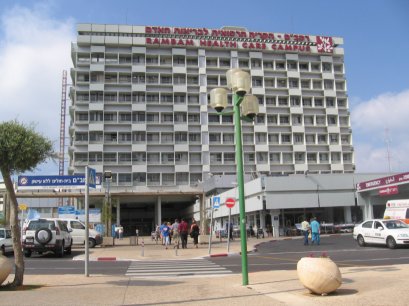
Dr Shraga Barzel, who spent a year in Riverdale in the early 90s and who heads the neo-natal unit at Haifa’s Rambam Hospital met us at the gate.

As we went inside the hospital, ambulances pulled up with the injured from the latest Haifa rocket attack. Outside, we saw rows and rows of cots as doctors and nurses quickly took the injured inside.

Dr Barzel and Jesse brought me to the office of the Director General, Dr Beyar, who pointed out that there's a great need at Rambam to build a unit that will be secure from rocket attacks. In the midst of our conversation, another siren sounded, and we all gathered in an adjacent vestibule for protection.

From there we walked into the dining room that had been turned into a makeshift triage section. A nurse was dealing with someone who looked like a very troubled individual. Jonny was clearly suffering from stress. We were told that he enjoyed soccer, and a smile crossed his face when we discussed Italy’s World Cup victory.

In the hospital we visited a number of injured soldiers. Amongst them was Ronen who had been injured when he left his tank to help a comrade who was hurt. He looked so young and so shell-shocked, all we could do is tell him he's not alone, that our people are with him.

As we left the hospital and started to climb the Carmel to Jesse’s home, I felt overwhelmed by all the pain I had seen. Jesse turned to me and said it looks like you need a psychiatrist. He pulled out a CD of my dear friend, Elli Kranzler, a professional psychiatrist and brilliant soul singer at our Bayit in Riverdale. Elli and his daughter, Ravital were singing the haunting words of the Psalm, Gam Ki Elech-“Even though I walk in the valley of the shadow of death, I fear no evil for You are with me.” On the right side of the car, I could see the blue waters of the Mediterranean Sea. Above our heads, the heavens sprinkled with fluffed white clouds, and on our left, the Carmel housing projects neatly tucked into the mountains, beautifully built by the people of Israel. It all seemed so peaceful, and yet we were walking in the valley of darkness. For the first time during this visit, tears came to my eyes.

Jesse took me to see his rabbi Edgar Nof, who leads the Or Hadash Reform synagogue. I felt a special connection to him. Rockets and katysuhas don’t distinguish between people. They kill all kinds of Jews and for that matter, non-Jews as well.

As I entered Jesse’s home, I reconnected with his wife, Noga. Noga's brother Effie was killed in the 1982 Lebanon War. She recalled my condolence visit to her family. Upon leaving, I recited the traditional Hamakom Yinachem Otach, which I explained to mean, May God comfort you. She reminded me that her father, Mordechai, the head of Zim Lines in New York, looked up at me and said, “Let me tell you the real meaning of Hamakom. Hamakom should be literally translated as ‘this place,’ the land of Israel, it is my only comfort.”

We moved on to the Elisha Hospital. Just as Elisha the prophet brought the dead back to life, this hospital for patients in a vegetative state carries his name, in the hope that somehow they will be revived.

We saw several soldiers at Elisha, but the one I'll always remember is Koby, a man in his 30s, who some 13 years ago was present at a terrorist bombing in Ashkelon. He ran to help the injured and then returned again to help others, only to be seriously wounded. He has been in a coma ever since that day. Seeing Koby reminded us that terror attacks often leave terrible aftermaths that go well beyond the moment of terror itself.

A private nurse sits with each patient at Elisha Hospital. The government provides around-the-clock private nursing for these patients. Most often, these special caretakers are immigrants from Russian-speaking countries. I thought of the countless demonstrations held all over the world demanding freedom for Soviet Jews. Today they are free in the land of Israel, trying to free others from their state of unconsciousness.

We reached out to hold Koby’s hand and the hands of those attending to him and started to sing Rav Shlomo Carlebach’s melody to Am Yisrael Chai, the Soviet Jewry theme song. Somehow, the song seemed much slower and sadder than usual. I looked up and saw Yonah holding the hands of some of the soldiers. I was overwhelmed by his obvious care and gentleness and gratified to see that all the experience and teaching he has received at Yeshivat Chovevei Torah, including the pastoral psychology classes, had made a big impact. Yonah will be an extraordinary empathetic rabbi.

We paid a visit to the Chief Rabbi of Haifa, Shaar Yashuv Cohen. As soon as we walked in the siren went off and we quickly walked into the shelter. I couldn’t help recalling a visit with the Chief Rabbi of Tel Aviv, Meir Lau during the Gulf War in 1991 when we ran through the streets as the Scuds fell.

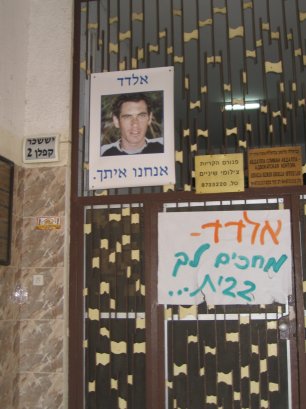
We traveled north to Kiryat Motzkin to visit the family of abducted soldier, Eldad Regev. As we entered the apartment building, we saw a large picture of Eldad with the words, ‘We Are Waiting for You: We Are With You.’

We knocked on the door and were greeted by Eldad's brothers, Eyal and Ofer, and their father, Zvi. We were immediately taken by their graciousness. Despite the immense stress of their situation, they were so hospitable; just normal people in the most abnormal circumstances. As we told them we wanted to do whatever we could for them it became clear that these were very private people. The very idea of beginning a public campaign for Eldad’s release was not compatible with their reserved nature.

Listening to the family speak, especially an aunt, who spoke of her family's history during the Shoah, I sensed that they felt so terribly vulnerable--so helpless. What they are feeling reflects on some level what is happening in the country. The rockets land, no one knows quite where, or where the next one might land. From that instant everyone is exposed. As strong as Israel is, we're not invincible, we're vulnerable. Many Israelis in recent days have expressed the deeply held conviction of “Ayn Lanu eretz Acheret”-We don’t have any other land besides Israel.


Hezbollah cannot destroy the state. But by instilling fear they are fulfilling their goal of breaking the morale of the people. I see the fear in the eyes of parents as well as children as they run to the shelters. The deserted towns of Carmiel and Tsfat reflect the same fear.

So Diaspora Jewish communities must do all we can to respond by giving strength, lending moral as well as financial support to the land of Israel and its people.

Here in Israel, everyone is doing something. Last Shabbat, Natan and Avital Sharansky spent the weekend at a One Israel camp for kids evicted from their homes in Gush Katif last summer, many of whom are living in southern areas under constant Kassam attack. Natan played chess with the youngsters. Hundreds of Israelis in areas beyond rocket range have opened their homes to house refugees from the north. Volunteers man telephone hotlines, and others collect food and supplies for those confined to shelters for almost two weeks.

As we head back to Tsfat the images of those we have seen today flash through my mind. All we could do is recite a simple prayer: May God be with the people and the land of Israel.

Introduction: Diary Of Rabbi Avi Weiss' Week Long Trip In Israel
Day 1: Arrival in Tsfat
Day 2: Shabbat in Tsfat
Day 3: Haifa
Day 4: Tiberias and Nahariya
Day 5: Tsfat and Raanana
Day 6: Sderot, Kiryat Gat and Jerusalem
Day 7: Haifa and The Shomron

Diary of Rabbi Avi Weiss' Return Trip To Israel--Following the Ceasefire


Technorati Tag: .


Day 4: Tiberias and Nahariya

Tiberias and Nahariya

Monday: July 24, 2006

Today, for the first time, we experienced a katyusha attack up close. We were visiting a bomb shelter in Tiberias, a town hard hit by days of rocket attacks. Together with Yonah Berman and Rabbi Yamin Levy, we tried to bring joy to the children cooped up in these stuffy, cramped rooms with little ventilation and horrific sanitation facilities.

One set of parents invited us to see their home just 100 feet away. As we left their apartment after spending a few minutes there, the siren went off. I moved slowly, not believing I was in any real danger when suddenly the shouts came,” Run, it's coming this way!”

It was impossible to reach the shelter in the few seconds before we heard the thunderous booms hitting the ground. Between 4-6 rockets landed about 100 yards away. The Katyushas set the fields ablaze and people were afraid that the synagogue just down the road would be set on fire. Thank God that didn't occur. Rockets hit upper Tiberias injuring five people at the very same time as the attack we witnessed.

No one was physically hurt by this particular attack, but I could see the fear in the eyes of the children in the bunker. Little girls were digging their nails into their mother’s hands. Their knees were shaking as they looked to their parents for embrace and love and protection, which their parents could not offer in any foolproof way.

Such is the goal of terror--to instill fear, to immobilize, to make children's bodies quiver and the elderly shake in trepidation.

What could we say to these children as we left? Only to hug them and to tell them how much we love them.

This incident brought home powerfully how vulnerable one could feel not knowing where or how the rockets could hit. I wondered deep down how is it that any human being can target civilians and children?

Even hospitals are potential Hezbollah targets. This was brought home hours earlier when we went to see the Nahariya Hospital. Nahariya is Israel’s most northern coastal town and has been shelled relentlessly. The hospital rooms on the floors above ground have all been cleared out, as hospital officials are fearful that rockets will hit and injure and kill. In fact, the entire hospital has moved underground. Imagine, a hospital functioning through underground tunnels and wards.

Many of these wards are filled with people undergoing normal, scheduled hospital treatment, but there are also a number of soldiers and civilians who have been injured in the war. Jews and Arabs alike. Hizbollah doesn’t discriminate.

Amongst the soldiers we encountered was Eyal, a tank commander from Kibbutz Tirat Tzvi. As his girlfriend and mother sat close by, Eyal insisted that he would return to the battle after his recovery. “My friends are there fighting, I can’t allow them to be there without me,” he said firmly. Together we recalled Matan Robinson from the same kibbutz, who gave his life fighting terrorists in Jenin.

We went to see the family of abducted soldier, Ehud Goldwasser in Nahariya. We met Ehud’s wife, Karnit and his parents Shlomo and Mikki. This is a family that is so full of the joy of life and so full of hope. As we shared the love that Jews and freedom-loving people have for them, we expressed our support and told them of the outpouring of love for Ehud around the world. We discussed ideas about possible public activity to try to secure Ehud’s freedom.

Over the years I have encountered many families of kidnapped sons, but in Karnit I found an unusual spirit. Karnit expressed such deep love, the love of a soul mate for her husband, and in many ways she reminded me of Avital Sharansky who traveled the world to gain her husband’s freedom. May Karnit be successful and may Ehud soon be free.

Our last stop was with the Strauss family, whose name graces a significant portion of Israel’s dairy products. They sit in their plush home near Nahariya with the possibility of going anywhere they want. “This is our home,” they said “and we will not move from here.”

As we left Nahariya we stood in prayer for a few moments on the beach overlooking the Sea. The air was still warm. Perhaps, some would suggest, standing out there in prayer was foolhardy. But we needed this moment just to look around and see the beauty of a peaceful Israel. As we heard more booms in the distance, all we could do was offer the prayer that peace come soon.

Introduction: Diary Of Rabbi Avi Weiss' Week Long Trip In Israel
Day 1: Arrival in Tsfat
Day 2: Shabbat in Tsfat
Day 3: Haifa
Day 4: Tiberias and Nahariya
Day 5: Tsfat and Raanana
Day 6: Sderot, Kiryat Gat and Jerusalem
Day 7: Haifa and The Shomron

Diary of Rabbi Avi Weiss' Return Trip To Israel--Following the Ceasefire

Technorati Tag: .


Day 5: Tsfat and Raanana

Tsfat and Raanana

Tuesday: July 25, 2006

Today was a transition day as we moved from the north to Jerusalem in preparation for going south to Sderot, Ashkelon and the communities near Gaza tomorrow.

This morning, as we drove toward Tsfat’s Sieff Hospital to visit the wounded, the siren sounded. Having experienced a close call in Tiberias the day before, Yonah Berman, my student and traveling companion stopped the car and we jumped out and hit the ground to avoid flying shrapnel. As I lay there, I offered a prayer that no one be hurt. We got up only to see that the rocket had landed 200 yards from us in an open area just missing the Emergency Room of the hospital. Last week there was a direct hit on one wing of the hospital.

In the wards of Sieff Hospital we saw all kinds of efforts being made by caring people to bring relief to those in distress. A protected room had been converted to an early childhood center, where the children of hospital workers are cared for. With the constant sirens and rocket attacks, the only way parents can come to work is if they can keep their children with them. Clowns and volunteers with guitars and bongos keep the kids entertained. The kids crowded around as smiles crossed their faces. I spotted a beautiful little Ethiopian boy and lifted him in the air. Like me, his name is Avraham, and his father is Moshe.

In another area of the hospital, Miriam Botzer of Livnot U’Lehibanot and some other volunteers have created a Snoezelen room, a special relaxation area that both stimulates and relaxes the senses. It was created especially for those who need a calm environment.

We went on to room after room filled with wounded soldiers. I was deeply struck by Guy, 33, the commander of a tank brigade. Looking into his face one can see he is seriously wounded. His eyes are sunken and deep as he explains how his tank gunner died in his arms. As we walked in, I could see he was dictating something to a woman soldier. Guy's mother, Rachel, told me he was dictating the eulogy to be given at the funeral of his friend, Lotan Slavin, 21. I told Guy that we would be offering prayers for his recovery in shul this Shabbat in New York. He looked up and said, “Rather than pray for me, pray for my soldiers.”

In another bed lay Tiran, a Druze soldier named after Israel's capture of the Tiran Straits in 1967. I asked Tiran what message I could bring to my community. Somewhat surprisingly, he said, “Tell them to come and live in Israel.”

Nearby lay Avraham. He too was seriously wounded. I'll never forget his words. “We must go in. Better we are hit than the civilians.” I expressed the deep support from Jews around the world. The highest level of love, I remarked to Avraham as well as a group of 30 soldiers we met a day earlier, is not when you love someone else, but when you just know that the other person loves you. I offered the prayer that the soldiers realize how much they are loved.

As we drove south, we picked up Yonatan, a soldier waiting for a ride on the road. Yonah, my student, who had served in the army, engaged him in conversation. It turned out that Yonatan was in the tank behind Guy, whom we had just left in Sieff Hospital, and helped treat Guy after he was wounded.

We quickly felt extraordinary closeness with Yonatan as we expressed our support. We took him directly to his home before he went on to Lotan’s funeral. As we parted, we pleaded with him to take money for gifts for all his fellow soldiers. We embraced and promised we would meet again soon.

Continuing on our way, we stopped in Raanana to pay a shiva visit at the home of fallen Egoz commander, Benjy Hillman. All we could do was sit in silence. The pain is beyond words when a young man like Benjy is lost. When I finally managed to explain to his mother, Judy, why we were there, she said quietly, “It makes a great difference when people say they care.”

Tomorrow we’re on our way down south. With all that's happening in the north, we forget that Kassams are still dropping on Jewish communities in the south. The fighting is easier because Hamas has not been given a chance to dig in. Hezbollah has had six years to regroup and build itself up since Israel withdrew from Lebanon in 2000.

I’m not a military man, and know little about military matters. But what I'm sensing from everyone here is that Israel has been taken by surprise. We’ve been surprised by the number of Katyushas, their range and even their whereabouts.

Some military analysts are claiming that Hezbollah can’t be eliminated by air strikes alone, since the terrorists are operating from inside deep bunkers. It appears that more ground forces will be sent in to do the job, which means that things will likely get worse before they get better.

Traveling today from north to south, I literally saw two countries. Up north, there’s hardly a car on the road; stores and banks are closed and there’s no one on the streets. As we moved south of Haifa, we saw people relaxing on the beaches and I actually enjoyed being in a typical Israeli traffic jam! South of Haifa, cities are bustling and people are going about their everyday lives.

But of course Israel is not two countries it is one. Now is not the time for political debates, or for exacerbating the tension that too often exists between religious and secular Israelis. The only way we will overcome is if we unite as one people with one heart.

In recent years it was the belly of Israel, Netanya, Hadera and Tel Aviv that was vulnerable and suffered from terrorists coming from Judea and Samaria. At times the south suffered as Kassams rained down from Gaza. Now it is the north that's a war zone. We can overcome it all if we live the message of Rabbi Yehudah Halevi that in the end the Jewish people is like a body. If any part of the body hurts, then every part of the body hurts. So too with the land and the people of Israel.

Introduction: Diary Of Rabbi Avi Weiss' Week Long Trip In Israel
Day 1: Arrival in Tsfat
Day 2: Shabbat in Tsfat
Day 3: Haifa
Day 4: Tiberias and Nahariya
Day 5: Tsfat and Raanana
Day 6: Sderot, Kiryat Gat and Jerusalem
Day 7: Haifa and The Shomron

Diary of Rabbi Avi Weiss' Return Trip To Israel--Following the Ceasefire

Technorati Tag: .


Day 6: Sderot, Kiryat Gat and Jerusalem

Sderot, Kiryat Gat and Jerusalem

Wednesday: July 26, 2006

My student Yonah Berman and I were looking forward to a calmer day as we drove south to Sderot. What we didn’t realize was that what awaited us was a day filled with tremendous anxiety and pain.

On the way down south we stopped at the temporary home of former Gush Katif residents, Matti and Aliza Yifrach. Last summer I stayed with them for a week in Netzer Hazani during the last days before Israel’s pullout from Gaza. Right after they were taken out of their home, the Yifrachs moved with many other Netzer refugees to Hispin in the Golan. Today they explained to me that because they had gone to Hispin in an effort to keep their community together, and refused the government’s offer of immediate temporary housing, the authorities are now denying them the “caravilla” offered to other former Gush Katif residents. At the end of August they have to be out of their temporary home and have nowhere to go.

As we entered Sderot, we could immediately recognize a small town in the midst of significant trauma. Hand-lettered signs hung in the square in front of the modest municipality building read: “We wish to sleep in peace.” Another sign read: “Through this war we’ve been forgotten,” and still another one read: “It is not fair to ask that children, women and the elderly be heroes.”

We met with Oren, Sderot’s assistant mayor and soon were joined by a group of US Conservative rabbis who had come to express support. The meeting once again brought home the reality that all of our people are in this struggle together, whatever our affiliations, commitments or backgrounds. I embraced many of my rabbinic colleagues whom I knew from the States.

The story that Oren told us was one of significant poverty and unemployment in Sderot. He reached out, asking his guests to help however we could.

We were taken to a small hill just outside the city and shown how just down the road, a few hundred yards away lies Beit Hanoun the launching pad for the Kassam rockets that are a constant backdrop to life in Sderot. In the midst of his briefing, Yakov, the head of security for Sderot, suddenly said, “I have to run, Kassams have landed in a nearby village.”

Yakov allowed us to jump into his van as he raced up and down hills at tremendous speed to get to the targeted area. By the time we arrived, a number of other security officers were already there, examining the rocket and assessing the damage.

As we moved to leave the area, Yakov got word that another Kassam had been fired at the same time, and yet another one had hit the Sderot cemetery. All at once I felt like I was in some kind of army command post as Yakov juggled calls on 3 or 4 cell phones while keeping one ear cocked to the voices crackling over the walkie-talkie as he received updates of incoming. All told, 6 rockets fell in the one hour we were together.

“Life isn’t normal here,” Yakov said as his wife called to check up on him. “There are no kids on our streets during the day as parents have taken them oit of townare afraid for them to be outdoors.” Yakov is right; a town without children is a town without a soul.

And yet, there were glimmers of normal life unfolding. As we passed another security officer who was racing around, he recognized Yakov and stopped his truck. The two men chatted and suddenly the man smiled as he lifted up a car seat carrying his infant child. Yakov asked why he had brought him along. “My wife is out of the house and I had no choice,” he answered.

Sderot does seem to have a semblance of normalcy not seen in the north. There are pedestrians in the streets and most stores are open. Unfortunately, Sderot has become used to the Kassams. It’s become part of the way of life here and life goes on. Ein breira—there’s no choice.

With so much attention rightfully being paid to the north, it’s too easy to forget that right on the border with Gaza, things are dangerous too. People have been killed and maimed by Kassams.

As we left the town a security person told us that he had received a beeper message that 10-14 soldiers had been killed in Southern Lebanon. My heart sank thinking of these young heroes, imagining how they fell and how they breathed their last breath, and the pain, the unbearable pain of their parents notified of their deaths.

We listened closely to the radio as we left Sderot. There was no mention of any dead. I wondered if maybe the report was wrong and quickly called the secuiryt officer. He said no, the soldiers are gone, but the country can’t be officially notified until the families are informed.

In the midst of the national disasters, one cannot forget personal relationships. We stopped for a short while in Kiryat Gat to see Marcia Levine whom I knew from Riverdale. She was a woman who wondered into the boiler room of the Whitehall Building that housed the Hebrew Institute of Riverdale in its very early days. Marcia fell in love with Israel. She went on to make aliya 25 years ago and raised a beautiful family here.

As we sat there, I had the powerful realization that today I have lived exactly as long as my mother lived. 62 years, 1 month and 2 days. Coincidentally, it was through Marcia that I was able to see my mother for the last time in her life. Marcia’s parents invited me to Israel to perform her wedding and it was then I saw Ima, who lived in Israel, for the last time. Even in the most stressful times there are still personal moments that are very deep.

Back in Jerusalem we went to see my dear friends, Natan and Avital Sharansky. We felt great joy seeing them but the mood was somber as no one could get out of their mind the young lives that had been lost.

This war may have no name, but it is a war, a very difficult one and for Israel to overcome there will tragically be many more losses.

There was a time in 1967 when Israel was surrounded by enemy nation states. Egypt in the south, Jordan and Syria in the east, and Lebanon in the north. Now, it’s Islamic fundamentalist terrorists that surround us. They are fighters who are not afraid to die; in fact they want to die because to them, death is glory. This is a Milchama Hakadmon— now we’re fighting the front line of the war. It’s a fight first for Israel’s very existence but also for the existence of the free world.

Like all Israelis and Jews everywhere, I feel great pain at the loss of life and suffering of innocent civilians on all sides of this war. But we must remind the world that Israel’s intent is solely to fight the Hezbollah terrorists. When civilians are tragically killed in the fighting, there’s regret and heartache in Israel. Contrast this to Hezbollah intentions, which are to deliberately target civilians, even hospitals, and to rejoice when they do so.

For Am Yisrael the centerpiece of Torah is God’s declaration to our people and all of humankind, “Behold, I have placed before you life and death. Choose Life.” I keep thinking of the soldiers who gave their lives. May their souls and their families and our people be forever blessed.

Introduction: Diary Of Rabbi Avi Weiss' Week Long Trip In Israel
Day 1: Arrival in Tsfat
Day 2: Shabbat in Tsfat
Day 3: Haifa
Day 4: Tiberias and Nahariya
Day 5: Tsfat and Raanana
Day 6: Sderot, Kiryat Gat and Jerusalem
Day 7: Haifa and The Shomron

Diary of Rabbi Avi Weiss' Return Trip To Israel--Following the Ceasefire

Technorati Tag: .


Day 7: Haifa and The Shomron

Haifa and The Shomron

Thursday: July 27, 2006

News that more than 24 soldiers were injured in yesterday’s terrible battle in Bint Jbail that cost 8 Israeli lives, compelled us to return to Haifa’s Rambam Hospital this morning.

On the way, Rabbi David Fendel, head of the hesder yeshiva in Sderot called to tell us that four of his students were amongst the injured. He arranged that the father of Ohad, one of the wounded soldiers would meet us in the lobby. As had now become his custom, Dr. Jesse Lachter also greeted us and stayed with us throughout our visit.

Someone remarked that the hospital resembled Givati brigade headquarters. So many of these elite unit soldiers were there to visit their wounded comrades. Amongst those we met was Tsachi, who didn’t respond when I spoke to him. Someone sitting nearby told me he had (hopefully temporarily) lost his hearing as a result of the battle. We encountered many Ethiopian soldiers like Avraham and Lior. It was a powerful moment. Throughout the 1970s and 1980s we had been out there in the streets protesting for the freedom of Ethiopian Jews and now we had the privilege of seeing these young Ethiopian soldiers defending Israel and all of the Jewish people.

Aside from the injured soldiers, there were many, many ordinary citizens lying in the wards who had been hurt from Katyusha shrapnel. Amongst them was Yuri, who together with his wife had emigrated from Chechnya. His eyes were sad as he explained how the Katyusha had landed leaving its deadly fragments cut into his skin. At that moment, with tears in his eyes, Yuri told me he wasn’t sure he would live, and he asked for God’s protection, offering the deepest prayer that God watch over him.

The Intensive Care Unit cares for those most seriously injured. We spent some time just outside the doors of the unit speaking to families of soldiers being treated. Amongst them was Moshe and Penina, whose son, a helicopter pilot was injured a few days ago in an incident that killed his co-pilot. According to his parents, B (the IDF does not allow pilots to be identified) had every bone in his body broken. They pointed to several young men sitting nearby. “These are other pilots who between bombing runs come running to the hospital to inquire about our son’s welfare.”

Everywhere we saw the support from the activists of Vaad L’maan Hachayal (Committee for the Welfare of Soldiers) and many other volunteer organizations who came with gifts and flowers for the wounded.

From Rambam we traveled to Eli in the Shomron to attend the funeral of Amichai Merchavia, 24. The crying and wailing pierced our hearts. Rabbi Eli Sadan who heads B’nai David, an extraordinary yeshiva in Eli where Amichai studied, spoke about the name Amichai—my people lives. Rav Sadan told the hundreds of mourners that this young man lived and died so that his people live. Still another rabbi quoted the sentence from Psalms: “From the straits I call upon you, O Lord, answer me by giving us relief.” The Hebrew verb to give relief is Amichai’s last name, Merchav ka. Although Amichai’s death is so painful, his legacy and his family will in the end transform the darkness to light.

There were other more political expressions of grief. One speaker recalled that Amichai had written the army chief of staff last year expressing understanding for the motives of soldiers who refused to take part in the Gaza pullout. Halutz responded by suspending Amichai for a year, but Amichai was resinstated after he begged to be allowed back into the army so he could fight the present war.

Still another of those who eulogized Amichai proclaimed a phrase used often by the right in recent years: “The eternal nation is not afraid of a long war.” Finally, on a more personal level, a friend sobbed uncontrollably as he cried aloud, “Amichai, you won’t be at the wedding of your sister that takes place in two weeks.”

What struck me is that at this funeral the vast majority of mourners were from the political right. And yet those on the left, like Jesse Lachter and so many others I’d met up north who did not share the same political views, expressed the same fears and the same sorrow at the many losses.

As Amichai’s body was taken to the cemetery from the simple central synagogue in Eli where the funeral took place, he was followed by his parents Moshe and Tova. Such an unnatural sight, when parents accompany their child to his burial place. His body was placed into an open army vehicle, draped with an Israeli flag. Three soldiers sat on each side, motionless, with great dignity and tremendous respect. When Amichai’s father learned that I’m a rabbi from New York representing Jews who stand with him, he fell on my shoulders as we both cried.

Hundreds of mourners walked behind Moshe and Tova and their remaining nine children to the cemetery. Moshe was the last one to give a eulogy for Amichai. “The hurt is so deep,” he said. “ I’ve lost my son but this is the price of our love of the land.”

All over Israel there’s consensus that this war is a fight for Israel’s survival. There’s across the board agreement that this war must be fought and won. With Israel on the front line we must do all we can in our own way to do our share to see to it that our people live and live in the spirit of Amichai.

Over the past seven days, Yonah Berman and I have tried to do our small share to help. Yonah’s presence and assistance have been invaluable. Here’s a young man who will graduate and receive smicha next year from Yeshivat Chovevei Torah. I saw from his work here under extremely difficult conditions, that Yonah combines pastoral sensitivity with an empathetic ability.

The first stop on our mission was the funeral of Benjy Hillman, we had no idea that one week later our last stop would be at the funeral of another young Israeli hero, Amichai Merchavia. The name Amichai was mentioned today scores of times at the funeral. Each time, I could only think of our youngest grandson, Amichai, born just a few weeks ago in Jerusalem as well as another grandson in New Jersey named Yair Amichai. Amichai Merchavia gave his life so our grandson and all of our grandchildren and children may live.

I find it so hard to leave Israel; I so much want to stay, to be with my people. As I walk through the airport lounge it’s as if there’s a magnet pulling me back. Israel is our land, and Am Yisrael our people. The destiny of the Jewish people is unfolding here in the Jewish state where we are sovereign.

We are physically, psychologically and emotionally exhausted after this week of sharing some of the experiences of war weary Israelis in the north and south. We’ll need time to process it all. From these feelings we have a tiny, tiny glimpse of the extraordinary pressure and difficulties the soldiers and those living in the bunkers and the wounded and their families are going through.

In one week we saw so much pain, so much death, suffering and anguish, yet there is also so much resolve and so much life.

Amichai. My People Lives.

Introduction: Diary Of Rabbi Avi Weiss' Week Long Trip In Israel
Day 1: Arrival in Tsfat
Day 2: Shabbat in Tsfat
Day 3: Haifa
Day 4: Tiberias and Nahariya
Day 5: Tsfat and Raanana
Day 6: Sderot, Kiryat Gat and Jerusalem
Day 7: Haifa and The Shomron

Diary of Rabbi Avi Weiss' Return Trip To Israel--Following the Ceasefire


Technorati Tag: .


Sunday, July 23, 2006

Operation Matok: Northern Israel and Sderot

You can view this text with pictures here

July 20, 2006/24 Tammuz 5766


Dear Friends,

Shalom! But as you all know Israel does not have Shalom, Israel is presently at War.
In this war the front lines are Haifa, Tzfat, Teveria, Nahariya, Kiryat Shemona,
Sderot, (Down South) and dozens of other villages and towns. Over one million
Israelis are stranded either in or near bomb shelters for over a week. No one knows
how long this war will last, but we have no doubt that the people and Government of
Israel are determined to defeat her enemies.

The ability of Israel's civilians to withstand the daily pressure of rocket and missile
attacks is a very important variable in this war. Hence we believe that all steps that
strengthen the Israeli Home Front are vital for both humanitarian and strategic
reasons. That is why we began, and now are expanding "Operation Matok"
(Sweetness). We have mobilized appliance, candy, and food distributors, bus
companies, teenagers, Hesder Yeshiva students, and concerned citizens, all for the
purpose of delivering "Goody Bags" (candies, snacks, etc.), and badly needed
cooler/fans to bomb shelters up North and in Sderot. To date 1,500 "Goody Bags"
have been delivered to the Kiryat Shemona area. Attached you will find some pictures
that illustrate how this project helps raise morale, and sends a message that "Am
Yisrael" stands with them at this difficult time.

We are asking you, "Acheinu Kol Beit Yisrael" (Our Brothers and Sisters) to help
pay for "Operation Matok". We would now like to raise $50,000. We intend to buy
500 cooler/fans (Which can be used in the future as well, should the need arise.) at
approximately $70 a piece, and we intend to distribute 13,500 more "Goody Bags" in
the days ahead. It is very important to note that every person working on this project
is a volunteer.

We thank you for your assistance. With Gods help, and with "Sata D'Shemaya", Am
Yisrael will emerge victorious!

Should you be interested in joining us here in Israel and helping in the distribution of
the "Goody Bags" and the cooler/fans please contact Effy Rifkin at 011 972 2 537-
9777, or you can email Effy at: menahel@chessed.org.il

Please make out your checks to Rambam Mesivta (Memo: Operation Matok)
Please mail your checks to: Rambam Mesivta
Attention: Operation Matok
15 Frost Lane
Lawrence NY 11559

Sincerely,
Yotav Eliach - Principal Machon Ha Torah Moti Yogev - Colonel IDF Reserves
Ori Schechter - Lt. Colonel IDF Reserves Eli Moyal - Mayor of Sderot
Uri Ariel - Member of Knesset Effy Rifkin- Director, Orot Chesed
Chanan Porat - Former Member of Knesset
Yiftach Rontal - General IDF Reserves

You can view this text with pictures here

See a list of ways to help at What We Can Do To Help Israel

Technorati Tag: .


Wednesday, July 19, 2006

Magen David Adom On Code Red High Alert

Header Band_01
Urgent Message from American Friends of Magen David Adom
MDA on Code Red High Alert!
July 18, 2006

AFMDA LAUNCHES CODE RED CAMPAIGN
“What if the MDA Ambulance Doesn’t Come?”

To keep the ambulances rolling, to make sure the ambulances will always be there when needed, to insure all necessary medical supplies are in place and to give emergency personnel the assistance they need, American Friends of Magen David Adom has launched the “CODE RED CAMPAIGN.” Please help us insure that MDA can continue to answer every call by making a contribution at our secure online server: www.afmda.org.

Over one million Israelis in the north of Israel – Jews, Arabs and Druze – are in bomb shelters as Hizbollah continues its lethal barrage into Israel. Since Wednesday, July 12, MDA has treated over 400 wounded Israelis.

The MDA National Blood Services Center, which supplies 100% of the Israel Defense Forces’ blood needs and 97% of the nation’s, has also been moved underground so that it is safe from attack.

Magen David Adom has deployed 750 ambulances and Mobile Intensive Care Units in the north and also assigned double shifts to 12,000 MDA personnel.

SAVING LIVES IN ISRAEL - NOT JUST AMBULANCES
A substantial number of MDA’s 12,000 volunteers are high school students. In addition to pulling double shifts, alongside MDA’s paramedics and professional staff, these young people are also working hard to keep the people in northern Israel’s bomb shelters healthy and in good spirits.
Magen David Adom, through its volunteers, is making sure people in the shelters have food and drink. MDA volunteers are also going to the shelters to play with and entertain the children.


MDA REINFORCES NORTHERN OPERATIONS
As Hizbollah Katyusha rockets continue to slam into the Galilee, MDA has bolstered its fleet of emergency vehicles to 750, deploying them from the border of Lebanon at Rosh HaNikra to the center of the country.

TUESDAY - HIZBOLLAH ROCKET BARRAGE CONTINUES
One person was killed and another wounded in Nahariya on Tuesday afternoon, July 18, as 12 Katyusha fell on the city. The deceased was just a few feet from his bomb shelter, which his family had just entered, when the rocket struck. Magen David Adom answered the call.

Other northern Israeli cities and towns were also under attack this afternoon and evening. Seven Katyushas fell on Haifa, including the train depot where eight people were killed on Sunday, and rockets also landed on Karmiel, Kiryat Shemona, Safed, the Gush HaLav region near Safed and fields near Shlomi. Casualties were reported and Magen David Adom is currently in the field, responding to all of these incidents.

MONDAY - ROCKETS PUMMEL ISRAEL
Hizbollah fired more than 50 rockets on Monday night, July 17. Magen David Adom ambulances and crews had an exhausting evening as Katushyas fell on Safed, Karmiel, Rosh Pina, Kiryat Tivon, Sakhnin, Hatzor Haglilit, Peki’in, Kiryat Shmona and other towns.

Earlier in the day, seven Katyusha rockets struck Haifa, wounding 11. That morning, Katyushas also struck the Western Galilee villages of Julis, Abu Snaan and Kfar Yasif as well as Tiberias as well as the Western Galilee town of Mitzpe Tal El. Three Katyushas were also fired at the northern town of Karmiel, causing severe damage to a building. Rockets landed in Tiberias and adjacent Lake Kinneret beaches, as well as Acre and Safed. In addition, rockets were fired for the first time on communities in the southern Golan Heights. Magen David Adom treated 30 people injured in these attacks and transferred those needing further assistance to hospitals.

On Sunday, rockets also landed in Afula, Nazareth and other nearby towns.

GAZA LAUNCHES MORE QASSAMS
Two Qassam rockets, launched from the Gaza Strip on Tuesday morning, July 18, injured a worker at a kibbutz near Sderot and another landed in an open field near Ashkelon. Magen David Adom came to the aid of the injured worker.

In the south, over 20 Qassam rockets were fired at Sderot, Nahal Oz and Ashkelon on Sunday night, July 16 and Monday morning, July 17. Two people were lightly injured and were treated by Magen David Adom, which continues on high “Code Red Alert” in the Negev and Lachish Regions as well.

Please help us insure that MDA can continue to answer every call by making a contribution at our secure online server: www.afmda.org.

American Friends of Magen David Adom

email us at - info@afmda.org
visit our website at - www.afmda.org
American Friends of Magen David Adom-ARMDI | 888 Seventh Avenue, Suite 403 | New York, NY 10106 | 212.757.1627

See a list of ways to help at What We Can Do To Help Israel

Technorati Tag: .


Sunday, June 25, 2006

Just Say After Me: Firing Kassams Is A War Crime

On Thursday, Justice Minister Haim Ramon spoke to Ynet about a number of topics, but one thing stands out if for no other reason that it has been so long in coming:
Firing 40 Qassams a day on Sderot and trying to intentionally kill civilians is a war crime.

...Accidents during battle happen to every superpower that is engaged in the war on terror; it happened in London, in Spain, it is happening in the United States – it happens everywhere
True, this is only one Israeli official saying this, but:
  • Imagine if Olmert would say that too--instead of just issuing apologies.
  • Imagine if the Israeli government as a whole issued such a statement.
  • Imagine if Israel made of point of saying this and hammering the point home at every opportunity
  • Imagine if the Media started saying this.
To a degree some in the media do seem to be making the point.

Justice Minister Ramon:
...these incidents that may be deemed war crimes by the international community can be easily avoided if Israel ceases to be a target of daily terror emanating from the Gaza Strip; and this is taking place after Israel withdrew from the entire Strip and evacuated 8,000 Israelis from the area.”
Cliff May:
Is there no one – in Gaza, in Europe, at the UN – who will say that it is at the very least irresponsible to set up a launch site for a missile attack on Israel so close to areas where Palestinian civilians swim, sunbathe and picnic?

Also, note how every story on this emphasizes that Hamas has been “observing a truce.” How is permitting the firing of missiles from territories under its control, not a violation of this “truce”?
Charles Krauthammer:
But the obvious question not being asked is this: Who is to blame if Palestinians are setting up rocket launchers to attack Israel — and placing them 400 yards from a beach crowded with Palestinian families on the Muslim Sabbath?

Whether the rocket bases are near civilian beaches or in remote areas, why are the Gazans launching any rockets at Israel in the first place — about 1,000 in the past year?

To get Israel to remove its settlers, end the occupation and let the Palestinians achieve dignity and independence? But Israel did exactly that in Gaza last year. It completely evacuated Gaza, dismantled all its military installations, removed its soldiers, destroyed all Israeli settlements and expelled all 7,000 Israeli settlers. Israel then declared the line that separates Israel from Gaza to be an international frontier. Gaza became the first independent Palestinian territory ever.

And what have the Palestinians done with this independence, this judenrein territory under the Palestinians’ control? ...They declared war instead.
The point sounds so simple.
"What we're doing is self defense," Ramon said. "Contrary to the Palestinian terror, we try not to hurt civilians. The situation with them is completely different. Their aim is to target our civilian population in Sderot and the near-Gaza communities."
It just bears repeating.

Alot.

Technorati Tag: . and and and and