The failure of the Bush and the Obama administrations to topple Syria's president Bashar al-Assad goes a long way to explaining Washington's declining Middle Eastern position. United by a distinct lack of vision, as opposed to hopes and wishful thinking, as well as determination and a coherent plan of action, these otherwise very different administrations helped erode America's stature in the region. Widely seen as a declining superpower that has lost belief in itself and its leading role in the world, Washington earns neither fear nor respect in the Middle East.
Showing posts with label President Bush. Show all posts
Showing posts with label President Bush. Show all posts
Tuesday, November 19, 2013
The Failure To Topple Syria's Assad and the Decline of US Power in the Middle East


Wednesday, January 17, 2007
Implications of Bush's "Surge" for Iran and Israel
The President Hangs Tough
by Jonathan Rosenblum
Yated Ne'eman
January 17, 2007
As a resident of Israel, I followed President Bush’s speech last week, in which he announced a change of direction in Iraq, less with an eye to the shifts in American policy and more with an eye to what those shifts reflect about the President himself. Only the most extreme optimist could state with confidence at this point that another 20,000 American troops in Iraq will succeed in establishing some degree of stability in the country and preventing its return to the Hobbesian state of nature – a war of everyone against everyone else.
The results of the new American initiatives will depend greatly on the Iraqis themselves. Can the Sunni insurgents be neutralized? Will the Shiite-led government have the courage to confront and destroy the Iranian-sponsored Shiite death squads associated with Moqtada al-Sadr’s Mahdi Brigades?
Most press attention centered on the President’s announcement of an increase in troop strength – a step that had long been anticipated. But that increase in troop strength was far from the only new step announced by the President, and perhaps not the most significant.
President Bush announced, "We will interrupt the flow of support from Iran and Syria. And we will seek out and destroy the networks providing advanced weaponry and training to our enemies in Iraq." That statement, opined the New York Sun, effectively declared that the United States is at war with Iran.
While the United States has long accused Iran of meddling in Iraq, even American officials were said to be shocked by the scope of Iranian involvement revealed by the capture last month of five Iranians, including Brig.Gen. Mohsen Chirazi, the No. 3 ranking official in Iran’s elite al-Quds Brigade. Documents seized at the time showed that Iran is in contact with both Shiite and Sunni militias, the latter including those who have in the past attacked some of the most holy Shiite mosques. They also confirmed that Iran is shipping weapons to these groups, including deadly, shaped charges designed to pierce armored vehicles.More articles by Jonathan Rosenblum are available at Jewish Media Resources.
The President’s threat of armed confrontation between American forces and Syrian and Iranian forces flew directly in the face of the recommendations of the Iraqi Study Group, headed by former Secretary of State James Baker III and former Congressman Lee Hamilton. The ISG had recommended the United States enter into dialogue with both Iran and Syria in an attempt to convince them to play a more constructive role in Iraq.
The significance of President Bush so blatantly rejecting the ISG’s recommendations lies not just in the fact that the President is right and the ISG wrong (though it is important to first understand why he is). Amir Taheri, formerly editor of Iran’s largest daily paper, writing in the November Commentary, rejects the notion that it would be possible to live with a nuclear Iran: "As the embodiment of the Islamic Revolution, [Iran] is genetically programmed to clash not only with those of its neighbors who do not wish to emulate its political system but also with other powers that all too reasonably regard Khomeinism as a threat to regional stability and world peace."
And as former CIA director James Woolsey testified last week, the chances of the current Iranian regime giving up its nuclear ambitions are virtually nil. The only way to prevent Iran from obtaining nuclear weapons is either regime change in Teheran or a direct military attack. American engagement with Iran would deal a death blow to any immediate hopes of regime change by totally demoralizing all democrats and reformers.
It would, in effect, throw a lifeline to the mullahs at a time when the regime is beset by a wide variety of internal tensions. Forty percent of Iranians today live under the poverty level, as opposed to 27% when the Ayatollah Khomeini seized power in 1979. In 1977, Iran’s per capital GNP was equal to Spain’s; today it is one-quarter of Spain’s According to Taheri signs of fraying power are all about: the regime’s coercive forces, including the Revolutionary Guards, have refused to crush strikes and student demonstrations; no major intellectuals or cultural icons still support the regime; each election has been more and more rigged, depriving the regime of legitimacy.
But, Taheri warns, the nucleus of a political alternative to the regime cannot be created "so long as the fear exists that the U.S. and its allies might reach an accommodation with the regime and leave Iranian dissidents in the lurch."
BUT FROM AN ISRAELI POINT OF VIEW, the most significant thing about President Bush’s rejection of the advice tendered by the ISG was what it revealed about the man’s character. Faced with plummeting poll numbers, widely criticized, even in his own party, for his stubborn adherence to his vision of a new Middle East, and advised by one and all to heed the advice of the foreign policy solons appointed by Congress to show the way out of the morass in Iraq, the President held his ground.
And just why is that so significant for Israel? Because it means that President Bush might still take military action to stall the Iranian nuclear program before leaving office, despite the fact that doing so would be widely condemned both in America and by her "allies," and might well result in articles of impeachment being brought against the President.
When he sees something clearly, and feels that the responsibility has been thrust upon him, the President is not dissuaded by political expediency or questions of his good name. President Bush has said many times that the United States cannot afford to have an Iran committed to leading an Islamic jihad around the world in possession of nuclear weapons and sitting atop the waterway through which 40% of the world’s oil supplies flow. And that is particularly true when, as Woolsey pointed out in his congressional testimony, the Iranian leadership has spoken repeatedly of its willingness to "martyr" the entire Iranian nation, and has even expressed the desirability of doing so as a way to accelerate an inevitable, apocalyptic collision between Islam and the West. . . . "
If the United States does not act to prevent Iran from acquiring nuclear weapons, the feeling in Jerusalem is that Israel will do so for the reason expressed by Deputy Defense Minister Ephraim Sneh in November (and previously quoted in these pages): "I’m afraid that living [under a dark cloud of fear from a leader committed to its destruction] most Israelis would prefer not to live here; most Jews would prefer not to come here with their families; and Israelis who can will live abroad. . . . I’m afraid Ahmadinejad will be able to kill the Zionist dream without pushing a button."
But it makes a very great difference whether the United States or Israel strikes at Iran. Even if an American attack resulted in oil prices skyrocketing $40 per barrel and the world economy tanking, the U.S. cannot be turned into a pariah nation; it is simply too powerful and too central to the world economy. That is hardly the case with respect to Israel, which has already been declared a pariah by a wide swath of European elites.
Should Israel strike at Iran, it would face a barrage of missiles from Iran’s large arsenal of missiles easily capable of reaching Israel. In addition, it is almost certain that Hizbullah, an Iranian puppet, would renew last summer’s missile attacks, and likely that the Syrians would also join in. Israel would, then, face a potential ground war on at least two fronts while much of its air force was engaged against Iran.
Admittedly, even in the event of an American attack on Iran, Iranian missiles would almost surely be launched at Israel, though direct American involvement might deter Syria from joining in for fear of retaliation. Israeli defense experts are divided about whether Israel’s anti-missile defenses and civil defense networks are capable of keeping the casualties from an Iranian attack in the hundreds, rather than thousands or tens of thousands.
The final reason that an American attack is vastly preferable is that America has military capacities far beyond those in Israel’s possession, and could greatly limit Iran’s ability to respond to attack, without having to commit virtually any ground troops. Arthur Herman argues in the November Commentary that it is a great mistake to focus exclusively on the ability of air power to take out Iranian nuclear installations.
While most defense analysts point to the Iranian threat to close the Straits of Hormuz in response to an attack, Herman notes that the ability to close the straits is a double-edged sword that actually works against the Iranians because of their dependence on imported petroleum products. Before attacking Iranian nuclear sites, he suggests, an American naval force could first cut off Iranian tankers, while guaranteeing the safety of non-Iranian tankers through the Straits of Hormuz. The U.S. air force would then destroy Iran’s air defense systems, missile sites along the Gulf coast, and its gasoline refineries. Within weeks, if not days, Iran would run dry of gasoline, and its military would be rendered useless. Amphibious American forces could also seize Iranian oil assets in the Gulf, including 100 off-shore wells and platforms. Only after, or in conjunction with these steps would a direct attack be launched on Iran’s nuclear installations.
Herman points out that America successively carried out a smaller-scale version of these actions in 1987, and thereby helped to bring the Iraq-Iran war to a close. Israel has nowhere near the naval power to carry out any of the preliminary steps outlined by Herman, and would have to rely exclusively on air power to destroy Iranian nuclear installations, but without the ability to drastically limit Iran’s ability to respond.
If President Bush does not act against Iran’s nuclear infrastructure before leaving office, it is almost impossible to imagine any possible successor, whether Democrat or Republican, who might do so subsequently. Therefore it was good news for all those who care not only about Israel’s survival but that of the free world that the President showed last week that he is still capable of doing what is necessary despite the political cost.
Upon his determination a great deal depends.
Technorati Tag: Israel and Iran and President Bush.

Wednesday, November 08, 2006
Two Years To See What Bush And Democrats Have Planned For Israel
Here is Arutz Sheva's initial reaction to the Democratic victory in yesterday's election:
I wrote about Bush's expected initiative in a post on Soccer Dad: Where Would You Find A Palestinian Technocrat, Anyway? and his attempt to undo the damage of a Hamas government.
If Bush is acting because he "needs an achievement" instead from a sense of real purpose, he is likely to take the easy way--at Israel's expense. The usual formula starts with confidence-building measures for Abbas followed by all-out concessions (also known as diplomatic measures).
The closing prediction that Democrats will cut aid to Israel is a possibility, but then again Arutz Sheva does not quote a source for the prediction. We'll have to just wait and see if the Democrat's indignant reaction to the ads of the Republican Jewish Coalition about the faltering Democratic support of Israel is based on a real feeling for Israel by Democrats, or anger at being outed.
In any case, Gillerman's claim that "Israel has nothing to worry about" is wrong.
If he were right, it would be a first.
U.S. President George W. Bush is expected to increase his involvement in the Middle East in his remaining two years in office in a bid to regain his credibility among American voters, according to Israel’s ambassador to the United Nations Dan Gillerman. He said in an interview on Tuesday with Ynet that he believes that Bush “needs an achievement” in the region in order to recoup his party’s losses over the war.I am not reassured by Gillerman's confidence.
Gillerman surmised that Israel’s relationship with the United States is secure, regardless of the results of the upcoming American elections for American legislators.
“Israel has nothing to worry about,” he said. “The alliance between Israel and America is a historic one based on values and cooperation.”
Others are not so sure, predicting that Democrats will cut foreign aid to Israel by next summer.
I wrote about Bush's expected initiative in a post on Soccer Dad: Where Would You Find A Palestinian Technocrat, Anyway? and his attempt to undo the damage of a Hamas government.
If Bush is acting because he "needs an achievement" instead from a sense of real purpose, he is likely to take the easy way--at Israel's expense. The usual formula starts with confidence-building measures for Abbas followed by all-out concessions (also known as diplomatic measures).
The closing prediction that Democrats will cut aid to Israel is a possibility, but then again Arutz Sheva does not quote a source for the prediction. We'll have to just wait and see if the Democrat's indignant reaction to the ads of the Republican Jewish Coalition about the faltering Democratic support of Israel is based on a real feeling for Israel by Democrats, or anger at being outed.
In any case, Gillerman's claim that "Israel has nothing to worry about" is wrong.
If he were right, it would be a first.
Technorati Tag: Israel and President Bush and Democrats and Election.
Friday, October 13, 2006
October 15, 2006: 3rd Anniversary of the Murder of 3 Americans by Palestinian Terrorists
Three years later, and nothing has been done about it.
Jeff Jacoby reported at the time:
On December 17, 2002, Hamas and Palestinian Islamist Jihad joined together in declaring that "Americans are the enemies of the Palestinian people . . . [and] a target for future attacks." The very next day Hamas declared that "Americans [are] now considered legitimate targets as well as Israelis." In June 2002, there was a chat-room discussion on an official Hamas website considering various options for killing Americans either in Israel or Gaza.
Arutz Sheva reported on April 14, 2006:
Bush will probably sign the waiver again--and it will be the closest thing we have to an American response to the Palestinian murder of Americans.
Crossposted at Israpundit
Jeff Jacoby reported at the time:
THREE AMERICANS -- John Branchizio, Mark Parson, and John Martin Linde -- were murdered last Wednesday when terrorists in Gaza bombed the diplomatic convoy they were riding in. News accounts immediately described the attack as a first -- "an unprecedented deadly attack on a US target in the Palestinian territories," to quote the Associated Press. But Branchizio, Parson, and Linde were not the first Americans to be murdered by Palestinian terrorists. They were the 49th, 50th, and 51st in the past 10 years alone.But instead, the murders were downplayed:
According to CAMERA, these are not the first American officials to be murdered by Palestinian Arabs:USA Today's Arieh O'Sullivan claimed that “the killings reflected a potentially dangerous new escalation in a conflict that for the past half-century has largely treated U.S. officials as bystanders. Terrorist Palestinian groups have generally avoided attacks on U.S. officials.”
The New York Times’ John F. Burns reported that “the bombing was the first fatal attack on an official American target since the current Palestinian uprising began three years ago .... In decades of conflict, attacks on American officials in Israel and the Palestinian territories have been almost unknown, notwithstanding Palestinian militants’anger at American support for Israel.”
Washington Post, Baltimore Sun, and Washington Times’ coverage was similar.
On March 3, 1973, “Black September Organization” gunmen acting for Yasir Arafat's Fatah faction of the Palestine Liberation Organization kidnapped and later murdered U.S. Ambassador to Sudan Cleo A. Noel Jr., U.S. diplomat George C. Moore, and a Belgian colleague. Some reports state that National Security Administration communication intercepts show that Arafat approved the kidnapping and the murders (Inside the PLO by Livingstone and Halevy, p. 280; Wall Street Journal, Ion Mihai Pacepa, Jan. 10, 2002)The Republican Study Committee on December 10, 2003 published a detailed list of American Citizens Killed or Injured by Palestinian Terrorists, stating:
On Jan. 1, 1977, gunmen reportedly part of the Popular Front for the Liberation of Palestine, another P.L.O. faction, kidnapped and murdered U.S. Ambassador to Lebanon Frances E. Meloy and U.S. diplomat Robert O. Waring in Beirut.
In addition to U.S. officials, approximately 103 American citizens have been killed, 119 wounded, by Palestinian terrorists in Israel and the disputed territories since 1968. At least 39 have been murdered since the Palestinians rejected the U.S.-Israeli offer of a West Bank and Gaza Strip state and launched the current terror war three years ago. Although many of these victims were not targeted for being Americans, reports stating that the three security guards murdered on October 15 are the first Americans killed by Palestinian terrorists, either following September 29, 2000, or before, are simply wrong.
Since Yasser Arafat “renounced” violence in the Oslo Peace Accords on September 13, 1993, at least 52 American citizens, including women and children, have been murdered by Palestinian terrorists, and at least another 83 Americans have been injured.Matthew Levitt, a senior fellow in terrorism studies at The Washington Institute, wrote on the same day as the murders that other Western diplomats have been targeted by Palestinian terrorists:
there is precedent for Palestinian groups attacking convoys of Western diplomats traveling in Gaza and the West Bank. On December 21, 2002, a Palestinian gunman fired on a German diplomatic vehicle at close range as it drove through Jenin. Similar incidents occurred in February 2001 and November 2002, when Palestinian gunmen fired on Canadian and Danish diplomatic vehicles, respectively.Levitt specifies cases of anti-American rhetoric and attacks by various Palestinian terrorist groups--
On December 17, 2002, Hamas and Palestinian Islamist Jihad joined together in declaring that "Americans are the enemies of the Palestinian people . . . [and] a target for future attacks." The very next day Hamas declared that "Americans [are] now considered legitimate targets as well as Israelis." In June 2002, there was a chat-room discussion on an official Hamas website considering various options for killing Americans either in Israel or Gaza.
On March 26, 2002, members of Palestinian Islamist Jihad (PIJ) attacked the members of the Temporary International Presence in Hebron (TIPH). They murdered two observers--Jinjis Twintuk of Turkey and Catherine Broyikes of Switzerland--and injured Hussein Asraslan of Turkey. Two members of PIJ were formally charged with executing the attack, and according to the indictment the terrorists fired at the observers' car even though they identified themselves as TIPH representatives.
When members of al-Aqsa Martyrs Brigades swore to avenge the arrest of Fatah and al-Aqsa leader Marwan Barghouti, a senior leader of al-Aqsa declared in late April 2002, "Now, American targets are the same as Israeli targets." A month later, on May 1, 2002, members of the Popular Front for the Liberation of Palestine (PFLP) took credit for detonating a bomb in the garden of the British Council in Gaza City. They claimed it was in retaliantion for the transfer of five PFLP terrorists and a PA official to a Jericho jail where U.S. and British civilian observers were stationed to verify their confinement.
A recent sermon on official PA TV described the US as "the foremost enemy of the Muslim nation" and compared it to Pharaoh of the Bible saying: "There is no God besides me." [PA TV February 21, 2003]
This past Friday, the PA sermon broadcast on official PA TV included the following threats and warnings to the US: "We hear statements by the little American President, oppressive statements. He says Israel has the right to defend itself... These statements carry destruction for America itself... This president sees himself like one who has ascended to the mountaintop and like one expecting someone to push him so that he falls into the abyss, he and his people with him. We warn the American people that this president is dragging them to the abyss... [Allah] take vengeance on Your enemies, our enemies, enemies of religion." [PA TV Sheikh Ibrahim Madiras, Oct. 10, 2003]
A recent sermon on official PA TV told Muslim believers to anticipate the destruction of the US:
"If we go back 1400 years in time, we find that history is repeating itself, worshippers of Allah. The Prophet Mohammed was besieged by two powers, Persia in the east and Rome in the west. These represent the Soviet Union and America of today. Persia represents Russia in the east, and America stands for Rome in the west. Persia fell first in the east, just as Russia fell first in the east, and America will fall, may it be Allah's will, just as Rome fell..." [Official Sermon PA TV, September 5,2003,Sheikh Ibrahim Madiras.]Clearly, the American diplomats were murdered today by Palestinians fulfilling their role in their war against Americans, as they have been taught by their leaders, through years of hate-mongering and calls for violence against Americans.
In response, the US has done nothing substansive or even symbolic.
Arutz Sheva reported on April 14, 2006:
That Thursday was April 13. That means the 6-month waiver should be expiring any day now.The United States has enabled the PLO office in Washington to stay open despite the Hamas terrorist group’s rise to power. The US Ambassador to the UN, however, blocked an anti-Israel proposal.
A six-month waiver was enacted by the Bush administration Thursday allowing the PLO’s Washington office to stay open despite the fact that the movement’s Fatah group is responsible for dozens of terrorist attacks and attempts a week in Israel.
Bush will probably sign the waiver again--and it will be the closest thing we have to an American response to the Palestinian murder of Americans.
Crossposted at Israpundit
Technorati Tag: US and Terrorists and Palestinians.
Wednesday, October 11, 2006
James B. Baker III Is Back
Soccer Dad notes the aura that seems to exist around James B. Baker III. Baker of course is back in the limelight now that he is chairman of the panel reassessing Iraq strategy.
The New York Times describes him this way:
The New York Times describes him this way:
At 76, Mr. Baker still enjoys a reputation as one of Washington’s craftiest bureaucratic operators and as a trusted adviser of the Bush family, which has enlisted his help for some of its deepest crises, including the second President Bush’s effort to win the vote recount in Florida after the 2000 presidential election. Mr. Baker served as White House chief of staff, as well as secretary of state under the first President Bush.On the other hand, Powerline quotes William Katz, who is not quite as impressed
Let us not forget Baker's catastrophic performance as secretary of state under Bush 41, a performance marked by cynicism, an absence of any admirable principle, and an intense hostility to Israel. Baker is widely reported to have said, in a private meeting, "F**k the Jews, they don't vote for us anyway," when asked about Jewish concern over his Mideast policy. He famously read out the White House phone number when testifying before Congress, saying the Israelis could call it when they were ready for peace.Oh, that James Baker.
He presided over the sending of Brent Scowcroft to break bread with the Chinese only six months after Tiananmen Square, as if nothing had happened. When asked why Americans should support the first Gulf War, he replied, "Jobs." Nothing like inspiring the nation. After that war, he famously went to Iraq and essentially turned his back on those who were revolting against Saddam.
He says we should talk to enemies like Syria, and relates how he made 15 trips there without result, but that on the 16th try he succeeded. What was the "success"? Why, Baker says, the Madrid Conference. What did the Madrid Conference accomplish? Hard to say, but, to paraphrase Eisenhower's famous comment - if you give me a week, I might be able to think of something.
The first Bush administration was even said to worry that the liberation of Eastern Europe was proceeding too quickly. No "tear down that wall" talk from the crowd.
With the exception of the freeing of Kuwait's oil wells, it's hard to think of any real, lasting accomplishment when Baker was at State. If he should emerge as a pinch hitter, we should recall what happened the last time he came to bat.
Technorati Tag: James B. Baker III.
Monday, September 25, 2006
September 2003: Bush Meets With Rabbis During Aseret Y'mai Teshuvah
Powerline recounts this meeting of Bush with 16 rabbis from around the country, giving the notes of one of the rabbis who attended.
I just thought it was interesting.
Technorati Tag: Jews and President Bush.
Wednesday, September 20, 2006
But Will It Be Worth The Wait?
The world is waiting to see whether the Hamas government will follow through on its promises, or pursue an extremist agenda. And the world has sent a clear message to the leaders of Hamas: Serve the interests of the Palestinian people. Abandon terror, recognize Israel's right to exist, honor agreements, and work for peace.-----
President Bush Addresses United Nations General Assembly September 19, 2006
The international community must continue to make clear to Hamas that democratically elected leaders cannot have one foot in the camp of democracy and one foot in the camp of terror. (Applause.) The world is waiting to see what choice Hamas makes.
President Bush Addresses American Legion February 24, 2006
And waiting, and waiting...
Technorati Tag: Hamas and Bush.
Wednesday, September 13, 2006
One Moderate Arab
From an OpEd in Tuesday's New York Post by Emilio Karim Dabul, a freelance writer and PR consultant living in New Jersey--and Arab Muslim.
And he doesn't have to reject Islam in order to do that.
WELL, here it is, five years late, but here just the same: an apology from an Arab-American for 9/11. No, I didn't help organize the killers or contribute in any way to their terrible cause. However, I was one of millions of Arab-Americans who did the unspeakable on 9/11: nothing.
The only time I raised my voice in protest against these men who killed thousands of innocents in the name of Allah was behind closed doors, among the safety of friends and family. I did at one point write a very vitriolic essay condemning their actions, but fear of becoming another Salman Rushdie kept me from ever trying to publish it.A moderate Moslem is not someone who rejects violence because it is not working, but because it is wrong.
Well, I'm sick of saying the truth only in private - that Arabs around the world, including Arab-Americans like myself, need to start holding our own culture accountable for the insane, violent actions that our extremists have perpetrated on the world at large.
Yes, our extremists and our culture.
Every single 9/11 hijacker was Arab and a Muslim. The apologists (including President Bush) tried to reassure us that 9/11 had nothing to do with Islam, but was a twisting of a great and noble religion. With all due respect, read the Koran, Mr. President. There's enough there for someone of extreme tendencies to find their way to a global jihad.
There's also enough there for someone of a different mindset to find a path to enlightenment and peace. Still, Rushdie had it right back in 2001: This does have to do with Islam.
And he doesn't have to reject Islam in order to do that.
Technorati Tag: Islam and 9/11.
Wednesday, September 06, 2006
A Thought About Bush's 'National Strategy for Combating Terrorism' and Hamas
It's after 1am in the morning, and I cannot begin to figure out the nuances of Bush's new "National Strategy for Combating Terrorism" as he described it on Tuesday.
Austin Bay has scanned parts of the document, posts some of the content and has some thoughts.
Personally, when I read stuff like...
News such as...
I've read some positive reviews of Bush's speech, but in just over a month, on October 15, will be the 3rd anniversary of the murder of 3 Americans by Palestinian Arabs terrorists when they blew up a US diplomatic convoy in Gaza. To date, the murderers are free.
If all of Bush's talk has no practical application for Palestinian Arab terrorists, then Bush need not have bothered.
Austin Bay has scanned parts of the document, posts some of the content and has some thoughts.
Personally, when I read stuff like...
Deny terrorists the support and sanctuary of rogue states. The United States and its allies and partners in the War on Terror make no distinction between those who commit acts of terror and those who support and harbor terrorists. Any government that chooses to be an ally of terror has chosen to be an enemy of freedom, justice, and peace. The world will hold those regimes to account. To break the bonds between rogue states and our terrorist enemies, we will work to disrupt the flow of resources from states to terrorists while simultaneously working to end state sponsorship of terrorism.and
The United States currently designates five state sponsors of terrorism: Iran, Syria, Sudan, North Korea, and Cuba. We will maintain sanctions against them and promote their international isolation until they end their support for terrorists, including the provision of sanctuary. To further isolate these regimes and persuade other states not to sponsor terror, we will use a range of tools and efforts to delegitimate terrorism as an instrument of statecraft. Any act of international terrorism, whether committed by a state or individual, is reprehensible, a threat to international peace and security, and should be unequivocally and uniformly rejected. Similarly, states that harbor and assist terrorists are as guilty as the terrorists, and they will be held to account....I naturally think of Hamas, Fatah, and the PA.
News such as...
Palestinian terror organizations are currently training in the West Bank and Gaza Strip to carry out operations aimed at kidnapping Israeli soldiers, said a terror leader whose group in June abducted Israeli Defense Forces soldier Gilad Shalit....not to mention of course the firing of Kassam rockets at Israeli cities from areas directly under the control of Hamas--who was behind the kidnapping of a soldier--does seem to fall under the category of "terrorism as an instrument of statecraft."
I've read some positive reviews of Bush's speech, but in just over a month, on October 15, will be the 3rd anniversary of the murder of 3 Americans by Palestinian Arabs terrorists when they blew up a US diplomatic convoy in Gaza. To date, the murderers are free.
If all of Bush's talk has no practical application for Palestinian Arab terrorists, then Bush need not have bothered.
Technorati Tag: Israel and President Bush and Palestinians and Hamas and Fatah and Palestinians.
Thursday, August 31, 2006
The Questions Not Being Asked About the Centanni/Wiig Kidnapping
At The Corner, Cliff May writes about his impressions about what was left out of the interview Greta Van Susteren did with Steve Centanni and Olaf Wiig:
Meanwhile, some have suggested that Centanni and Wiig have been mum about their Moslem status because it would be an asset for working again in Gaza.
Maybe not.
True, as Moslems they may be saved from being beheaded, but not from being shot:
1) Has any Palestinian religious or political leader publicly condemned the coerced conversion? Has U.N. Secretary General Kofi Anan said a word about it? (Freedom of religion is guaranteed by the U.N. Charter.) How about the leading Muslim organizations in the U.S. and Europe? If not, why not and what does this tell us?Andrew Bostom has an article outlining how Centanni's and Wiig's forced conversion was not exceptional, but is part of the long history of forced conversions to Islam.
2) Centanni and Wiig continue to emphasize that their experience should not discourage news organizations from covering Gaza, from "telling the story of the Palestinian people...Come and tell the story. It's a wonderful story," Centanni said. Is the mission of Fox's London bureau to tell the "wonderful story" of the British people? Do reporters cover the White House in order to tell the "wonderful story" of George W. Bush? This is patronizing and it's pandering. Journalism and public relations are both respectable professions. But there is a difference between them. When dealing with violent groups in the Middle East do journalists somehow seem to forget this. (BTW: Will Centanni and Wiig return to Gaza? Since I assume they did not sincerely convert, they will not now be practicing Muslims – they will be apostates and therefore targets for capital punishment. No story in that?)
3) Will Palestinian authorities prosecute those responsible for this crime? Or have they already guaranteed the perpetrators amnesty and other benefits? Will the media aggressively attempt to find the answer? Or will the failure of Palestinian authorities to hold criminals accountable not be seen as part of the "wonderful story" that needs to be told?
4) Will journalists investigate whether there is any connection between those who committed this crime and the murder, in 2003, of three Americans who were part of a delegation on its way to interview Palestinian candidates for the Fulbright Scholarship? Those responsible for that crime have never been brought to justice and the issue has been allowed to fade.
5) The fact that Palestinian leaders managed to secure the release of these journalists surely suggests that they could secure the release of the kidnapped Israeli soldier as well. Why has that not happened?
6) Is there any chance that there will be some self-examination by the media about the extent to which kidnappings and other threats intimidate journalists and influence their coverage, not least in such places as Gaza and Lebanon? Surely, anyone who fancies himself a media critic should be all over this story.
Meanwhile, some have suggested that Centanni and Wiig have been mum about their Moslem status because it would be an asset for working again in Gaza.
Maybe not.
True, as Moslems they may be saved from being beheaded, but not from being shot:
Palestinian journalists in the Gaza Strip complained on Tuesday that they were being subjected to a campaign of intimidation and terror by various armed groups and urged the Palestinian Authority to punish those responsible.
Several Palestinian journalists and editors have been killed or beaten over the past few years by unidentified gunmen, especially in the Gaza Strip. Until today, none of the assailants have been caught.
The blind eye the media has shown towards the implications of the kidnapping should not be surprising. There is a thin line between being blind...and being scared.
Technorati Tag: Israel and Gaza and Wiig and Centanni.
Sunday, August 27, 2006
Death to Israel!--Hey, It's Only an Opinion
LGF links to an article in the Salt Lake Tribune:
Hey, it's only an opinion.
Sleep tight.
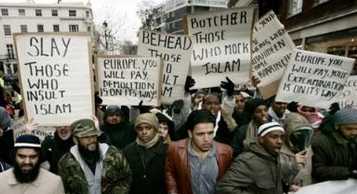
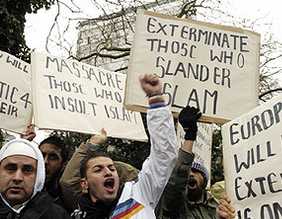
Members of Utah's Jewish community are alarmed by a proposed demonstration that will call for "Death to Israel."But according to the police, there is no reason to be unduly concerned. The group sponsoring the event has an innocuous name, only 9 people on average show up for such events and of course:
A man - whose name wasn't available Thursday - has applied for a free-speech permit from Salt Lake City to demonstrate on sidewalks near City Hall on Wednesday. The city is reviewing the application.
City officials cannot constitutionally deny it based on the content of the message.
"It's not like they're threatening to kill people," [police spokesman Joe] Cyr said. "They're just [expressing] their opinion."Whew! What a relief.
Mayor Rocky Anderson, who will speak at an anti-Bush rally on Wednesday, said he doesn't know if the city will grant the Death to Israel permit.Or reminiscent those Moslem protests we've seen in London:
''Do I agree with that sort of hateful expression? I don't. It's so reminiscent of the 'Death to America' slogans that we hear around so much of the militant Muslim world,'' Anderson said.
Earlier this month, The Associated Press reported thousands of Iraqi Shiites chanted "Death to Israel" and "Death to America" in Baghdad to show support for Hezbollah militants fighting Israeli troops in Lebanon.
 |  |
 |  |
Hey, it's only an opinion.
Sleep tight.
Technorati Tag: Israel and Anti-semitism.
Thursday, August 24, 2006
Voices in the Democratic Party About Israel--and Jews
In Is the Democratic Party Going European?, Jonathan Rosenblum writes about a growing trend within the Democratic Party vis-a-vis Israel.
A deep ambivalence towards Israel has infected the Democratic Party, which many political analysts are currently projecting to take over one or both houses of Congress in the next elections. A recent Bloomberg/Los Angeles Times poll comparing voter attitudes on the war in Lebanon and towards Israel shows Republicans to be far more supportive of Israel than Democrats. Though the Democratic Party is the political home of the vast majority of American Jews, 54% of Democrats advocate that the United States adopt a more neutral – i.e., less pro-Israel – stance to the Middle East, as opposed to only 29% of Republicans. Nearly two-thirds of Republicans felt the Israeli bombing in Lebanon was fully justified, as opposed to only 29% of Democrats.This by itself is not really something new. In June of last year, while conducting a mock impeachment inquiry over the Iraq war, a number of Democrats took a swipe at Israel:
The session took an awkward turn when witness Ray McGovern, a former intelligence analyst, declared that the United States went to war in Iraq for oil, Israel and military bases craved by administration "neocons" so "the United States and Israel could dominate that part of the world." He said that Israel should not be considered an ally and that Bush was doing the bidding of Israeli Prime Minister Ariel Sharon.Howard Dean spoke out against those statement. But Rosenblum goes further, looking at the views expressed within the Democratic Party not only about Israel in particular, but about Jews in general:
"Israel is not allowed to be brought up in polite conversation," McGovern said. "The last time I did this, the previous director of Central Intelligence called me anti-Semitic."
Rep. James P. Moran Jr. (D-Va.), who prompted the question by wondering whether the true war motive was Iraq's threat to Israel, thanked McGovern for his "candid answer."
At Democratic headquarters, where an overflow crowd watched the hearing on television, activists handed out documents repeating two accusations -- that an Israeli company had warning of the Sept. 11, 2001, attacks and that there was an "insider trading scam" on 9/11 -- that previously has been used to suggest Israel was behind the attacks.
On the angry Left blog sites, which play an ever larger role in Democratic Party politics, attacks on Jews are commonplace.If anti-Semitic statements like this are more common among the more liberal left-wing members of the Democratic Party, then a lot will depend on the degree to which their influence within the Democratic Party as a whole increases. Their influence is not certain and still remains to be seen. But it is a warning sign that Israel--and Jews--can never be certain of who their friends and allies are.
After spending several months campaigning for Senator Joseph Lieberman in Connecticut, Lanny Davis, former special counsel to President Clinton, revised his lifelong view that intolerance and hate-speech are more likely to be found on the Right. In a piece in the Wall Street Journal, Davis provided a sampler of the anti-Semitic attacks on Senator Lieberman posted on some of the most widely read and influential Democratic blog sites.
Lieberman was accused of supporting the war in Iraq so that American soldiers, not Israeli ones, would die. One post on Daily Kos, the most influential Democratic blog, read, "Jews only care about the welfare of other Jews . . . Ignore all the Jewish propaganda about participating in the civil rights movement of the ‘60s." Another Daily Kos reader described Lieberman as a "racist and religious bigot." And a reader at Huffington Post opined that Lieberman "cannot escape the religious bond he represents. His wife’s name is Haggadah or Diaspora or something you eat at Pesach." Yet another blogger made fun of the beard Lieberman grew during the Three Weeks, and suggested that he dye it "blood red."
Venomous caricatures of Israel as the new Third Reich have long been standard fare in respectable papers in Europe, but the migration of such views across the Atlantic is deeply worrying, if only because America is Israel’s one absolutely indispensable ally.
Technorati Tag: Israel and anti-Semitism and Democratic Party and Daily Kos.
Wednesday, August 23, 2006
Two Americans Kidnapped By Palestinian Terrorists
On August 14, Fox News Channel reporter Steve Centanni and freelance cameraman Olaf Wiig were kidnapped in Gaza City by Palestinian terrorists. This really should not be news--because based on past experience, you would think that the whole incident was another case of mistaken identity and they would have been returned by now.
But the Palestinian terrorists who kidnapped them have not yet returned them.
This is not an incident like that of Benjamin Bright-Fishbein, who was kidnapped in Nablus by the al-Aqsa Martyrs' Brigades--and then when they figured out they had kidnapped an American and not an Israeli, he was turned over to Palestinian security forces.
This is much more serious. Remember that in 2 months--October 15 will mark the 3rd anniversary of the murder of 3 Americans by Palestinian Arabs terrorists when they blew up a US diplomatic convoy in Gaza:
The downgrade of the PLO office is required by the Anti-Terrorism Act of 1987, which has been delayed because of U.S. national security interests.
Maybe now would be an appropriate time to realize how deeply US national security interests--especially the security of her citizens--are served by serving notice upon the Palestinian Arabs that they will be held responsible for their actions: not only the murder of American citizens in the past, but also responsible currently for the safety of Americans such as Centanni and Wiig who enter Palestinian controlled land.
It may also be time to make the U.S. Palestinian Anti-Terrorism Act of 2006 into law.
Little attention has been paid to this kidnapping.
It is time to shine a bright light on this Palestinian act and demand action.
Crossposted at Instapundit.
But the Palestinian terrorists who kidnapped them have not yet returned them.
This is not an incident like that of Benjamin Bright-Fishbein, who was kidnapped in Nablus by the al-Aqsa Martyrs' Brigades--and then when they figured out they had kidnapped an American and not an Israeli, he was turned over to Palestinian security forces.
This is much more serious. Remember that in 2 months--October 15 will mark the 3rd anniversary of the murder of 3 Americans by Palestinian Arabs terrorists when they blew up a US diplomatic convoy in Gaza:
John Branchizio, 37, of Texas; John Linde Jr., 30, of Missouri; and Mark Parsons, 31, of New Jersey, all died in Gaza as a direct result of Palestinian terror. They are among the more than 50 American citizens murdered by Palestinian terrorists since the signing of the Oslo accords, and none of their killers have yet to pay for their actions.Also, October means that once again Bush is due to sign another waiver of the Anti-Terrorism Act of 1987, the congressionally mandated downgrade of the status of the PLO Office in the United States.
The downgrade of the PLO office is required by the Anti-Terrorism Act of 1987, which has been delayed because of U.S. national security interests.
Maybe now would be an appropriate time to realize how deeply US national security interests--especially the security of her citizens--are served by serving notice upon the Palestinian Arabs that they will be held responsible for their actions: not only the murder of American citizens in the past, but also responsible currently for the safety of Americans such as Centanni and Wiig who enter Palestinian controlled land.
It may also be time to make the U.S. Palestinian Anti-Terrorism Act of 2006 into law.
Little attention has been paid to this kidnapping.
It is time to shine a bright light on this Palestinian act and demand action.
Crossposted at Instapundit.
Technorati Tag: Israel and Palestinians and Steve Centanni and Olaf Wiig and Terrorism and Gaza.
Friday, August 18, 2006
The Many Uses of Jimmy Carter
"There you go again."
Reagan to Carter during 1980 debate
Jimmy Carter is clearly handy to have around.
The Palestinians know Carter is always good for approving flawed elections.
The Nobel Prize committee know Carter is good for a slap in the face to Bush.
The Washington Post knows that Carter is good for an anti-Bush diatribe.
Der Spiegel knows a good thing and gets some good mileage out of Carter as well.
Is Carter in the running for Secretary General of the UN?
10,000 prisoners?
Well, if terrorists are militants, I guess when captured they become mere prisoners.
when the militants in Lebanon or in Gaza take one or two soldiers...
Rockets, missiles, and threats to destroy Israel are irrelevant and need not be mentioned.
Not for nothing does Carter say:
But history cannot be merely ignored. And surely not historical facts.
Aside from history, it can easily be argued, based on Carter's general and context-free statements, that even contemporary events are beyond his grasp.
Worse, Carter believes that he has his finger on the pulse of Americans who have a similarly simplistic view of the world
Technorati Tag: Israel and Jimmy Carter and Der Spiegel.
Reagan to Carter during 1980 debate
Jimmy Carter is clearly handy to have around.
The Palestinians know Carter is always good for approving flawed elections.
The Nobel Prize committee know Carter is good for a slap in the face to Bush.
The Washington Post knows that Carter is good for an anti-Bush diatribe.
Der Spiegel knows a good thing and gets some good mileage out of Carter as well.
SPIEGEL: You also mentioned the hatred for the United States throughout the Arab world which has ensued as a result of the invasion of Iraq. Given this circumstance, does it come as any surprise that Washington's call for democracy in the Middle East has been discredited?Entire nation...civilian population
Carter: No, as a matter of fact, the concerns I exposed have gotten even worse now with the United States supporting and encouraging Israel in its unjustified attack on Lebanon.
SPIEGEL: But wasn't Israel the first to get attacked?
Carter: I don't think that Israel has any legal or moral justification for their massive bombing of the entire nation of Lebanon. What happened is that Israel is holding almost 10,000 prisoners, so when the militants in Lebanon or in Gaza take one or two soldiers, Israel looks upon this as a justification for an attack on the civilian population of Lebanon and Gaza. I do not think that's justified, no.
Is Carter in the running for Secretary General of the UN?
10,000 prisoners?
Well, if terrorists are militants, I guess when captured they become mere prisoners.
when the militants in Lebanon or in Gaza take one or two soldiers...
Rockets, missiles, and threats to destroy Israel are irrelevant and need not be mentioned.
Not for nothing does Carter say:
I think most people believe that enough time has passed so that historical facts can be ignored.True, past history--events--can be put behind us. If not, disagreements, conflicts and wars would never be brought to resolution.
But history cannot be merely ignored. And surely not historical facts.
Aside from history, it can easily be argued, based on Carter's general and context-free statements, that even contemporary events are beyond his grasp.
Worse, Carter believes that he has his finger on the pulse of Americans who have a similarly simplistic view of the world
I think I represent the vast majority of Democrats in this country. I think there is a substantial portion of American people that completely agree with me. I can't say a majority because we have fragmented portions in our country and divisions concerning gun control and the death penalty and abortion and gay marriage. [emphasis added]I don't know how many people 'completely agree' with Jimmy Carter, but one thing is obvious--newspapers around the world adore him.
Technorati Tag: Israel and Jimmy Carter and Der Spiegel.
Look Out Pallywood, Hezbollywood. Here Comes Hollywood!
Nicole Kidman has been joined by 84 other major Hollywood stars in a special ad in Thursday's Los Angeles Times, according to the Herald Sun:
Considering the general anti-Bush slant of Hollywood, to see actors come out in support of Israel is a welcome surprise.
"We the undersigned are pained and devastated by the civilian casualties in Israel and Lebanon caused by terrorist actions initiated by terrorist organisations such as Hezbollah and Hamas," the ad reads.The list of those who joined Kidman is not too shabby either:
"If we do not succeed in stopping terrorism around the world, chaos will rule and innocent people will continue to die.
"We need to support democratic societies and stop terrorism at all costs."
Michael Douglas, Dennis Hopper, Sylvester Stallone, Bruce Willis, Danny De Vito, Don Johnson, James Woods, Kelly Preston, Patricia Heaton and William Hurt.According to YNet News, this is the result of efforts by the Israeli Consulate in Los Angeles since the start of the fighting, and the consul general, Ehud Danoch, is still active:
Directors Ridley Scott, Tony Scott, Michael Mann, Dick Donner and Sam Raimi also signed their names.
Other Hollywood powerplayers supporting the ad included Sumner Redstone, the chairman and majority owner of Paramount Pictures, and billionaire mogul, Haim Saban.
Consul General Danoch is continuing with his PR activities, and on Wednesday night he briefed the heads of the William Morris agency on the recent events in Lebanon.It will be interesting to see just what else Danoch can come up with.
Considering the general anti-Bush slant of Hollywood, to see actors come out in support of Israel is a welcome surprise.
Technorati Tag: Israel and Hollywood.
Thursday, August 17, 2006
Media Fakery Goes Beyond Israel
Writing in the Washington Times, Joel Mowbray notes:
The media consistently shows itself to be a willing pawn of Islamists and those who oppose Democracy in the region. But which came first, their hatred of Bush and Israel, or their fawning--yet fearful--attitude towards the Islamists?
But while the widespread use of Arab locals in covering the Middle East raises many legitimate concerns, the Palestinian propaganda machine has enjoyed tremendous success over the years hoodwinking supposedly sophisticated Western journalists. And Hezbollah appears to have done the same over the past month.It is easy to forget that Israel actually is not the only victim of faked photos. Glenn Harlan Reynolds reminds us:
We've seen this kind of fakery before, of course, and not just where Israel is concerned. The Boston Globe ran fake rape photos purporting to show U.S. troops raping Iraqi women. The photos turned out to come from a Hungarian porn site. Nor does the fakery stop with photos. Rutten's own L.A. Times ran a nasty piece about Paul Bremer's departure from Iraq, saying that he didn't even give a farewell speech and suggesting that he was afraid to look Iraqis in the eye. In fact, Bremer had given a speech that was nationally televised in Iraq. As columnist John Leo observed in response to this bit of bogosity: "What's new about the press is that so many people who follow it with a critical eye now have an outlet to howl about inaccuracy and partisanship. The big media used to be able to shrug off critics like this. Now they can't."We've mentioned his recurring parallel between Israel on the one hand and the US in Iraq in a previous post on the problem of the reliance on 'fixers' by the media in both Israel and Iraq.
The media consistently shows itself to be a willing pawn of Islamists and those who oppose Democracy in the region. But which came first, their hatred of Bush and Israel, or their fawning--yet fearful--attitude towards the Islamists?
Technorati Tag: Israel and Media Bias and Iraq and US.
Wednesday, August 16, 2006
After The War With Hezbollah: The Weeks of Consolation
There have been attempts to find something positive about the results of Israel's war with Hezbollah. Bush has said that Hezbollah lost. Others have picked through the cease-fire to find 'victories' that Israel accomplished for the steep price it paid in lives disrupted and lost. Many of these attempts smack of desperation and a refusal to face the facts.
But not all.
In Final Reckoning, Yossi Klein Halevi writes that Israel is
But not all.
In Final Reckoning, Yossi Klein Halevi writes that Israel is
a nation whose heart has been broken: by our failure to uproot the jihadist threat, which will return for another and far more deadly round; by the economic devastation of the Galilee and of a neighboring land we didn't want to attack; by the heroism of our soldiers and the hesitations of our politicians; by the young men buried and crippled in a war we prevented ourselves from winning; by foreign journalists who can't tell the difference between good and evil; by European leaders who equate an army that tries to avoid civilian causalities with a terrorist group that revels in them; by a United Nations that questions Israel's right to defend itself; and by growing voices on the left who question Israel's right to exist at all.There is alot of bitter medicine in what follows, but Halevi closes with this thought:
Still, in the Jewish calendar, the summer weeks after the fast of the Ninth of Av, commemorating the destruction of the Temple, are a time of consolation. "Be consoled, be consoled, my people," we read from the Torah on the Sabbath after the fast. And so we console ourselves with the substantial achievements of the people of Israel during this month of war. First, our undiminished capacity for unity. My favorite symbol of that unity is the antiwar rapper, Muki, whose hit song during the era of Palestinian suicide bombings lamented the absence of justice for the Palestinians but who, this time, insisted that the army needs to "finish the job" against Hezbollah. Second, our middle-class children, with their cell phones, iPods, and pizza deliveries to their army bases. In intimate combat, they repeatedly bested Hezbollah fighters, even though the terrorists had the advantage of familiar terrain. This generation has given us some of Israel's most powerful images of heroism, like the soldier from a West Bank settlement and father of two young children who leaped onto a grenade to save his friends, shouting the Shema--the prayer of God's oneness--just before the grenade exploded. Along with the recriminations, there will be many medals of valor awarded in the coming weeks.Nachamu, Nachamu Ami.
But the last month's fighting is only one battle in the jihadist war against Israel's homefront that began with the second intifada in September 2000. Israel won the first phase of that war, the four years of suicide bombings that lasted until 2004. Now, in the second phase, we've lost the battle against the rockets. But the qualities this heartbreak has revealed --unity and sacrifice and faith in the justness of our cause--will ensure our eventual victory in the next, inevitable, bitter round. Such is the nature of consolation in Israel in the summer of 2006.
Technorati Tag: Israel.
Tuesday, August 15, 2006
Why Supporters of Israel Should NOT Be Depressed?
On the one hand, there is Glick and Bayefsky.
On the other hand, there is Rich Lowry at The Corner, who asked an Israeli official why American supporters of Israel should not be depressed by the cease-fire agreement and came back with this list:
More to the point is this National Review editorial:
On the other hand, there is Rich Lowry at The Corner, who asked an Israeli official why American supporters of Israel should not be depressed by the cease-fire agreement and came back with this list:
—"The resolution as a resolution is favorable to this country," and creates a solution in southern Lebanon that is in Israel's interest. Provided it is implemented.Ummm, isn't that last point a good reason for us to get depressed?
—"I don't know how Nasrallah can now pretend it's a victory. The resolution says south of the Litani is a Hebollah-free zone. That means that its state-within-a-state is going to disappear."
—"Before Nasrallah was on the border, able to lob missiles and rockets and kidnap soldiers. We have pushed him north of the Litani. That is an amazing achievement. It's what we've been demanding for years."
—There is still the problem of long-range rockets, but there is an embargo and if Syria violates it, it will be open to all sorts of sanctions and punishments. Granted, those would require another U.N. resolution, but the threat is there. And the international force is going to police border crossings. They should at least be able to stop missiles coming in on semi-trailers.
—"Kofi has to report back in 30 days with a plan" about how the things in the resolution are going to happen.
—"The sense has always been that we are good at winning wars and losing the diplomacy." Now, there's lots of argument about the conduct of the war, "but there's no doubt that we won the diplomacy. The question is whether it will be implemented. As a platform it's good—it's a positive platform."
—"In Lebanon, until Qana, a lot of people were willing to be critical of Hezbollah. The cease-fire has allowed those voices to surface again. The political dynamic in Lebanon is returning to the pre-Qana dynamic."
—When people ask when Israel is going to leave southern Lebanon, the Israelis can say as soon as the international force arrives. It creates an incentive for the international force actually to materialize. Until then, the resolution legitimizes the Israeli presence in Lebanon.
—There's lot of ferment in Lebanon. The chief of staff of the Lebanese army has been quoted saying that the army won't go down to the south unless Hezbollah agrees to pull out because it doesn't want to fight Hezbollah.
—If Hezbollah decides not to honor the ceasefire, Israel is in a stronger position both politically/diplomatically and militarily to respond. It will hold its positions on the Litani River.
—But again, it all depends on the implementation.
More to the point is this National Review editorial:
In the final tussling over the resolution, Israel insisted that there be no “vacuum” between the exit of its forces and the arrival of an international force, as such a vacuum could be exploited by Hezbollah to return to the south. But since Hezbollah was never fully pushed from the area, it is going to be there, vacuum or not. The Lebanese army, a pathetic rust-bucket riven by sectarian tensions, isn’t going to seriously challenge Hezbollah. It’s not clear at the moment whether it even has the capability to transport itself to the south, and in recent weeks it has been evident that Hezbollah is in a position to dictate to the Lebanese government, not the other way around. Nor will the international force threaten Hezbollah, even if its mandate is exceedingly ambitious by milquetoast U.N. standards. Over time, as the sense of urgency behind its mission declines, it will surely begin to look more and more like the old accommodationist UNIFIL force.The editorial concludes with a point that shows the above list of Israeli accomplishments for what it is and warns of what the future will bring if the West continues upon its current half-hearted path:
Hezbollah has a crucial advantage over any competitors for ultimate control of the south — not just the legitimacy that comes with the support of the Shia population, but the sheer will that motivates it to fight and die for its cause. Are French and Italian troops willing to die for the enforcement of Resolution 1559, calling for the disarming of Hezbollah? To ask the question is to answer it. In theory, an international force could police Lebanon, but that would require a tough-mindedness and a willingness to sacrifice that aren’t on offer.
If current trends continue, the Bush administration’s project in the Middle East will require the same sort of expedient we have just seen in the Israel–Lebanon conflict: a papering over of what is essentially a failure.
Technorati Tag: Israel and Lebanon and UN and Hizbollah and Hezbollah.
Monday, August 14, 2006
Scowcroft and the Myth of Israeli Responsibility for Mideast Unrest
The Best of the Web notes that on October 25 last year, the following appeared in The Washington Post about Brent Scowcroft, former National Security Advisor to Presidents Gerald Ford and H. W. Bush:
Technorati Tag: Israel and Arabs and Brent Scowcroft and Jihad and Iran and Islam.
Scowcroft, in his interview, discussed an argument over Iraq he had two years ago with Condoleezza Rice, then-national security adviser and current secretary of state. "She says we're going to democratize Iraq, and I said, 'Condi, you're not going to democratize Iraq,' and she said, 'You know, you're just stuck in the old days,' and she comes back to this thing that we've tolerated an autocratic Middle East for fifty years and so on and so forth," he said. The article stated that with a "barely perceptible note of satisfaction," Scowcroft added: "But we've had fifty years of peace." [emphasis added]In response to Scowcroft's satisfaction that there have been 50 years of peace among the autocratic rulers in the Mideast, James Taranto points out:
Now let's see. Between 1953 and 2003, here are the Mideast wars we can think of off the top of our head: the Six Day War, the Yom Kippur War, the Iran-Iraq War, the Gulf War, the two Palestinian intifadas against Israel, the Algerian Civil War, the Yemen Civil War and two Sudanese civil wars. That doesn't even count acts of terror against non-Mideastern countries, from the Iranian invasion of the U.S. Embassy to the attacks of 9/11.Now you can argue that Scowcroft was speaking only in terms of Arab conflicts and not those based on wars with Israel, which brings the number of conflicts down, but Raphael Patai, has his own list--which does not include Israel--counting just from 1970 to 1983, which he lists in a chapter he added to an updated version of his The Arab Mind in 1983:
1. Intermittent disputes involving border warfare and assassinations between South Yemen on the one hand, and North Yemen and Saudi Arabia, on the other since the early 1970's. A brief but fierce border war between the two Yemens took place as recently as March, 1979.
2. A major and bloody, albeit brief, conflict between Jordan and Palestinian guerillas in 1970, complicated by Syrian intevention.
3. Fighting between the Kurds and the Iraqis, which lasted several yesrs.
4. A bloody conflict between Northern and Southern Sudan, 1956-1972.
5. Clashes between South Yemen and Oman, linked to the Dhofar rebellion, 1972-1976.
6. A tripartite confict between Algeria on the one hand and Morocco and Mauritania, on the other, over the control of the former Spanish Sahara, beginning in 1976 and subsequently transformed into guerrilla warfare against Morocco by the Polisario, the freedom fighters of the Western Sahara, supported by Algeria and Libya, which was still in progrss in 1982.
7. Intermittent hostility, and actual border fighting, including air attacks, between Egypt and Libya in 1977.
8. The Lebanese civil war, which began in 1975, involving two outside parties, Syria and the Palestine Liberation Organization, still unresolved in early 1982.
9. The invasion of Chad by Libya in 1980.
10. The war between Iraq and Iran, wich began in the fall of 1980, in which Iraq is supported by Jordan and Iran by Syria, making it in effect, an inter-Arab conflict. It was still in progress in early 1982.
11. In February, 1982, a conflict flared up between the Syrian government and Muslim fundamentalists in the Syrian city of Hama, in which several thousands were killed and major parts of Hama were destroyed. [p.357-358]
Now on July 30, Brent Scowcroft, former National Security Advisor to Presidents Gerald Ford and H. W. Bush, wrote an op-ed piece in the Washington Post about the potential opportunity for resolving the conflict between Israel and the Palestinian Arabs based on the current war in Lebanon.
Besides some debatable assumptions about what Israel and the Palestinian Arabs can come to agreement on--unless Scowcroft is relying on international pressure on Israel to paper over their differences--Scowcroft still thinks Israel is the initial domino that will set everything else aright:
The benefits of reaching a comprehensive settlement of the root cause ofHistory clearly shows the capability of the Arab world to generate massacres and enormous bloodshed among themselves without recourse to Israel as a spark. Currently, the source of instability in the Mideast is Iran's drive towards Muslim leadership, now manifesting itself through its Hezbollah proxy attacking Israel, with whom Iran has no border and no real issue. This, as part of the growing Islamist threat, should direct the world's attention away from attempts at simplistic solutions focused purely on the Palestinian Arabs and instead towards the genuine threat to world peace.
today's turmoil would likely ripple well beyond the Israelis and the
Palestinians. [emphasis added]
Technorati Tag: Israel and Arabs and Brent Scowcroft and Jihad and Iran and Islam.
Friday, August 11, 2006
Endgame
Insight on the News--published by the same company that publishes the Washington Times--had an article just a couple of days ago that Bush and Rice were divided on how to deal with Israel and the war in Lebanon:
Now, just a couple of days later, Rice's position has won out
And whatever effect it may have, it will not be empowering Israel:
No international force can really be expected to stop Hezbollah.
The chances that Israel will get her soldiers back without having to give something up is unlikely.
Nothing will stand in the way of Hezbollah re-arming itself.
Nasrallah will claim victory--for Hezbollah and by implication Syria and Iran as well.
And what at first was viewed as an opportunity to change the region for the better, will weaken the way Israel is viewed by its enemies.
Whether this is Bush's idea of Olmert's, the fact remains that Israel will be the worse for it.
No one will see this as a draw.
If a cease-fire is really put into place, if there is a bright side--please feel free to point it out.
The U.S. response to the Israeli-Hezbollah war was said to have divided both the administration as well as the family of President George W. Bush. At the same time, it marked the first time since Ms. Rice became secretary of state that the president has overruled her.The issue boils down to a choice--as it often does--between the military and diplomatic options, and the ramifications of those choices:
The disagreement between Mr. Bush and Ms. Rice is over the ramifications of U.S. support for Israel's continued offensive against Lebanon. The sources said Mr. Bush believes that Israel's failure to defeat Hezbollah would encourage Iranian adventurism in neighboring Iraq. Ms. Rice has argued that the United States would be isolated both in the Middle East and Europe at a time when the administration seeks to build a consensus against Iran's nuclear weapons program.Of course what Rice considers 'stabilizing' others might refer to as 'empowering'.
Instead, Ms. Rice believes the United States should engage Iran and Syria to pressure Hezbollah to end the war with Israel. Ms. Rice has argued that such an effort would result in a U.S. dialogue with Damascus and Tehran on Middle East stability.
Now, just a couple of days later, Rice's position has won out
And whatever effect it may have, it will not be empowering Israel:
With the UN Security Council on the verge of passing a cease-fire resolution, the IDF understood on Thursday that Operation Change of Direction was ending, for better or for worse.
The IDF was disappointed. Senior officers said they had been looking forward to the fight. Reaching the Litani and eliminating Hizbullah from the villages on the way could have provided, senior officers believe, the victory that Israel has been trying to obtain since July 12. By Thursday night, the chance of that happening was drifting away.
In the end, Israel will have nothing to show for this.
No international force can really be expected to stop Hezbollah.
The chances that Israel will get her soldiers back without having to give something up is unlikely.
Nothing will stand in the way of Hezbollah re-arming itself.
Nasrallah will claim victory--for Hezbollah and by implication Syria and Iran as well.
And what at first was viewed as an opportunity to change the region for the better, will weaken the way Israel is viewed by its enemies.
Whether this is Bush's idea of Olmert's, the fact remains that Israel will be the worse for it.
No one will see this as a draw.
If a cease-fire is really put into place, if there is a bright side--please feel free to point it out.
Technorati Tag: Israel and Iran and Lebanon and Hizbollah and Hezbollah
Subscribe to:
Posts (Atom)