Showing posts with label Kofi Annan. Show all posts

Tuesday, January 02, 2007

New UN Secretary General: Is The Party Already Over?

And to think that things started out looking so promising...
  • The Jerusalem Post reported that, Ban Ki-Moon was the first South Korean foreign minister to visit Israel and is generally considered to a friend of Israel.

  • The Mail & Guardian reported that senior officials at the UN were unhappy with the appointment Ban Ki-Moon: a hopeful sign in itself.

  • Haaretz reported that Ban Ki-Moon condemned Holocaust denial as well as Iran's call for the elimination of Israel.
But that was all last year. Come January 1 and according to the Jerusalem Post, the party is already over:

Ban Ki-Moon, the new secretary-general of the United Nations, said on Monday that the Israeli-Palestinian issue was at the core of solving all the problems in the Middle East.

..."If the issues with the conflicts between Israel and Palestine go well, [resolutions of] other issues in the Middle East, including Lebanon, Iran, Iraq and Syria, are likely to follow suit.
On the bright side, Ban is considering some changes in personnel which supposedly could affect the way the UN operates in Israel and the West Bank. He is also supposedly planning on streamlining the UN bureaucracy.

But bottom line, Ban is already beginning to sound like Kofi Annan.

According to the Jerusalem Post, Ban "is not known to have developed expertise on the Middle East."--if Ban Ki-Moon owns up to that, he would be the first international figure to admit it.

Speaking of following in Kofi's footsteps:
Ban is temporarily residing at a hotel. He will not move into his official residence - an 85-year-old neo-Georgian town house on New York's fashionable Sutton Place overlooking the East River - until renovations (the first since 1950) are completed. The General Assembly recently approved $4.9 million to modernize the residence's heating, air conditioning, plumbing, kitchen and security, which is expected to take about nine months. [emphasis added]
This comes in the wake of Kofi's last scandal:
...after Kofi and his wife moved into the rent-free official UN residence at the beginning of 1997, their old low-rent taxpayer-subsidized apartment appears to have been passed to the family of his brother, Kobina Annan — who for some years has been serving as Ghana’s ambassador to Morocco, complete with an official residency in Rabat. [emphasis added]
The sooner Ban streamlines the bureaucracy, the better.
Unless, of course, he intends to become part of it.


Technorati Tag: and and .


Tuesday, October 24, 2006

Getting Recognition For Jews Who Fled Arab Countries

Hat Tip: The Astute Bloggers

From Haaretz:
World Jewish groups began a global campaign yesterday calling for recognition of Jews from Arab countries as refugees in the Middle East conflict.

"The world sees the plight of Palestinian refugees, and not withstanding their plight, there must be recognition that Jews from Arab countries are also victims of the Arab-Israeli conflict," said Stanley Urman, executive director of Justice for Jews from Arab Countries (JJAC).

JJAC, a U.S.-based coalition of Jewish organizations, is one of the groups coordinating the campaign, which aims to record testimonies of Jews who fled in the face of persecution, list asset losses and lobby foreign governments on their behalf.

Jewish groups have estimated that since 1948 at least 900,000 Jews have been forced to leave their homes in Arab countries such as Egypt, Iraq, Libya, Syria, Lebanon and Yemen.

At least 600,000 went to Israel. The rest sought sanctuary in France, Britain, the United States and other countries.
The Astute Bloggers notes that in contrast to the approximate 900,000 Jews who were forced to leave there homes in Arab countries, approximately 720,000 Arabs left then-Palestine in 1948.

On the one hand, Arabs will inflate the number of Arabs who fled.
On the other, how likely is it that this issue will get the attention it deserves from Europe in general or the UN in particular?

That would be the UN that established the UN Day of Solidarity with the Palestinian People, coming up on November 29. Last year, Kofi Annan attended--standing in front of a map of the Middle East with Israel missing and saying:
I invite everyone present to rise and observe a minute of silence in memory of all those who have given their lives for the cause of the Palestinian people and the return of peace between Israel and Palestine. [emphasis added]
I wish the JJAC luck.

Technorati Tag: and and .

Wednesday, October 11, 2006

Looking Forward to Kofi Annan's Successor

Boker Tov, Boulder! has some good news--Kofi Annan will be out as Secretary General of the UN at the end of the year.

The likely replacement may be good news as well. South Korean Foreign Minister Ban Ki-Moon.
According to the Jerusalem Post, he was the first South Korean foreign minister to visit Israel and is generally considered to a friend of Israel.

On the other hand, the UN itself is unhappy with the potential choice:
Senior officials at the United Nations expressed despair on Friday at the prospect of Kofi Annan being succeeded as Secretary General by Ban Ki-moon, the South Korean Foreign Minister.

"The mood among staff is glum," one of the officials said. "We are not very excited about the outcome." With morale low at the UN after five years dominated by divisions, deadlock and corruption, they are sceptical about Ban's ability to turn the organisation round or provide the strong, inspirational leadership they had been hoping for.

Another official, who has met Ban several times, said: "He is pretty faceless and does not have much charisma. Kofi, for all his problems, is a man of considerable dignity, political insight and wide international experience."
If the UN itself is unhappy with the choice, that is a good sign already--and if a UN official can describe the scandal plagued Kofi Annan as "a man of considerable dignity, political insight and wide international experience," then the UN is clearly overdue for a change.

Technorati Tag: and and .


Monday, August 28, 2006

What is Kofi Annan doing for the kidnapped Israeli soldiers?

From the Wall Street Journal Editorial Page

Hostage Crisis
What is Kofi Annan doing for the kidnapped Israeli soldiers?

BY JUDEA PEARL AND RUTH PEARL
Monday, August 28, 2006 12:01 a.m. EDT

As the parents of Daniel Pearl, The Wall Street Journal's reporter who was kidnapped and brutally murdered in Pakistan in 2002, we share the anguish of the families of the kidnapped Israeli soldiers, and their frustration with the international community for failing to secure the release of their loved ones. For more than six weeks now, these soldiers and their families live each day tortured by unimaginable fears and shattered hopes, praying desperately for the nightmare to end; we relive this nightmare each time an innocent person falls victim to the inhumanity of terrorist abduction.

Whatever success the U.N. Security Council would presume to claim, it cannot be said that Resolution 1701 has effectively addressed the direct cause of the fighting--the kidnapping of Israeli soldiers, Ehud Goldwasser, 31, and Eldad Regev, 26, by Hezbollah, and the earlier abduction of Gilad Shalit, 19, by Hamas. Secretary-General Kofi Annan's call for the unconditional release of these soldiers has been ignored. Moreover, in flagrant violation of international humanitarian law, the terrorists have not only seized the soldiers as hostages for political blackmail, they have not allowed the Red Cross to visit them. Their families do not know their physical condition; they have no proof they are even alive.

And so now these families of Ehud, Eldad and Gilad are asking to meet with Kofi Annan. They wish to plead with the secretary-general to use the full weight of his moral authority to mobilize and intensify the efforts of the international community he leads--an influential body that has managed to compel two fierce armies to cease hostilities--to address this flagrant violation of humanitarian law.

On that score, these families are correct: The time has come for Mr. Annan to personally and aggressively intervene, and to insist publicly that, at the minimum, the Red Cross, or his personal humanitarian representatives, be given immediate access to these soldiers.

Will he? It seems unlikely. Sadly, this is not the first time that concerned parents have turned to Mr. Annan in much the same circumstances. Six years ago, another delegation of distressed families came to the U.N. with a similar tragedy, following the abduction of three Israeli soldiers by Hezbollah from under the noses of Unifil and, by some accounts, with their help. The investigation that was subsequently conducted found that the U.N. had made "serious errors in judgment" by hiding information that "would have been helpful in an assessment of the condition of the three abducted soldiers." At that time, the U.N.'s interest in appearing "neutral" overshadowed its commitment to the preservation of human lives. The world cannot afford a repeat of such inaction and poor judgment.

Undoubtedly, the secretary-general will tell the families of Ehud, Eldad and Gilad that he has dispatched a high-level team to Beirut that will urge the release of their loved ones. But that team negotiates behind closed doors. And by not publicly demanding the unfettered access of humanitarian representatives to the kidnapped soldiers, Mr. Annan has deprived his team of the force of credibility and seriousness they need in those negotiations.

When our son Daniel was in captivity, millions of people around the world prayed for his safe return. In that prayer, they made a solemn pledge never to allow abductions of innocent people to become the norm of civilized society, no matter the political purpose, regardless of grievance or goal.

Kofi Annan's resolve against these acts of terrorism will determine to a great extent what norms will govern our society in generations to come, and whether organizations such as Hezbollah and Hamas will gloat in unruly appetite or be reined in by moral principles. We urge Mr. Annan to make bold and brave efforts to ensure--as a legacy and gift--that we will not allow our children and our world be taken captive by terror. Mr. Secretary-General, this time, help bring the boys back home.

Mr. and Mrs. Pearl are co-founders of the Daniel Pearl Foundation (www.danielpearl.org), a U.N.-affiliated NGO.

Technorati Tag: and and and and and and and and and .

Monday, August 14, 2006

Glick and Bayefsky on The Cease-Fire

Artuz Sheva offers the following summary of the points made by Caroline Glick and international legal scholar Prof. A. Bayefsky in their damning analysis of the UN cease-fire, An Unmitigated Disaster.

* Responsibility for determining compliance is in the hands of UN Secretary-General Kofi Annan, who has "distinguished himself as a man capable only of condemning Israel for its acts of self-defense while ignoring the fact that in attacking Israel, its enemies are guilty of war crimes."

* No mention of Hizbullah-patrons Syria or Iran, thus ignoring the regional aspect
of the war.

* Rewarding Hizbullah's aggression by giving international legitimacy to its demand for territory - namely, the Shaba Farms - via acts of aggression. Moreover, by allowing Lebanon to make territorial claims on Israel despite the fact that in 2000 the UN determined that Israel had withdrawn to the international border, the resolution sets a catastrophic precedent for the future.

* Though Israel had demanded an an arms embargo against Hizbullah, this issue is put off to a vague date in the future - and the power to oversee such an embargo is placed in the hands of the Lebanese government, of which Hizbullah is a member.

* The resolution calls upon Israel to withdraw all of its forces from southern Lebanon even before Lebanese and UNIFIL forces are fully deployed in the area - creating a vacuum allowing Hizbullah to reinforce its positions in south Lebanon.

* The resolution makes no operative call for the release of IDF soldiers Ehud Goldwasser and Eldad Regev being held hostage by Hizbullah. "By relegating their fate to a paragraph in the preamble, which then immediately turns to Hizbullah's demand for the release of Lebanese terrorists held in Israeli jails, the resolution all but eliminates any possibility of their returning home."

* It should be assumed that Hizbullah's presumptive victory in its war against Israel will act as a catalyst for violence by Hizbullah allies in Iraq against the Iraqi government and coalition forces in the weeks to come.

* Iran emerges as the main victor in the current war.

* By handing a victory to Hizbullah, the resolution strengthens the belief of millions of supporters of jihad throughout the world that their side is winning and that they should redouble efforts to achieve their objectives of destroying Israel and running the US out of the Middle East.


Of course, Olmert can always spring into action--reiterating for the umpteenth time that he is still going to plow ahead with the Israeli withdrawal from the West Bank.

It's hard to find anything positive about the cease-fire--other than the fact it serves as a reason to remove Olmert from office.

Technorati Tag: and and and and .


Tuesday, August 08, 2006

When Hezbollah Bombs UN Force--Kofi and Reuters Have It Covered

It's not only when Palestinian Arabs are killed that World Opinion tends to take on a more nuanced approach.

When UN forces are shot at, apparently it is important to first check who did the shooting before Kofi Annan can know whether or not he should make a statement.

Geoffrey MG's Beyond Wallacia notes that UN forces suffered a rocket attack by Hezbollah on Sunday--though you might not have noticed from Kofi's uncharacteristic silence.

According to Reuters:
Three Chinese soldiers in the United Nations peacekeeping force were lightly wounded on Sunday when a mortar round fired by Hizbollah hit their base in southern Lebanon, a spokesman for the UNIFIL force said.

"A mortar round from Hizbollah impacted inside the headquarters of the Chinese contingent in the al-Hinneyeh area," the spokesman said.

"They received medical treatment in position. Their condition is stable and they were not evacuated."
Fortunately, none of the UN force were seriously hurt.

But the Reuters article doesn't stop there of course. The rest of the article strives for balance by recounting incidents where Israel bombed UN forces--going so far as to recount an incident back in 1996:
An Israeli air strike killed four U.N. military observers at their base in southern Lebanon on July 25. Other Israeli shells have hit UNIFIL positions and wounded peacekeepers during the 26-day-old war between Israel and Lebanese Hizbollah guerrillas.

In 1996, during Israel's Grapes of Wrath campaign in Lebanon, Israeli bombed a UNIFIL compound in the southern village of Qana, killing 106 civilians sheltering inside.

UNIFIL was created in 1978 after Israel's first major invasion of southern Lebanon and has been there ever since.

The United Nations has called for a bigger, more robust and better armed force in the area as part of expected resolution for a lasting ceasefire.
So let's see.

o The title of the article: Hizbollah fire wounds 3 UN peacekeepers in Lebanon
o The total number of words in the article: 178 (minus neutral last paragraph = 152)
o The number of words describing the Hezbollah bombing: 69 (45% of article)
o The number of words describing Israeli accidental bombing: 83 (55% of article)

So not only does Reuters need to mention Israel, but goes out of its way to dedicate as equal an amount of text as it does to Hezbollah--and goes over.

In the interests of balance, did Reuters report the historical background on the kidnapping of Israeli soldiers--that when Hizbollah kidnapped Israeli soldiers in October 2000, UN forces aided Hezbollah at the time? Or that UNIFIL was bribed by Hezbollah? Or that the UN had important video that it denied it had, and would not give it over until it was edited?

Just asking.

Technorati Tag: and and and and and and .

Sunday, July 30, 2006

Photos That Damn Hezbollah

Hat Tip: The Corner

The following is from The Herald Sun. Personally, I think the title of the article is overly optimistic, since the nature of the media--and Kofi Annan--is to ignore or whitewash these kinds of details.

Make sure to check out the site to see the uniforms Hizbollah wears--simultaneously hiding from the IDF and putting the lives of the Lebanese in danger.
Photos that damn Hezbollah
Chris Link

July 30, 2006 12:00am
Article from: Sunday Herald Sun


THIS is the picture that damns Hezbollah. It is one of several, smuggled from behind Lebanon's battle lines, showing that Hezbollah is waging war amid suburbia.

The images, obtained exclusively by the Sunday Herald Sun, show Hezbollah using high-density residential areas as launch pads for rockets and heavy-calibre weapons.

Dressed in civilian clothing so they can quickly disappear, the militants carrying automatic assault rifles and ride in on trucks mounted with cannon.

The photographs, from the Christian area of Wadi Chahrour in the east of Beirut, were taken by a visiting journalist and smuggled out by a friend.

...The images include one of a group of men and youths preparing to fire an anti-aircraft gun metres from an apartment block with sheets hanging out on a balcony to dry.

Others show a militant with AK47 rifle guarding no-go zones after Israeli blitzes.

Another depicts the remnants of a Hezbollah Katyusha rocket in the middle of a residential block blown up in an Israeli air attack.

The Melbourne man who smuggled the shots out of Beirut and did not wish to be named said he was less than 400m from the block when it was obliterated.

"Hezbollah came in to launch their rockets, then within minutes the area was blasted by Israeli jets," he said.

"Until the Hezbollah fighters arrived, it had not been touched by the Israelis. Then it was totally devastated.

"It was carnage. Two innocent people died in that incident, but it was so lucky it was not more."

The release of the images comes as Hezbollah faces criticism for allegedly using innocent civilians as "human shields".

Mr Egeland blasted Hezbollah as "cowards" for operating among civilians.

"When I was in Lebanon, in the Hezbollah heartland, I said Hezbollah must stop this cowardly blending in among women and children," he said.


Technorati Tag: and and and and .


Thursday, July 27, 2006

Mitchell Bard: The UN Failure in Lebanon

Fact Sheet
by Mitchell Bard

The UN Failure in Lebanon

The United Nations was understandably upset when an Israeli bomb hit a base used by the UN Interim Force in Lebanon (UNIFIL) on July 25, 2006, and killed four military observers. The Secretary General of the UN, however, displayed a shocking lack of judgment when he immediately accused Israel of deliberately attacking the UN, a charge rejected by Israel.

Throughout his tenure, Kofi Annan has shown no reluctance to condemn Israeli actions while simultaneously refusing to criticize the terror that provokes them. This was evident just days earlier when he spoke to the Security Council and accused Israel of using “excessive force” while failing to utter the word “terrorism” to describe that actions of Hizballah that sparked the current fighting or to mention Hizballah’s sponsors Syria and Iran.

Not surprisingly, Annan has failed to mention that UNIFIL bases have been used by Hizballah fighters as a shield behind which they fire at Israel. He also has been silent on Hizballah attacks on UNIFIL. The same day UNIFIL reported the Israeli bombing, it also said another UN position was directly hit by a Hizballah mortar. Hizballah also fired from the vicinity of UN positions at Alma ash Shab, Tibnin, Brashit, and At Tiri. The day before Hizballah opened small arms fire at a UNIFIL convoy. There’s more:

* On July 24, one unarmed UN military observer was seriously wounded by small arms fire from the Hizballah side during an exchange with the IDF. He was evacuated to Israel and taken by an IDF helicopter to a Haifa hospital where he was operated on; his condition is now reported as stable.
* On July 21, A UN-run observation post just inside Israel was hit by rockets fired by Hizbullah that fell short of their targets in northern Israel.
* On July 20, UNIFIL reported that Hizballah was setting up rocket launchers near its troops and firing from the immediate vicinity of the UN positions in Naqoura and Maroun Al Ras.

Annan has called for an investigation of the July 25 incident and, if it is conducted fairly, the report will show that UNIFIL has been an utter failure for its entire existence and that its complicity in Hizballah activities helped spark the current conflict.

In March 1978, PLO terrorists infiltrated Israel. After murdering an American tourist walking near an Israeli beach, they hijacked a civilian bus. When Israeli troops intercepted the bus, the terrorists opened fire. A total of 34 hostages died in the attack. In response, Israeli forces crossed into Lebanon and overran terrorist bases in the southern part of that country, pushing the terrorists away from the border.

On March 19, 1978, the Security Council adopted resolutions 425 (1978) and 426 (1978), in which it called upon Israel immediately to cease its military action and withdraw its forces from all Lebanese territory. It also established UNIFIL. The IDF withdrew and the United Nations sent in a military contingent on March 23, 1978, that was supposed to prevent any further attacks against Israel from Lebanon. But UN troops were unable and unwilling to prevent terrorists from reinfiltrating the region and introducing new, more dangerous arms.

UNIFIL’s failure to prevent more than 200 terrorist attacks ultimately led Israel to reenter Lebanon in 1982 to drive out the PLO. Three years later, following the expulsion of the PLO leadership, and destruction of its terrorist infrastructure, Israel withdrew the bulk of its forces, leaving behind a 1,000-man force, deployed in a strip of territory extending eight miles into south Lebanon to protect towns and villages in northern Israel from the type of attacks it is now enduring. Israel said it would completely withdraw from Lebanon in return for a stable security situation on its northern border.

The hope was that the terrorists remaining in Lebanon would be disarmed. Instead, Iran was allowed to finance and arm Hizballah,. which initially confined itself to launching Katyusha rocket attacks on northern Israel and ambushing Israeli troops in the security zone, but gradually escalated its attacks on Israeli civilians. UNIFIL stood by and did nothing.

In April 1995, the IDF mounted “Operation Grapes of Wrath” to halt Hizballah’s bombardment of Israel’s northern frontier. During the operation, Israeli artillery mistakenly hit a UN base in Kafr Kana, killing nearly 100 civilians. Afterward, a Joint Monitoring Machinery, including American, French, Syrian and Lebanese representatives, was created to prohibit unprovoked attacks on civilian populations and the use of civilians as shields for terrorist activities.

Attacks against Israeli troops in the Security Zone and civilians in northern Israel continued, however, and as the number of casualties mounted, the Israeli public began to favor a withdrawal of its soldiers. On May 24, 2000, all IDF and South Lebanon Army outposts were evacuated. The Israeli withdrawal was conducted in coordination with the UN, and constituted an Israeli fulfillment of its obligations under Security Council Resolution 425 (1978).

Israel thought that by completely withdrawing from Lebanon, Hizballah would have no justification for continuing its attacks — the old land for peace formula — and that UNIFIL would now do its job and prevent any further crossborder provocations. Instead, Hizballah interpreted Israel’s unilateral withdrawal as a victory for its terrorist methods. Rather than cease-fire, Hizballah was emboldened and believed it could continue to pursue its broader agenda of destroying Israel.

As a pretext for its attacks, Hizballah claims Israel “occupies” Shebaa Farms. This 100-square-mile, largely uninhabited patch was captured from Syria. In January 2005, the UN Security Council adopted a resolution condemning violence along the Israel-Lebanon border and reasserted that the Lebanese claim to the Shebaa farms area is “not compatible with Security Council resolutions.”

Meanwhile, UNIFIL has been a complete failure in meeting the objective of stopping terrorist attacks against Israel. On October 7, 2000, for example, three Israeli soldiers were abducted by Hizballah. The terrorists crossed through a UN-patrolled area to get to the soldiers on the Israeli side of the Israeli-Lebanese border, but were videotaped by UN troops. For almost nine months, Kofi Annan denied possessing any videotape related to the kidnaping. The UN finally admitted that they possessed the tape, but it was later learned they had two additional tapes and other evidence related to the abduction. When Israel demanded to see the tapes, the UN initially refused, but eventually relented after imposing a number of conditions, including editing them so as to obscure the faces of the kidnappers. The UN said it wanted to remain neutral and did not want to provide intelligence on one party. The three soldiers were later declared dead.

Since then, Hizballah has engaged in a number of attacks that have killed both Israeli soldiers and civilians and UNIFIL has done nothing to prevent the violence. In the current violence in Lebanon, UNIFIL remains an impotent force, allowing Hizballah to use its bases as a shield against Israeli fire and refusing to prevent rocket attacks even when launched from near its troops. UNIFIL is now aiding Hizballah by repairing roads that Israel has destroyed to prevent resupply of the terrorists.

The lesson of UNIFIL is that an international force, especially one sponsored by the UN, will not prevent a future conflict unless it is given a clear mandate to stop terrorists from attacking Israel and given the means to prevent provocations.

Read all Fact Sheets


Technorati Tag: and and and and .

Friday, July 21, 2006

Why Is Annan More Critical of Hizbollah Than Hamas?

Annan includes Hizbollah in his criticism of Israel:
Annan said Hezbollah's actions in launching rockets into Israel and abducting Israeli soldiers "hold an entire nation hostage" and set back prospects for Middle East peace.

..."While Hezbollah's actions are deplorable, and Israel has a right to defend itself, the excessive use of force is to be condemned," he told the Security Council.
But when it comes to Hamas:
"I am gravely concerned about Gaza. I call for an immediate cessation of indiscriminate and disproportionate violence and the reopening of closed crossing points, without which Gaza will continue to be sucked in a downward spiral of suffering and chaos, and the region further inflamed."

..."Israelis continue to ensure Qassam rocket attacks, though fortunately without casualties in the past month." [emphasis added]
So Annan's message is:
o The rockets fired at Israel are at least partially Israel's fault
o Israel is not suffering casualties...so what's the big deal

Why the difference between Annan's approach to Hizbollah and Hamas?
o The difference in weapons used
o The difference in damage done
o And maybe this:
One of Saudi Arabia's leading Wahhabi sheiks, Abdullah bin Jabreen has issued a strongly worded religious edict, or fatwa, declaring it unlawful to support, join or pray for Hezbollah, the Shiite militias lobbing missiles into northern Israel.
Would the condemnation of some Arab countries of Hizbollah as opposed to Hamas be part of Annan's calculated reaction?

Technorati Tag: and .


Thursday, July 20, 2006

The Difference Between Bolton and Annan

From the website of the United States Mission to the United Nations

Reporter: The news for the last 48 hours from the Middle East, it is more and more apparent now that many in the Middle East, Lebanese and others, are accusing the U.S. and the Security Council of being the obstacle to a real ceasefire immediately because that’s what they need. Could you explain in a couple words what is really your position about this?
Ambassador Bolton: Well look, I think we could have a cessation of hostilities immediately if Hezbollah would stop terrorizing innocent civilians and give up the kidnapped Israeli soldiers. So that to the extent this crisis continues, the cause is Hezbollah. How you get a ceasefire between one entity, which is a government of a democratically elected state on the one hand, and another entity on the other which is a terrorist gang, no one has yet explained. The government of Israel, everybody says, has the right to exercise the right of self-defense, which even if there are criticisms of Israeli actions by some, they recognize the fundamental right to self-defense. That’s a legitimate right. Are there any activities that Hezbollah engages in, militarily that are legitimate? I don’t think so. All of it’s activities are terrorist and all of them are illegitimate, so I don’t see the balance or the parallelism between the two sides and therefore I think it’s a very fundamental question: how a terrorist group agrees to a ceasefire. You know in a democratically elected government, the theory is that the people ultimately can hold the government accountable when it does something and doesn’t live up to it. How do you hold a terrorist group accountable? Who runs the terrorist group? Who makes the commitment that a terrorist group will abide by a ceasefire? What does a terrorist group think a ceasefire is? These are - you can use the words “cessation of hostilities” or “truce” or ‘ceasefire”. Nobody has yet explained how a terrorist group and a democratic state come to a mutual ceasefire.
The explanation of course is to redo the playing field so that terrorist groups become freedom fighters and are therefore 'in bounds.'

Right Kofi?

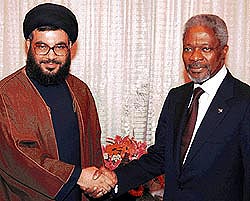
The highlight of Annan's visit to Beirut was his meeting on Tuesday with Nasrallah. June 2000
(photo: Reuters)


Technorati Tag: and and and .


Friday, July 14, 2006

Will the UN Protect Hizbollah Kidnappers--Again?

In response to Israel's reaction to Iran's twin proxies Hamas and Hizbollah infiltrating Israel to kidnap IDF soldiers, Kofi Annan is taking action: sending a team of three, led by by Vijay Nambiar--Annan's political advisor, along with UN Middle East envoys Alvaro de Soto and Terje Roed Larsen.

Nambiar and de Soto are your garden variety UN representatives, making general statements about the need for peace and humanitarian considerations and condemning violence--combined with condemnations of Israel's reactions to attacks on her citizens.

Vijay Nambiar, when he was India's Permanent Representative said in 2003:
"Israel remains oblivious of the limitations of its uni-dimensional policy based on a military approach that relies on the might of its forces without recourse to a concomitant political approach. Its policy of military blockades, curfews and restrictions perpetuate continued dislocation of normal life, economic deprivation and loss of freedom and further demoralisation of the Palestinian people," Mr. Nambiar said.

"This has led, inevitably, to continuing acts of violence and retribution against Israeli forces and civilians," he said.
Commitment to the Oslo and the Roadmap, return of territory, and allowing Arafat to establish the PA don't count. Palestinian attacks are inevitable reactions to Israeli action. Apparently, if there is a cycle of violence--Israel started it. Of course, that was when Nambiar was India's representative to the UN.

Meanwhile, in connection to the Hamas kidnapping, De Soto said:
Señor de Soto called on Corporal Shalit’s kidnappers to release him as soon as possible, saying: “It does not serve any Palestinian interest to continue to hold this hostage.” However, he said that the UN was “very alarmed at the situation, particularly the humanitarian one”. He reminded Israel of its obligations under international law not to punish civilians and to ensure that it did not react with undue harshness.
According to de Soto, Israel is guilty of breaking international law--the Palestinians are guilty of not being pragmatic

And then there is Mr. Larsen, who bought the lie about Jenin, a lie exposed by the Palestinians as well.

His name also comes up in connection with another Hizbollah kidnapping:
On October 7, 2000, Hezbollah forces illegally crossed the Israeli border with Lebanon through a UN patrolled area and kidnapped three Israel Defense Force soldiers, Adi Avitan, Binyamin Avraham, and Omar Souad. UNIFIL peacekeepers videotaped the incident; however, the United Nations denied possessing any such videotape for almost nine months. On July 6, 2001, The UN admitted, contrary to their earlier denials, that they had possession of the tape as of 18 hours after the incident occurred.
About that UN denial:
Israeli Defense Minister Binyamin Ben-Eliezer demanded that the tape be handed over to Israeli officials. He complained that UN Special Envoy to the Middle East Terje Larsen had denied the existence of the tape as recently as late June. "Since the kidnapping we have claimed all the time that there is a videotape in the hands of a UN peacekeeper. We asked for it many times. Unfortunately they said no, and no, and no," he said. Some Israeli officials have hinted that UNIFIL unwittingly played a role in the kidnapping. UN Spokesman Fred Eckhard has categorically denied this.
Events played out like this:

October 7, 2000: Hizbollah kidnapping

Seven hours after the kidnapping, UNIFIL officers find Hizbullah's getaway cars. They find and catalogue 53 items in the cars, including fake UN flags, stickers and UNIFIL license plates. The amount of blood in the vehicles indicates that the occupants "may have been badly injured and may succumb to their injuries."-- but Athmanathan's assessment is not communicated to senior UN or Israeli officials.

October 8, 2001: An Indian UNIFIL officer films the vehicles' recovery, during which armed Hizbullah terrorists detain the convoy and demand the vehicles at gun-point. The UNIFIL Force Commander turns the vehicle over to Hizbullah "to avoid confrontation and because they were not United Nations property."

July 6, 2001: UN finally admits to having the tape, but won't turn it over because they must remain neutral.

Kofi Anan calls for an internal investigation following indications that UNIFIL had hidden the existence of the tape from Israel and senior UN officials for months and the UN "did not deliberately mislead the Israeli government."


July 15, 2001: A third video clip that "purports to show still photographs of Hizbullah fighters during the abduction itself" is shown on Lebanese TV.

July 16, 2001: According to the UN internal investigation:
General Athmanathan informed Mr. Guéhenno that, on 11 July, UNIFIL had learned of the existence of another videotape (hereafter referred to the Shebaa tape). This videotape, which did not indicate any time or date, nor the identity of the person filming, showed the shelling of IDF posts on 7 October, three to four kilometres from the abduction site, as well as activity in a UNIFIL shelter. The footage on this videotape is of the bombardment of Israeli positions along the Blue Line, and shows smoke that could be of the burning Israeli jeep. It appeared to be filmed from several locations, including from in or near a United Nations observation post and shelter.
The video was not of the kidnapping itself.

July 30, 2001:
US Congress adopts resolution 411-4 for UN to release video

August 2, 2001: The UN releases the results of its investigation. Read report here.

UN admits "serious errors of judgement were made, in particular, by those who failed to convey information to the Israelis, which would have been helpful in an assessment of the condition of the three abducted soldiers." But:
Rather than giving the tape directly to Israel, though, the UN decided place sharp restrictions on when and how Israel could view the tape, allowing Israeli officials to view the tape only three times, at neutral sites in Geneva and Austria. The UN also refused to turn over the aforementioned items, which were bloodstained personal belongings of the IDF soldiers and UN officials fervently denied the existence of a third tape, a tape that many Israeli officials claim may have offered the most direct and useful information.
According to the Jerusalem Post:
Israel Ambassador to the UN Yehuda Lancry announced that Israel had accepted the UN's offer to view an edited version of the video [of the recovery], in which the faces of Hizbullah terrorists who may have been involved in the kidnapping are obscured.
According to Palestine Facts:
Only heavily edited versions were eventually turned over to Israel, indicating a cover-up was still operating in the matter, probably to protect UNIFIL personnel who were involved or who were negligent in their duties. An Indian member of UNIFIL gave an interview to an Israeli newspaper in which he said that four Indian members of UNIFIL helped Hezbollah carry out the abduction.
November 1, 2001: Israeli army rabbi Israel Weiss pronounces the soldiers dead.
Their remains have yet to be recovered.

Among the conclusions of the internal investigation:
The videotape of 8 October was the catalyst for this investigation. There is nothing in the Indian Battalion videotape that justified its release to any party on elementary considerations of humanity. The investigation team uncovered the existence of another tape that, despite the fact that it was taped on 7 October, and the fact that it was filmed in a nearby location, also contains no information that bears on the well-being of the soldiers. The Force Commander's initial assessment and subsequent assessments by other senior officials has not varied: neither the tape nor the photographs contain any information that relates to the well-being of the soldiers. The investigation team concludes that at no time was videotape or other photographic material relevant to the condition of the soldiers withheld.
Apparently the sole justification for handing over the tape is whether it indicates the condition of the kidnap victims. The possibility that revealing the identity of Hizbollah kidnappers could lead to the rescue of the hostages is not a consideration.

There remain loose ends aside from the negligent handling of the situation by the UN from the beginning. Even if it is true that UNIFIL hid facts from UN officials, the implications of the sloppiness of how the whole affair was mis-handled go all the way to the top.

So when the UN comes to town, there will be--as always--low expectations.

Check out David Kopel at the Volokh Conspiracy who has lots more--including information on eye-witness testimony by a member of UNIFIL that UNIFIL was there during the kidnapping and could have prevented it; also information on how Hizbollah has been bribing UNIFIL officials.

Also see Soccer Dad, who puts this in context with the death of UN observers on Tuesday.

Crossposted at Israpundit

Technorati Tag: and and and and .

Monday, June 26, 2006

Real Freedom Fighters Don't Use WMD

At least that's how it use to be. But now, the media whitewashes Palestinian terrorists when they use suicide belts and fire Kassams and now Katyushas. What's more--Al Aksa is now claiming to have WMD: chemical and biological weapons, and who in the media is reporting it so far?
Reliapundit was on the story early and sees this claim, following on the heels of the kidnapping of an IDF soldier, Corporal Gilad Shalit, as an attempt--backed by Iran--to provoke war and divert attention from Iraq and Afghanistan on the one hand and Iran's nuclear program on the other.

According to Haaretz, Israel is asking Kofi Annan and Secretary of State Rice to apply pressure on Abbas to secure Shalit's release, the idea being that the abduction is a test of Abbas' leadership and he should stay in Gaza to see that the crisis is resolved.

Even if Abbas is able to pull this off, that still leaves the WMD claim. What are the chances that the West will then expect Israel to sit still with such a threat, even unverified, on its doorstep and rely once again on negotiations.

Captain's Quarters makes two interesting points:

1. Either Al Aksa is bluffing--big mistake, or they really have the weapons--in which case "they have just signed the death warrants of both Hamas and Fatah and quite possibly the Palestinian Authority," the idea being that faced with real Genocide, Israel has no option but to defend herself to the full extent possible. In such a case, according to the Captain, even the West will not stand in Israel's way.

2. According to Al Aksa, these weapons were 3 years in the making. Since they do not have the wherewithal to manufacture this stuff, it must have been acquired. That would point to Syria, rumored to having acquired stockpiles of WMD from Iraq prior to the American invasion. In that case:
The Palestinians have just tipped us off to where the WMD went, and now we know where at least some it may have ended up. The Israelis may not be alone in marching through Gaza and the West Bank.
A Blog For All notes that the various International Laws the Palestinian terrorists have broken don't seem to matter to them very much. Of course, for that matter, no one in the West seems to be making much of that point either--though Justice Minister Ramon's comments this past Thursday come to mind.

A different reaction comes from Riehl World View:
I wouldn't be surprised if the group claims this isn't their doing and it's actually an Israeli intelligence operation meant to justify any possible incursion into Gaza. In any event, I fail to see the wisdom in announcing one has such weaponry if you haven't or aren't intending to use it. It doesn't make sense.
Back in December 2003, in an article for Frontpage, Emanuel Winston wrote about the various possible consequences of the establishment of a Palestinian Arab state on the other side of the Security Fence:
6. WMD, Weapons of Mass Destruction. Since the territory abandoned by Sharon will now be free of Israelis patrols or the IDF's snap raids, the Arab Palestinians can import WMD - including NBC (Nuclear, Biological and Chemical). Hezb-Allah, Al Qaeda, PFLP, PLO, Tanzim, Al Aksa Brigades, Hamas, et al will have no problem in acquiring NBC - WMD (Weapons of Mass Death) from Iran and Syria which would easily pass into Arab Palestinian hands - and may already have. Israeli intelligence definitely knows that of the 10,000 missiles on the Lebanese border in the zone abandoned by Barak, a substantial number have chemical warheads.
Didn't take long. The Palestinians don't even have a state yet and not only have they been recognized by the Red Cross, they also now claim to have the ability to destroy life en masse as well.

See also Jerusalem Post: Al-Aksa claims biological, chemical capabilities

Technorati Tag: and and and and

Tuesday, June 20, 2006

More On Gaza Beach

On June 16, there was a request for a UN probe:
UN observer in Palestine, Riyadh Mansour, submitted a request to UN Secretary General, Kofi Annan, to order an international probe in the circumstances linked to the massacre of seven Palestinian family members on a Gaza beach last week.

It is to be noted that member states in the Arab League, Organisation of Islamic Conference (OIC) and Non-aligned Movement (NAM) supported the Palestinian demand. Annan promised me to study the demand which needs Israeli approval, Mansour said, adding that he asked the Israeli leadership to forward an exhaustive report to the UN on the Gaza beach incident. [emphasis added]
The OIC reaction is an interesting contrast to the complete failure of the OIC to respond to their fellow Moslems when Russia invaded Afghanistan in 1979:

According to Bernard Lewis, in The Crisis of Islam:
Two member states, South Yemen and Syria, boycotted the meeting; Libya's delegate delivered a violent attack on the USA, while the representative of the PLO, a full member of the OIC, abstained from voting on the anti-Soviet resolution and submitted his reservations in writing.

...But it was left to the United States to organize, with some success, an Islamic counterattack to Soviet imperialism in Afghanistan. The OIC did little to help the Afghans...[p 91-92]
The Arab League, for its part, failed to condemn the Sudanese government’s policies in Darfur at their summit meeting in Khartoum in March 28-29 this year. I don't know anything about NAM.

Anyway, when Olmert rejected any international inquiry on Sunday into the incident, he was responding to the UN.

This is just as well, considering for example what happened when Israel agreed to let the Hague look into legality of the Security Fence:
Buried deep in the text of its opinion is a bombshell that purports to radically rewrite the rules of international law governing the inherent right of states to defend themselves and their citizens.

The ICJ recognises that this right is enshrined in Article 51 of the UN Charter. But the ICJ then says that this right is limited to self-defence in the case of armed attack "by one state against another state". That limitation does not appear anywhere in the text of Article 51 itself. Article 51 recognises that states have an inherent right of self-defence "if an armed attack occurs". It does not say that the armed attack must have been carried out by, or be attributable to, another state. [emphasis added]

This would impact the fight against international terrorism as well as affecting Israel's options if the PA claims (as it does) that it has no control over the terrorist attacks being launched against Israel. I don't know how much weight this decision by the ICJ actually has.

Who knows what kind of damage the UN could cause Israel if it was placed in a position of authority over Israeli actions.

Meanwhile, it is being reported that Israeli intelligence believes that Hamas increased tensions in the area--even before the Gaza beach incident--in order to head of Abbas' referendum. Apparently, someone forgot to tell Hamas that the referendum really has nothing to do with peace and recognition of Israel. According to the same article, Hamas may also intend to prevent Olmert from carrying out his Convergence Plan--whatever form it may take--but if it is carried out, then Hamas can again take credit.

Also, the Telegraph is reporting on the repurcussions of the shrapnel being recovered from the bodies of Palestinians Arab bodies. The difference is that they are reporting that the shrapnel recovered by Palestinian doctors shows it came from the Israelis, according to Marc Garlasco's examination. Look's like that will offset Israel's discovery that the shrapnel they recovered indicated it did not come from Israeli ordnance, the points raised by the German newspaper Sued Deutsche.

See also: Hurray For Pallywood--At Gaza Beach (June 19)
See also: Human Rights Watch / Garlasco Admit Israel Not Responsible (Updated) (June 20)
See also: Will Israel Go To The Videotape? (June 26)

Crossposted at Israpundit

Technorati Tag: and and and .

Friday, May 19, 2006

Report About Iranian Yellow Badge May Be Incorrect

The report about Iran instituting a special badges for non-Muslims may be incorrect (hat tip historymike's musings)
Iran report of Holocaust-style badges questioned
2006-05-19 09:06:12

The National Post is sending shockwaves across the country this morning with a report that Iran's Parliament has passed a law requiring mandatory Holocaust style badges to identify Jews and Christians.
But independent reporter Meir Javdanfar, an Israeli Middle East expert who was born and raised in Tehran, says the report is false.
"It's absolutely factually incorrect," he told The New 940 Montreal.

"Nowhere in the law is there any talk of Jews and Christians having to wear different colours. I've checked it with sources both inside Iran and outside."

"The Iranian people would never stand for it. The Iranian government wouldn't be stupid enough to do it."

Political commentator and 940 Montreal host Beryl Waysman says the report is true, that the law was passed two years ago.

"Jews should wear yellow strips, Christians red strips, because according to the Iranian mullahs, if a Mulsim shakes hands with a non-Muslim he becomes unclean."
Meanwhile, another report on the authenticity of the story comes from Amir Taheri, an Iranian author of ten books on the Middle East and Islam:

While the Iranian economy appears to be heading for recession, one sector may have some reason for optimism. That sector is the garment industry and the reason for hopefulness is a law passed by the Islamic Majlis (parliament) on Monday.

The law mandates the government to make sure that all Iranians wear "standard Islamic garments" designed to remove ethnic and class distinctions reflected in clothing, and to eliminate "the influence of the infidel" on the way Iranians, especially, the young dress. It also envisages separate dress codes for religious minorities, Christians, Jews and Zoroastrians, who will have to adopt distinct colour schemes to make them identifiable in public. The new codes would enable Muslims to easily recognize non-Muslims so that they can avoid shaking hands with them by mistake, and thus becoming najis (unclean).

The new law, drafted during the presidency of Muhammad Khatami in 2004, had been blocked within the Majlis. That blockage, however, has been removed under pressure from Khatami's successor, President Mahmoud Ahmadinejad.

AllahPundit discusses the back and forth of the story--he thinks it's true based on Taheri's credentials--at Hot Air.

Update 5/20:
The
source for the latest on the story and how it is playing out continues to be Allahpundit at Hot Air.
Among the repurcussions of the apparently erroneous report:
Technorati Tag: and and and and .

Sunday, April 09, 2006

Where Can I Get My Hamas Decoder Ring?

At least for now, it looks like good news: the EU is going to follow in the footsteps of the US and Canada in withholding funds from Hamas. According to Reuters:
The European Commission said on Friday it had halted aid payments to the Hamas-led Palestinian government because the new cabinet had not recognized
Israel's right to exist or renounced violence.
Meanwhile, according to The Irish Examiner Hamas has supposedly reacted to the threat--and follow-through--of the slashed funding and is willing to rethink its stand on Israel:
While Hamas condemned the EU move, one senior Hamas leader said the group is ready for a "two-state" solution with Israel, a softening in Hamas' position that would imply recognition of the Jewish state. [emphasis added]
So readiness for a two-state solution means that Hamas is ready to change it's charter and actually recognize Israel?

The Reuters/Yahoo article is even more optimistic:
Zahar has twice this week appeared to float trial balloons by talking of a "two-state solution," code for co-existence with Israel, in a letter to U.N. Secretary-General Kofi Annan, later half-denied, and an interview with the London daily The Times. [emphasis added]
So, according to Reuters, readiness for a "two-state solution" (why do they keep putting that in quotes anyway?) is code not only for recognition of Israel, but co-existence as well.

Not that what a terrorist group says really means anything, but what did Hamas say, anywa?.

According to YnetNews.com, here it is:
“We wish, like all nations of the world, to live in freedom and security, and that our people will be able to enjoy peace and independence, side by side with our neighbors in this holy part of the world,” Zahar wrote to Annan.
Even if one were to assume that Hamas words of peace would be backed up with concrete action--where is there any mention of Israel at all?

Gee, where can I get my Hamas decoder ring?

Funny thing though is that already on April 5th, there was already coverage that Hamas was denying any reconciliation with Israel:
Palestinian Foreign Minister and senior Hamas leader Mahmoud al-Zahar on Wednesday denied referring to a two-state solution to the Middle East conflict, wording that might have hinted at Israel's right to exist.

A senior Palestinian diplomat at the United Nations said on Tuesday that Zahar had made the reference in a letter he sent to U.N. Secretary-General Kofi Annan this week.

"Such a sentence was not used in the letter," Zahar told Reuters. A copy of the letter seen by Reuters also showed no mention of a two-state solution. [emphasis added]
Mmmmmm...Looks like Reuters doesn't have the decoder ring either. I guess their old decoder ring doesn't work for Hamas. You know, the decoder ring where "terrorist" really means "freedom fighter" and "disputed territory" really means "occupied territory".

But wait--it looks like Hamas is having trouble with the code too:
In an interview with Britain's Times newspaper published on Friday, Palestinian Foreign Minister Mahmoud al-Zahar, a senior Hamas leader, said the group was prepared to discuss what was meant by a two-state solution.
Hmmm. Which word is difficult for Hamas--two? state? or solution?

Doesn't anybody out there have a decoder ring?

See also Soccer Dad on this topic.

Crossposted at Israpundit

Technorati Tag: and and and and .

Tuesday, January 31, 2006

Pass the Bill--Not the Buck

Instead of passing the buck and requiring Israel to make concessions to strengthen the PA, maybe the US is seeing the light. That's the hope with a new bill being pushed in Congress, reported by the New York Sun (Congress Racing to Isolate a Hamas Regime):
Congress is moving quickly in the face of Hamas's victory in the Palestinian elections to slash American funding for the Palestinian Authority and the United Nations and ensure that America moves to isolate the new regime.

Rep. Ileana Ros-Lehtinen, a Republican of Florida, will introduce House legislation this week to slash American funding to the Palestinian Authority and the United Nations; designate the Palestinian Authority as a "terrorist sanctuary," and close down some Palestinian Authority offices in America as part of a reduction of Palestinian-American diplomatic ties.

The bill would be the first official move in Washington toward cutting funding to the Hamas-controlled Palestinian Authority, as concern about the terrorist organization's electoral victory has prompted increasingly vocal calls on Capitol Hill to stop aid to the Palestinian Arabs.

The bill is expected to be introduced tomorrow when the House reconvenes for President Bush's State of the Union address, and will start in the House International Relations Committee. Ms. Ros-Lehtinen is chairwoman of the committee's Subcommittee on the Middle East and Central Asia, which has congressional jurisdiction over the Palestinian Authority.

Ms. Ros-Lehtinen is on record as supporting Israel in general and the moving of the US embassy to Jerusalem

Whether such a bill would actual be passed in whole or in part is another question. But when you read about what it entails, it really is a thing of beauty:
According to senior congressional staff familiar with the legislation, Ms. Ros-Lehtinen's bill is a comprehensive crackdown on American aid to and interactions with a terrorist-controlled Palestinian Authority or Palestinian Legislative Council. The bill would "prohibit direct assistance to the PA, the PLC, municipalities, and other constituent elements that are 'governed' by individuals associated with Hamas or other terrorist entities," according to a "Dear Colleague" letter obtained by The New York Sun that will begin circulating in Congress today as an invitation to potential co-sponsors. America is contributing about $150 million in aid to the Palestinian government this year.

The legislation would also "audit all committees, offices, and commissions focused on the Palestinian agenda at the United Nations and recommend for their elimination," according to the letter. Ms. Ros-Lehtinen's bill would slash American U.N. contributions proportional to the amount spent by the United Nations on aid to Palestinian Arabs, and on Palestinian Authority-related programs. The Sun reported last week that the U.N. spends about $3.5 million a year on such activities; America shoulders about 22% of the U.N.'s operating costs.

Requests for comment yesterday from the United Nations about the proposed funding cut were not responded to immediately.

According to staff, the House legislation also would reduce America's ties to and interactions with a Hamasled Palestinian Authority, in order both to signal America's unwillingness to deal with terrorists and to protect America from possible terrorist activity conducted under the guise of official Palestinian Authority business here.

The bill would, for example, prohibit the State Department from issuing visas to all members or agents of foreign terrorist organizations, eliminating loopholes that might allow Hamas leaders to enter America to conduct diplomatic business as elected officials. The bill also would call for a reduction in America's diplomatic ties with the Palestinian Authority, and call for its diplomatic offices in Washington to be shut down, urging that American diplomatic business be conducted either in the Palestinian territories or through the Palestinian U.N. mission in New York.

According to Ynet.com:

Should the bill pass, it will enable the U.S. to place the Palestinians on a list of terror-supporting countries, resulting in severe sanctions on trade with the PA and the transfer of funds to it.

...The new bill is also supposed to demand the closing down of consulates and a reduction of diplomatic contacts with the Palestinians, and will also prevent the entry of Hamas leaders into the United States.

According to current laws, the U.S. cannot directly transfer funds to the PA without a signature by the president for reasons of "American national security."

No matter how good it sounds, or how much support, the bill might do no better than a bill languishing in Congress to apply pressure on Iran:

The House version of the Iran Freedom Support Act, introduced January 6, 2005, by Rep. Ileana Ros-Lehtinen, a Republican of Florida, now has 333 cosponsors - almost 77% of the House. The Senate companion bill, introduced February 9, 2005, by Senator Santorum, a Republican of Pennsylvania, has 42 bipartisan co-sponsors, or almost half the Senate. Neither Senator Clinton nor Senator Schumer, both Democrats of New York, has signed on to the bill.

Despite the overwhelming bicameral support, however, neither bill has progressed further in the legislative process. In the House, the legislation has been stalled under the International Relations Committee, chaired by Rep. Henry Hyde, a Republican of Illinois. The Senate bill has not been taken up by the Foreign Relations Committee, chaired by Senator Lugar, a Republican of Indiana. The delay is prompting outrage in a restive House, where Rep. Shelley Berkley, a Democrat of Nevada and a member of the International Relations Committee, has circulated a letter among the committee pressing Mr. Hyde to move on the bill.

The article in the Sun notes:

Yet Mr. Weiner [Rep. Anthony Weiner (D) of New York] cautioned that while support for cutting funding to the Palestinian Authority is high on Capitol Hill, it is uncertain whether the authority to slash diplomatic aid and ties rest with Congress as part of its power of the purse, or with the White House as part of the executive's power to set foreign policy."

At the end of the day, the State Department has to come around on this stuff," Mr. Weiner said. The congressman added that he has begun circulating a letter to Mr. Bush requesting that his budget proposal next month exclude any funding for the Palestinian Authority.

Speaking of the State Department, Secretary of State Rice had an interview with Reuters this past Friday:

In an interview with Reuters late on Thursday, Secretary of State Condoleezza Rice said the United States would not give direct assistance to Hamas. When asked whether this meant humanitarian aid would stop too, she declined to speculate.

In any case, the bill goes far beyond what is coming out of the Quartet as a whole. According to Threatwatch.org:

Referred to as ‘The Quartet’, the EU, UN, Russia and the United States seemed to speak with one voice from London, saying that any funding from them would be “reviewed by donors against that government’s commitment to the principles of non-violence, recognition of Israel and the acceptance of previous agreements and obligations.” That this much was managed in unison is notable, but it should also be recognized that absent was any direct language that stated funding will not flow, merely that it will be ‘reviewed’, which leaves plenty of room for nuance, debate and deviation once the spotlight and the momentum and velocity of widespread public opinion have abated.

The CNN article linked to in the above paragraph starts off...

The international community is willing to provide crucial aid to Palestinians if the new Hamas-led government commits to non-violence, recognizes Israel's right to exist and accepts current Mideast peace agreements, U.N. Secretary General Kofi Annan has said.
...so we already know what to expect from the EU, UN, and Russia once the requisite righteous indignation wears off.

Bottom line, a lot is going to depend on how the bill looks when it is finished being formulated and the cries of "National Security!" are dealt with. We will have to see how much of the original intent remains.


Crossposted at Israpundit

Technorati Tag: and .

Tuesday, December 13, 2005

Kofi Annan "Believes It Was Regretful"

Eye on the UN has coverage of "UN Day of Solidarity with the Palestinian People" back on November 29, 2005--the anniversary of the date in which the U.N. General Assembly voted in favor of the resolution that adopted the plan for the partition of Palestine in 1947.

This year the day was more 'provocative' than usual. Eye on the UN has photos of a map, standing between the Palestinian and UN flags. The map was displayed:
in the presence of all top three UN officials, the Secretary General, and the Presidents of the UN Security Council and the General Assembly. It purports to be a "map of Palestine." Israel, a UN member state for 56 years, is not on the map. Even the UN General Assembly partition lines of November 29, 1947 marking a Jewish and Arab state, which pre-date this 1948 map, do not appear.
And what would a commemoration be without a few words from Kofi Annan:
Secretary-General Kofi Annan addresses the public meeting at UN Headquarters. The anniversary of the UN partition vote that survivors of the concentration camps celebrated, has been described by Secretary-General Annan as "a day of mourning and a day of grief." Palestinians, and Arab citizens more generally, refer to it as part of "Al-Nakba," meaning the "catastrophe" of the creation of the state of Israel.
But that does not begin to compare with what can only be described as a true UN Moment:
In a moment which has been crafted to include the commemoration of suicide-bombers (from left to right) Nasser Al-Kidwa, Foreign Minister of the Palestinian Authority, President of the UN Security Council Andrey Denisov, President of the UN General Assembly Jan Eliasson, Chairman of the Committee on the Exercise of the Inalienable Rights of the Palestinian People Paul Badji, UN Secretary General Kofi Annan, (and two others) rise at the outset of the November 29th UN meeting with these words from the Chair. "I invite everyone present to rise and observe a minute of silence in memory of all those who have given their lives for the cause of the Palestinian people and the return of peace between Israel and Palestine."
Now there's a well-crafted sentence. But isn't "those who have given their lives for the cause of the Palestinian people" just a polite way of referring to terrorists? And who are "those who have given their lives for the...return of peace between Israel and Palestine"? Besides, to talk of the return of peace between Israel and Palestine implies (1) There was an entity called Palestine that existed at the same time as Israel. (2) There was peace at some point peace between Israel and this entity--an idea that makes no sense unless we are talking of the return of peace between Israel and itself.

This moment has been caught for posterity on video at the Eye on the UN website.

Setting aside the day for Palestinian Arabs and their allies to blast Israel is bad enough. For the UN to take active part is even worse. But all that the Secretary General has to say is that he is sorry about the map--sort of:
The U.N. Spokesman Stephane Dujarric told Yedioth Ahronoth on Monday that "the map that was displayed at the event is not an official U.N. map. Secretary General Annan believes it was regretful that the map was in the room during his speech. We have informed the event's organizers that such an incident should be prevented from repeating in the future."
Annan "believes it was regretful"? That phrase is so tortured that a Google search on it turns up 0 hits. He couldn't even say "Secretary General Annan regrets"? Is the spokesman so afraid of offending Palestinian sensibilities, that he had to hedge on even that?

Pathetic.

Technorati Tags: and .

Wednesday, September 21, 2005

Please Excuse the Transition

Yesterday at the United Nations, there was a meeting with the press, featuring Secretary of State Rice along with Kofi Annan and others. Here is one of the exchanges:

QUESTION: First of all, Secretary Rice, we just got the statement, but basically it said in the statement something about militias not candidates for -- armed militias not being candidates for elections. So let me put it another way. Prime Minister Sharon said last week that he will not -- that Israel will not help in -- if Hamas is part of the election. What is your view on that?

And also for the Europeans, what is there -- maybe Foreign Minister Straw. Since the EU said yesterday that it's about to, I think, 215 million Euro was the number to Gaza, what do we do to assure that money that goes into the Palestinian territories will not go into, you know, failed projects that might go to waste?

SECRETARY RICE: Before turning to my European colleague, let me just say that I think the Secretary General has said very well that there is concern that any democratic process must observe that you cannot have kind of an armed option within the democratic process. But we understand that the Palestinian political system is in transition, that it is in transition toward a democratic system, and that that has to be a Palestinian process.

We would hope that the elections can go forward and that everyone will cooperate to make those elections go forward because elections are fundamental to the continued evolution and development of the Palestinian process. That said, again, we have noted that ultimately it is the case that there is a fundamental contradiction between armed activities and the political process, armed activities that are outside the monopoly of the state on violence and the political process. And so that is a matter of principle ultimately.

We understand that this is a transition and I think everybody understands that this is a transitional process.


That's 4 times that Rice goes to the 'T' word. Considering the accumulation of arms following the Disengagement, the burning of synagogues, the failure to disarm Hamas and other terrorists, the murder of other Palestinian Arabs and the general overall corruption, I think it would be more accurate to say that what the Palestinians have on their hands it not a transition, but a mess. (The next time we have company at the house, I'll just tell them, "please excuse my daughter's room, it's in transition.")

Rice also uses the word process alot--6 times, including the impressive phrase "transitional process."

Rice seems to be going to great pains to push the idea that this is going to take a while, and that we should ignore the man behind the Kassam rocket. But the problem is that we are not in occupied Gaza anymore. This is land that is under the 'control' of the Palestinian Arabs, though at times it's difficult to tell which ones. It's time to start demanding some kind of accountability.

But it would be refreshing if the coddling would stop and someone would put their foot down. After all it was only last week that Bush was supposed to have indicated to Sharon that there will be no further steps in the diplomatic process if Gaza is not quiet. And Rice was supposedly at that meeting. Which may explain why rather than stick to the implications of Bush's words to Sharon, Rice comes out with:

I believe the Quartet's assessment of the Gaza withdrawal is that, in fact, it has been a successful withdrawal, that it demonstrated that the Israelis and the Palestinians can work together in the most detailed circumstances, in the most difficult circumstances. I think there has been excellent security coordination and cooperation that allowed the withdrawal to take place peacefully and effectively.

Our task now is to build on the momentum of that withdrawal to help the Palestinians create in Gaza a model for a Palestinian Authority that can indeed govern. And the international community is very actively involved in that. We talked today about security reform and the Ward mission that has been trying to improve the capabilities of the Palestinian security forces.

Yup, there she again talking about that momentum thing again. But from the way she describes it, you'd think there must have been a second disengagement going on that the rest of us weren't aware of.

More and more, it appears that Bush's Middle East policy is one big...transition.

Technorati Tag: .

Thursday, August 18, 2005

Is Disengagement The Answer?

Dr. Alex Grobman

That Jews need to be “disengaged” from the Arabs is not a new idea. In July 1937 the British issued the Palestine Royal Peel Commission that concluded: “An irrepressible conflict has arisen between two national communities within the narrow bounds of one small country. There is no common ground between them. Their national aspirations are incompatible. The Arabs desire to revive the traditions of the Arab golden age. The Jews desire to show what they can achieve when restored to the land in which the Jewish nation was born. Neither of the two national ideals permits of combination in the service of a single State.”

Expelling Jews from their homes in any part of Israel or in the disputed territories will not solve the Arab/Israeli conflict. How do we know? The Arabs have been quite explicit in explaining why the conflict persists. PLO spokesman Bassam-Abu-Sharif and other leaders claim, “The struggle with the Zionist enemy is not a matter of borders, but touches on the very existence of the Zionist entity.” In other words, it does not matter whether Israel retreats to her 1967 borders, those mandated by the UN in 1948 or the 1949 cease fire lines. As long as the Jewish State exists, the Arabs are determined to bring about her demise.

Deporting Jews from their homes is also illegal. Writing in The New Republic on October 21, 1991, Professor Eugene V. Rostow made this clear when he declared, “[UN] Resolution 242, which as undersecretary of state for political affairs between 1966 and 1969 I helped produce, calls on the parties to make peace and allows Israel to administer the territories it occupied in 1967 until ‘a just and lasting peace in the Middle East’ is achieved. When such a peace is made, Israel is required to withdraw its armed forces ‘from territories’ it occupied during the Six-Day War--not from ‘the’ territories nor from ‘all’ the territories, but from some of the territories, which included the Sinai Desert, the West Bank, the Golan Heights, East Jerusalem, and the Gaza Strip.”

In another essay in which he investigates the Arab claim for self-determination based on law, Professor Rostow concludes, “the [British] mandate implicitly denies Arab claims to national political rights in the area in favor of the Jews; the mandated territory was in effect reserved to the Jewish people for their self- determination and political development, in acknowledgment of the historic connection of the Jewish people to the land. Lord Curzon, who was then the British Foreign Minister, made this reading of the mandate explicit. There remains simply the theory that the Arab inhabitants of the West Bank and the Gaza Strip have an inherent ‘natural law’ claim to the area.”

“Neither customary international law nor the United Nations Charter acknowledges that every group of people claiming to be a nation has the right to a state of its own. International law rests on the altogether different principle.”

In the absence of a peace agreement, how can one legally or morally justify forcing Jews to leave their homes? What did the Jews do to warrant this treatment? They were encouraged by Israeli administrations to establish residences and business in the area. Isn’t expulsion penalizing the victim, while rewarding the aggressor? And when peace negotiations do begin, wouldn’t it be better to have a presence in the area as a bargaining chip?

Another concern must be that expulsion clearly demonstrates that the Arab Intifada was not fought in vain. If the Israelis retreat under fire as they did in south Lebanon, the Arabs will once again see that terrorism is the most effective means to ensure acknowledgment for themselves, their goals, and to achieve their objectives. According to a joint Israeli-Palestinian Public Opinion Poll in June 2005 conducted by The Palestinian Center for Policy and Survey Research (PSR) in Ramallah and the Harry S. Truman Research Institute for the Advancement of Peace at the Hebrew University of Jerusalem, 45% of the Israelis and 72% of the Palestinians believe that Ariel Sharon's decision to remove Israeli settlements from Gaza is a triumph for the Palestinian armed struggle against Israel, compared to 52% among Israelis and 26% among Palestinians.
Furthermore, 51% of the Israelis and 66% of the Palestinians believe that the Intifada and armed confrontation has helped Palestinians achieve national and political objectives that negotiations could not have achieved. Israeli settlers share these perceptions with the Palestinians. 72% of the settlers think the disengagement is a victory for the Palestinians and 77% believe the Intifada has helped them achieve political goals.

As to the long term possibility for a political solution to the Israel/ Palestinian conflict, 46% of the Palestinians and 36% of the Israelis believe that there never will be a political settlement, 29% of the Palestinians and 31% of the Israelis think that this goal can only be realized either in future generations or in the next generation, 19% of the Palestinians and 27% of the Israelis expect it will be achieved in the next decade or within the next few years.

In a recent interview, former Israeli Prime Minister Ehud Barak, who presided over the retreat from south Lebanon and the failed Camp David 2000 Summit, said that Sharon surrendered to terror after realizing that his attempts to curb the violence had failed. Barak believes that the disengagement policy is flawed because even after the Israelis evacuate their armed forces and civilians from Gaza, international law dictates that Israel will be held accountable for everything that occurs there.

Barak further claims that president George Bush did not promise Sharon that Israelis will be allowed to remain in Gush Etzion, Givat Zev, Ariel, and Maaleh Adumim. Israel will not be allowed to remain in this as a reward for leaving Gaza. Behind closed doors, Barak says, Americans will tell you that this in not true. “The public is being deceived,” he asserts. Why? Because “Sharon is not strong enough to tell the Israeli public the truth.” Sharon and Israeli defense minister Shaul Mofaz have replaced the former Mossad chief, the head of the security service, IDF Chief of Staff, and the National Security Advisor, and appointed people who support disengagement.

Sharon is not being honest about the security fence either, according to Barak. The communities behind the fence will be abandoned. Several areas of the fence have been left open allowing terrorists access to Hadera, Afula, Be'er Sheva and Tel Aviv. Sharon has also lost the city of Ariel, and soon Maaleh Adumim.

Equally disturbing is the admission by Moshe Ya’alon, former Israel Defense Forces (IDF) Chief of Staff that the IDF did not participate in most of the discussions that formulated the expulsion plan. Only after the Americans and Egyptians were informed of the arrangement did he learn about it.

After his recent meeting with U.S. Secretary of State Condoleeza Rice, Sharon once again called upon the Arabs to adhere to their agreement to stop the terrorism, violence and provocation, dismantle the terrorist organizations, collect their weapons and carry out organizational changes as a prerequisite to resuming the diplomatic process. Unless the threats are backed up with action, the Arabs will be even more encouraged to continue flaunting their agreements, if there are no consequences.

Another problem not openly discussed is that once Jews have been transferred out of the area, other Jewish communities will be exposed to Qassam rocket fire and terrorist infiltration. In January of this year, Colonel Uzi Buchbinder, head of the Home Front Command's civil defense department, warned that 46 western Negev communities would be within range of enemy rockets and terrorist attacks after the retreat.

That the Arabs will not be swayed in any way by Israeli withdrawal should not come as a surprise. As political scientist Shlomo Avineri observes, the Arabs see themselves as the only “legitimate repository of national self-determination” in the region. They do not accept that national groups in the Middle East have the same right to self-determination that they have properly demanded for themselves. This exclusivity “borders on political racism,” and should not be tolerated in the Middle East any more than it is Europe.”

A few examples he points out will illustrate the problems Arabs have with minorities. The Kurds have a different language, culture and customs than the Arabs, and the Iraqi and Syrian governments (and the non-Arab Muslims in Turkey and the Persians in Iran) have oppressed them for decades. Yet no Arabs have ever asked that the Kurds be given the right to self-determination. In 2005, when the international community supports the establishment of a state for the Palestinian people, no Arab moderate or academic has requested comparable rights for the Kurds.

The Berbers in Algeria and the Christian Maronites in Lebanon are similar situations, he continues. The Darfur region of Sudan can be added to this group. Arab militias, with the support of the Arab dominated government in Khartoum, have committed what UN Secretary General Kofi Annan has called “ethnic cleansing” against the indigenous black population. The refusal by the Sharon government to explain adequately the reasons for giving up land and transferring Jews in response to repeated terror attacks against its citizens, the failure to engage the Israeli public and politicians in an open dialogue about the implications of this policy, and its unfortunate success at fomenting distrust, alienation and hatred among various segments of the population does immeasurable damage to the Jewish people and weakens the Israeli and the American war on terrorism.

Before Israel “disengages,” there should be legal and moral justifications for uprooting Jews who have not violated any Israeli or international statue. When the Arabs are willing to accept the existence of the Jewish State and live in peace with her, then negotiations about future borders should be discussed. As long the Arabs want to destroy Israel, concessions only convince them that terrorism, rather than negotiation, is the best method to achieve their goal.

It appears that we have not progressed much since 1994, when Aharon Megged, the respected writer and supporter of the Labor Party, complained: “Since the Six Day War, and at an increasing pace, we have witnessed a phenomenon which probably has no parallel in history: an emotional and moral identification by the majority of Israel's intelligentsia with people openly committed to our annihilation." He also saw a trend by them “to regard religious, cultural, and emotional affinity to the land...with sheer contempt.” “You make peace with your enemies,” they incessantly proclaim, yet as Professor Edward Alexander observed, “it is clear that they can far sooner make peace with enemies wearing keffiyehs than with enemies wearing yarmulkes and tefillin.”

Dr. Grobman’s most recent book is Battling for Souls: The Vaad Hatzala Rescue Committee in Post War Europe [KTAV]. He is also co-author of Denying History: Who Says The Holocaust Never Happened? (University of California Press, 2000) His next book Zionism=Racism: The New War Against The Jews will be published in 2005.