Wednesday, August 23, 2006

Diary of Rabbi Avi Weiss' Return Trip To Israel--Following the Ceasefire

An account of Rabbi Weiss' return trip to Israel following news of the imminent ceasefire, August 13-20, 2006

Day 1: Arrival and Visiting the Family of Daniel Gomez
Day 2: Rambam Hospital, Greenberg Unveiling and Gomez Funeral
Day 3: Kiryat Shmona and Tsfat
Day 4: Maalot and Goldwasser Family in Nahariya
Day 5: A Wedding in Jerusalem
Days 6-8: Shabbat and Departure

Diary of Rabbi Avi Weiss' Trip to Israel During the War

Rabbi Weiss is the founder and Dean of Yeshivat Chovevei Torah Rabbinical School. He is also Senior Rabbi of the Hebrew Institute of Riverdale and President of AMCHA: The Coalition for Jewish Concerns.

You can email Rabbi Weiss at aweiss@yctorah.org

Technorati Tag: .


Day 1: Arrival and Visiting the Family of Daniel Gomez

Arrival; Visiting the Family of Daniel Gomez

Sunday, August 13, 2006

Since returning from Israel to New York two weeks ago I spent every day feeling drawn to go back. There was an urgent pull to be with our people in this dreadful time of war. And so, with the announcement of the imminent ceasefire and the sad knowledge that Israelis would face serious psychological trauma as they tried to get their lives back to normal, three of us associated with Yeshivat Chovevei Torah made another visit to battered northern Israel. I was accompanied by Rabbi Jason Herman, an outstanding YCT graduate now serving as rabbi of the West Side Jewish Center in Manhattan and Yonah Berman, an extraordinary YCT student who was with me through the first days of the war and remained in Israel to help out. Also in Israel was a dedicated group from our Bayit, the Hebrew Institute of Riverdale, who had come to do all they could to help in Israel’s time of need.

Stepping into the welcoming area of Ben Gurion airport I felt a sense of homecoming. Seeing my dear friend Yossi Shonfeld waiting for me lifted my heart. But as I looked into his face, I could immediately see that he was upset - there was a deep sadness in his eyes as he told me about the terrible loss in his home community of Nahalim. Daniel Gomez, a helicopter pilot and beloved son of Miriam and Patrick Gomez, the doctor of Nahalim, had been killed, leaving his wife, Sarit, who is six months pregnant. Daniel’s body had not yet been recovered.

We went directly to the home of Patrick and Miriam. Groups of friends stood in circles under the protective awning already set up in front of the Gomez’s modest home. It was as if the Gomez’s were sitting shiva before the funeral, reminding me of the way King David in effect sat shiva for his infant child before he was declared dead. I came as a total stranger sitting near Patrick, visiting a family I did not know. But we did know that we are part of the same larger family. We sat in silence much like the visitors who came to the Biblical Job. There is something elegant about Patrick, and when he did begin to speak one could sense his softness and humility and see why he is so beloved.

Slowly there appeared a fraternity of those who had experienced tragedy from this war. Among them were the parents of Benjy Hillman z”l, a senior Golani officer who was killed at the beginning of the war. They came to comfort Patrick and Miriam.

Day 1: Arrival and Visiting the Family of Daniel Gomez
Day 2: Rambam Hospital, Greenberg Unveiling and Gomez Funeral
Day 3: Kiryat Shmona and Tsfat
Day 4: Maalot and Goldwasser Family in Nahariya
Day 5: A Wedding in Jerusalem
Days 6-8: Shabbat and Departure

Diary of Rabbi Avi Weiss' Trip to Israel During the War

Technorati Tag: .


Day 2: Rambam Hospital, Greenberg Unveiling and Gomez Funeral

Rambam Hospital, Greenberg Unveiling and Gomez Funeral

Monday August 14, 2006


On Monday morning we went directly to Rambam Hospital again led by the kind and giving Dr. Jesse Lachter, who stayed with us for much of the day. At Rambam we came across Yechiel, a miluimnik (reservist) from the Golan Heights who was surrounded by a large and diverse family. Yechiel is 36 years old and could have chosen not to be involved on the front lines, yet he insisted on joining in.

In a soft whisper, Yechiel said that when he was wounded all he could think of was his little daughter. The thought of her growing up without a father gave him the strength to live. His eyes were sunken and sad. Yechiel’s emotional wounds will take longer to heal than his physical injuries.


In a nearby bed was Alon, whom we had seen two weeks earlier when he was wounded at Bint Jbail the day eight soldiers were killed. When we first saw Alon, he could not speak, but now he was able to connect and almost like a flower slowly opening up again and taking in the sun, Alon was gradually coming back to himself.

We visited the waiting room of the ER looking for the pilot who had been critically injured (the Israeli army does not allow pilots’ names to be made public). We had met his parents weeks before and they shared that for the first time he opened his eyes and recognized them. We were overwhelmed with joy when we heard that despite his critical injuries he had now been moved out of Rambam to a rehab facility. The doctors at Rambam have become experts at returning people from the jaws of death to life. There were still several dozen soldiers at Rambam, but the atmosphere was much more calm. Things were starting to get back to normal.

While at Rambam we met Uri Baruch whose daughter Sarit was murdered by terrorist Ibrahim Abayed. I’d met Uri when he visited Riverdale. Uri is devoting his life to help victims of terror with emotional and psychological rehabilitation. As we embraced in the hospital, Uri whispered that Abayed is now living openly in Rome, boasting of the way he killed Sarit.

From Haifa we made our way to Raanana for the unveiling for Mindy Greenberg, the wife of DJ Greenberg. It was heartbreaking to see Blu, Mindy’s mother-in-law, once again in mourning. Several years ago, Rabbi Yitz and Blu Greenberg had lost their son JJ, one of the great spirits of our time, and now they were mourning the loss of a daughter-in-law. As painful as the war is, life in Israel goes on and there are other tragedies like the untimely death of a vibrant woman like Mindy.

That night we returned to Nahalim for the funeral of Daniel Gomez. I have been to many funerals in Israel but none like this one. Daniel’s young wife Sarit rose and cried over and over, “I love you, Daniel. I’ll take care of our child down here, and please, you take care of him from heaven. I can feel the child churning in my womb but I can’t calm it.”

Rabbi Raffi Peretz, the Rosh Yeshiva of Atzmona where Daniel studied turned to Sarit and quoted the verse: “Ki Sarita im Elokim va-tukhal – you have fought against an adversary but have overcome.” It was surreal to see pilots, who are Israel’s symbol of its invincible army, break down in tears. One fainted as he stood in the heat of the night. Seeing them so vulnerable reflected a new reality in Israel; its army, its navy, its air force, all suffered losses. IDF’s aura of invincibility is no longer there. Perhaps this is a positive, as those who think they’re impenetrable, are the most vulnerable, and those who underestimate the enemy, as Israel did, are destined to suffer failures.

Daniel’s close friend Moshe told stories of how Daniel had landed against orders in Jenin, several years ago, to take out the wounded. He just couldn’t leave a soldier in the field. Now it was Daniel whose body had been recovered at great risk. It was Moshe who piloted the helicopter that flew Daniel’s remains out. Sobbing, Moshe related that as he flew with Daniel’s body, he instinctively wanted to radio him, to tell him what was occurring, but knew there would be no answer.

Daniel’s father Patrick offered what seemed to be apologies for not having said, “I love you” enough and not having hugged him enough. He spoke about how their love transcended words, transcended embrace. “Daniel just knew how deep our endless love for him was,” Patrick said. It seemed to me that Patrick’s words offered a hint that we should not hold back from expressing love while we can.

Coming back to the Shonfeld home was like an out of body experience. The Shonfelds are in the throes of preparing for the wedding of their daughter, Hadar to Ofer later this week. We in America have little idea of the emotional upheaval Israelis go through or of the issues confronting them in what should be a simple family simcha. When we prepare for weddings there’s an appropriate build up of excitement and happy anticipation. Here, Hadar is concerned that her brother Matan will not make it to her wedding as he is still deep in Lebanon. Hadar tells the family that if Matan doesn’t come she only wants the chupa, no party. Matan’s wife is sitting nearby with her cell phone anxiously awaiting a message from Matan that he’s OK. Ofer, the chatan, was also under pressure, having just returned from serving in the army down south. Even Yossi, Hadar’s father, who is always calm in the most difficult situations, is tense. Yossi feels deeply for Daniel, who although much younger, he had befriended. As I stood near Yossi at the funeral, I could see that he was not just present, he was, in fact, mourning himself.


This is reality in Israel today - the extreme highs and lows, the swing from moments of deep anguish to joy, from funerals to weddings and trying to switch gears and continue on. This shift is especially palpable these days, as Israel, deep in war just hours ago, was now in a ceasefire, which so far is holding. The quiet night was a stark contrast to the booms of Israeli artillery and the whooshes and hits of Hezbollah katyushas heard just days ago.

Day 1: Arrival and Visiting the Family of Daniel Gomez
Day 2: Rambam Hospital, Greenberg Unveiling and Gomez Funeral
Day 3: Kiryat Shmona and Tsfat
Day 4: Maalot and Goldwasser Family in Nahariya
Day 5: A Wedding in Jerusalem
Days 6-8: Shabbat and Departure

Diary of Rabbi Avi Weiss' Trip to Israel During the War

Technorati Tag: .

Day 3: Kiryat Shmona and Tsfat

Kiryat Shmona and Tsfat

Tuesday, August 15, 2006

Today would have been my mother’s 85th birthday. She died at 62, much too young. I wondered what she would have said about the war. I thought of the time when a group of thugs came into the summer camp my parents owned (Camp Aishel) and tried to attack some of the girls in their bunks. I tried to talk them out of it and refused to confront them. Sometimes, Imma told me, you have to stand up for your rights, and hit back.

Early morning, we traveled to Kiryat Shmona, the city hardest hit by Hezbollah rockets, having received 25% of all the Katyushas. Miraculously there were no fatalities. Just 24 hours after the ceasefire, things were slowly coming back to normal. Cars were moving; people were already rebuilding their stores.

We sat with Mayor Chaim Barbevai, around whom there had been some controversy, but he struck us as well connected with the amcha. What we learned in Kiryat Shmona is that the government supplies the funds to rebuild structures. The question is how fast that money will become available. No doubt that a tremendous amount of private funds, however, will still be needed for the social and psychological intervention required to get the city back to normal.

Kiryat Shmona was familiar to me as I had been there in 1993 for a week when there was a wave of Katyusha bombings. I spent Shabbat with Yossi Chimi who was running for mayor back then. Yossi dropped out of politics when a rocket seriously injured his wife Chani in the late 90s. Yossi owns the largest factory in Kiryat Shmona, employing 140 people. Part of the factory lies in ruins. He is savvy and smart, exuding the confidence of a company CEO. Despite the devastation and damage, Yossi intends to rebuild and continue his successful business. As we spoke, his son walked in and explained that, having just finished his army service, he was going to tour parts of South America, as many young Israelis do. “I have every intention to then come back to Kiryat Shmona, and make a difference.” “It’s not for you, it’s too limited,” replied Yossi. “No, it’s my home,” insisted the son. Here, it’s the reverse of the normal situation where parents want children to stay in the hometown and the young people can’t wait to leave.

We visited some of the poorer areas with donated toys to give out. As we walked through the streets people jumped us. “Give them to us! If you give them to the municipality to distribute, we will never see them.” There is division amongst the people here concerning the integrity of the local government.


We visited the Kiryat Shmona Hesder Yeshiva. The hills behind the yeshiva are all charred but the yeshiva itself stands untouched. The yeshiva students led by their rabbi Tzfania Drori remained throughout the war, and the Yeshiva was used as a base for IDF troops. There is a genuine feeling of gratefulness to the yeshiva for all it has done in distributing foods and offering relief to those who remained in the shelters.


On the way from Kiryat Shmona to Tsfat we encountered scores of soldiers in rows of tanks lined up along the roadside. It was eerie, as we walked from our cars towards the tanks, wondering if the soldiers would welcome or rebuff our approach. We were quickly surrounded by chayalim eager to talk. Amongst them was Amiad who told me he was a graduate of my brother Mordechai’s school in Margate, New Jersey. Mordechai and his wife Debbie are lovers of Israel. Their three youngest sons served in Tzahal. No doubt, Amiad, his student, would make him proud.


Soldier after soldier asked if there is really support in the US, do American Jews really care? Too many soldiers told us of moments when the right hand of the IDF didn’t know what the left was doing. There were reports of not enough food, no clear strategy, equipment failures. One soldier pointed out that when soldiers reached the Litani River, Hezbollah started to shoot from the other side. I’m not a military person but one gets a sense that the heroes in this war were these soldiers, not those planning strategy.

Yonah Berman, who served in an IDF tank unit before starting his rabbinic studies, crawled into one of the tanks, pulling Jason along. They gave away Pokemons and the happy soldiers attached them to their uniforms and tank barrels. I was just happy to be standing with scores of Israeli soldiers, the holiest Jews on the face of the earth.

A car came screeching to a halt and someone jumped out and yelled, “Rabbi!” It was Martin Taub from New York, father of Natalie and father in law of Davidi Jonas. He was traveling though the North with friends looking for soldiers, telling them how proud he was of them and bringing them gifts. That is what Martin does these days. Many think that there’s little individuals can do here, but people like Martin show that everyone can play a role. Words and gestures of support go a long way. From my perspective, this is not the time to intellectualize or philosophize about the war, that can come later. Now is the time to be there. I reflected on the line from Barnyard, a children’s movie Toby and I had taken our grandchildren to see. “A good leader is not the strongest or the smartest, but the one who cares the most.”


Everywhere in the North we felt the withdrawal. Tanks moving south; soldiers happy to be heading home. But there’s sadness that victory is not complete. The original objectives have not been achieved. The abducted soldiers have not been returned, Hezbollah has not been disarmed, and the threat of further attacks hangs in the air.

We stopped at Kfar Giladi where 12 reservists were killed in front of the kibbutz cemetery. Some have suggested they were negligent for not having taken cover when the siren sounded. Maybe. I reflected on how men, most of them married and with children, left their families and work to give of themselves to Medinat Yisrael. Today, the place of the devastation is peaceful and yet we knew that a tragedy had befallen Israel here.


In Tsfat that evening, the Sieff hospital seemed more or less back to normal. The shattered glass had been fixed. Only a few soldiers remained. One of them, a Druze named Hamdan asked us to get the word out that the Druze who serve in the IDF must also be supported. Lying in the Tsfat hospital was Yusuf, a Christian who had been wounded by katyusha shrapnel outside his home in Metullah. He had served for many years in the Southern Lebanese Army. He spoke of the close relationship between Christians and Jews. Yusuf’s father who was in the SLA for 25 years, was also there. He seemed distant, withdrawn until Jason approached him. Speaking fluent Arabic, Jason brought a smile to his face.

At Livnot u’Lehibanot in Tsfat there was a gathering to honor soldiers and volunteers who had been here throughout the war. We told the group that they were part of a symphony that helped Israel in its time of need. They were part of Israel’s larger army.

Looking out over the hills of Tsfat late that evening, it seemed so peaceful. I reflected on the idea that the topography of a country reflects its psyche. Here in Israel there is little twilight. The sun sets and minutes later it is dark. This evokes the contrasting moods that churn through Israel. Two weeks ago we were at war; the day before the ceasefire, 240 Katyushas fell on the north and then in an instant, quiet.

Despite the Hezbollah threat looming over the horizon, there is no denying the peace and silence and respite from the rocket fire. There is such a thirst for any semblance of peace here, that Israel seems willing to embrace that peace, even for a short time.

Day 1: Arrival and Visiting the Family of Daniel Gomez
Day 2: Rambam Hospital, Greenberg Unveiling and Gomez Funeral
Day 3: Kiryat Shmona and Tsfat
Day 4: Maalot and Goldwasser Family in Nahariya
Day 5: A Wedding in Jerusalem
Days 6-8: Shabbat and Departure

Diary of Rabbi Avi Weiss' Trip to Israel During the War

Technorati Tag: .


Day 4: Maalot and Goldwasser Family in Nahariya

Maalot and Goldwasser Family in Nahariya

Wednesday, August 16, 2006

Wednesday morning we headed north to Maalot where Yakov Marks, an American from Birmingham, Alabama, has lived with his family for over 20 years. He showed us the school building where 21 children were murdered by Palestinian terrorists in 1974. The school and several buildings surrounding it had sustained major damage in this war as well. There is much devastation in Ma’alot, the Matnas (community center) and many homes were destroyed. There was some nervous laughter as residents were returning, expressing relief that at least their lives were spared.

From a broad perspective, things haven’t changed much in Northern Israel. The same towns hit thirty years ago are still being hit. The school building in Ma’alot is still a target. Kiryat Shmona where nineteen were murdered in 1979, is still being shelled. Nahariya in 1974 was the site of a terrorist attack. A mother, hiding in a closet, with her infant child, covered his mouth, so that terrorists who had invaded their home, would not detect they were there. Inadvertently, the mother suffocated her child. This summer, Nahariya was once again in the line of fire. It seemed that Hezbollah is intent to drive home the point that Israel is as vulnerable today as it was thirty years ago.

We went on to Nahariya to see the family of Ehud Goldwasser, one of the kidnapped soldiers. Karnit, Ehud’s wife, who spoke in our Riverdale synagogue (the Bayit) a few Shabbatot ago, looked tired. The reality that her husband was not quickly coming home, has set in. She was asking questions I heard many times before. Should the family work only with the government, or take private initiatives? These were issues that Avital Sharansky and others dealt with in their struggles to free their spouses. Some kind of balance is needed. No matter, it is, from my perspective, absolutely necessary that Ehud’s plight remain in the Israeli headlines otherwise he will be forgotten, much like other Israeli MIAs.

We traveled down south to Yerushalayim, where I would spend the next day preparing for Hadar and Ofer’s wedding. Matan had come home, so things were getting better. On my end, I knew I’d be performing the wedding, speaking only in Hebrew. Yonah and Jason helped as we wrote out in Hebrew, comments I’d be offering under the chuppah. Once in Yerushalayim, my father, a Talmid Chacham and expert in the Hebrew language, was there to help as well.

Day 1: Arrival and Visiting the Family of Daniel Gomez
Day 2: Rambam Hospital, Greenberg Unveiling and Gomez Funeral
Day 3: Kiryat Shmona and Tsfat
Day 4: Maalot and Goldwasser Family in Nahariya
Day 5: A Wedding in Jerusalem
Days 6-8: Shabbat and Departure

Diary of Rabbi Avi Weiss' Trip to Israel During the War

Technorati Tag: .


Day 5: A Wedding in Jerusalem

A Wedding in Jerusalem

Thursday, August 17, 2006

I spent today preparing for the wedding. I received a call from Steve (Shlomo) and Ilana Bernstein. They had just been blessed with a child, and told me that they had heard of a chayal killed, whose name was Shai, the son of Shlomo, Bernstein. Their child’s name would also be Shai, and have the exact name of the fallen soldier, Shai, the son of Shlomo, Bernstein. I reached the soldier’s family in Be’ersheva. They were still sitting shiva. Shai’s sister was overwhelmed when she heard the news that her brother’s name would live on.

The wedding was surreal. Hadar and Ofer, their family and friends, many of whom had been serving in Lebanon, were pouring in wearing jeans and over shirts. Under the chuppah, I said, that the days of preparing for this wedding were difficult. “How does one dance and sing after such pain? No one knows why we suffered so. Our responsibility is to turn darkness into light, to go on, to marry, to have children and family, to build people and the land of Israel.” I thought long before mentioning this under the chuppah, but Ofer and Hadar felt it important.

The final sheva brachot of the wedding night included a mix of Israelis from all walks of life sitting around a table. Matan Vilna’i, who almost became Israel’s Chief of Staff few years ago, Eliezer Hemeli, a Brigadier General, da’atiyim and non da’atiyim, joined in singing Chassidic and modern Israeli melodies.

After the sheva brachot, a rock band played as Ofer, Hadar and their friends danced the night away. I sat there, thinking, here I am, an Orthodox rabbi, watching disco dancing, and yet, it was all holy. All these youngsters were for me, da’atiyim. They are young men and women, battle weary, who are ready to give their lives for all of us. All they want to do is to laugh, sing, and live.

I felt alive as Israeli music filled the air. This is our home, Israel. The fullness of Jewish life unfolds here. Funerals and weddings, tears and laughter, the differences were sharp. Yet the Israelis move on. Mind you, it’s not without a price. My sense is, that the mood swings in Israel are so swift, it plays out in the tension that often prevails in Israel in the way people drive, do business, talk to each other, and much more.

Day 1: Arrival and Visiting the Family of Daniel Gomez
Day 2: Rambam Hospital, Greenberg Unveiling and Gomez Funeral
Day 3: Kiryat Shmona and Tsfat
Day 4: Maalot and Goldwasser Family in Nahariya
Day 5: A Wedding in Jerusalem
Days 6-8: Shabbat and Departure

Diary of Rabbi Avi Weiss' Trip to Israel During the War

Technorati Tag: .


Days 6-8: Shabbat and Departure

Shabbat and Departure

Friday-Sunday, August 18-20, 2006

Shabbat was a time when Ofer, Hadar, and family celebrated together. On Shabbat morning, countless numbers of men, soldiers and civilians, rose to recite Birkat Hagomel, the blessing of thanksgiving to God for having protected them during the war. I had never seen so many recite this blessing, and yet, here in Israel, it was all so normal.

As Shabbat drew to a close, a couple introduced themselves to me as Sammy and Lea Zeria. They had just moved to Riverdale, and had come to Israel to be married up North at the beginning of the war. Their wedding was called off. And so, they were one of the fifty couples from up North married in a mammoth ceremony in Tel Aviv. As beautiful as that was, there had been no simcha dancing for them alone. So there we were, celebrating the wedding of Hadar and Ofer, turning it into a double ceremony, as Hadar and Ofer’s family became the larger family of Sammy and Lea, dancing and singing and giving them joy.

On Sunday I flew by helicopter with Boaz, Yossi’s brother, to Haifa. Boaz lives in California, and is planning to bring thirty CEOs from Orange County to Israel in a few months, and flew to Haifa to help plan the visit.

I had never seen Israel from the air. But flying from Haifa south over Israel, looking down at the mountains, the villages, the cities, Yerushalayim near the Knesset and the Old City and the Western Wall, and the Temple mount, shows one the grandiose beauty of Eretz Yisrael. Every part of our land is different, much like our people. From the air it looked so peaceful.

No doubt, it will take long to overcome the emotions of this War Without a Name. In time, there will be some serious political and military fallout. Hard questions are already being asked. My sense is that this war was a preliminary war to the one yet to come with Iran. Hopefully, we will have learned from our mistakes.

Driving to Ben Gurion to make the flight to the US, Yossi and I stopped at Patrick’s home. He and his family were in the last night of shiva. By now we recognized each other. Sitting near him, I whispered, “Le-olam lo eshkach” – we will never forget Daniel. With a soft smile he said, “tell your community, thank you, thank you for caring.” We embraced. Tears flowed from my eyes.

Day 1: Arrival and Visiting the Family of Daniel Gomez
Day 2: Rambam Hospital, Greenberg Unveiling and Gomez Funeral
Day 3: Kiryat Shmona and Tsfat
Day 4: Maalot and Goldwasser Family in Nahariya
Day 5: A Wedding in Jerusalem
Days 6-8: Shabbat and Departure

Diary of Rabbi Avi Weiss' Trip to Israel During the War

Technorati Tag: .


Human Rights Watch: Human Rights Vs. Human Life

On August 17, Kenneth Roth,Executive Director of Human Rights Watch in New York, wrote a column in the Jerusalem Post explaining HRW's position on Israel's war with Hezbollah. Roth's intent is clear from the start:
Why did so many Lebanese civilians lost their lives to Israeli bombing? The government line is that the IDF was doing the best it could, but these deaths were the result of Hizbullah hiding its rockets and fighters among civilians. But that assertion doesn't stand up to the facts.
Roth graciously grants that Hezbollah 'sometimes' hid among Lebanese civilians, and 'possibly' committed the war crime of using civilian shields, but insists that in the 2 dozen instances of Israeli bombings of Lebanon that they investigated--"in none of those cases was Hizbullah anywhere around at the time of the attack."

Roth insists HRW knows this based on their procedure:
We probed and cross-checked multiple eyewitnesses, many of whom talked openly of Hizbullah's presence elsewhere but were adamant that Hizbullah was not at the scene of the attack. We examined bombing sites for evidence of military activity such as trenches, destroyed rocket launchers and military equipment, or dead or wounded fighters. If we were unsure, we gave the IDF the benefit of the doubt.

The case of Kana shows how this works.
Kana is a solid example of how HRW works? OK, let's take a look at Kana. On July 30, HRW reported:
Responsibility for the Israeli airstrikes that killed at least 54 civilians sheltering in a home in the Lebanese village of Qana rests squarely with the Israeli military, Human Rights Watch said today. It is the latest product of an indiscriminate bombing campaign that the Israel Defense Forces (IDF) have waged in Lebanon over the past 18 days, leaving an estimated 750 people dead, the vast majority of them civilians.
Then, 3 days later, on August 2, HRW reports its correction:
A preliminary Human Rights Watch investigation into the July 30 Israeli air strike in Qana found that 28 people are confirmed dead thus far, among them 16 children, Human Rights Watch said today.

The initial estimate of 54 persons killed was based on a register of 63 persons who had sought shelter in the basement of the building that was struck, and rescue teams having located nine survivors. It now appears that at least 22 people escaped the basement, and 28 are confirmed dead, according to records from the Lebanese Red Cross and the government hospital in Tyre.
Questions:

o If the second report is preliminary, what was the first one 3 days earlier--the erroneous one that HRW widely circulated?

o According to Roth, HRW investigations are full of probes and cross-checking of eyewitnesses as well as the investigation of the physical evidence. But at Kana, Roth's prime example of HRW's methods, there was apparently no checking with survivors--or did survivors confirm the higher numbers?

o Reporters have noted Hezbollah's presence, control, and intimidation. Was Hezbollah present during HRW's investigations and influence those interviewed? Since Hezbollah does not wear uniforms, how would HRW know? For that matter, what steps are taken by HRW to insure that their own members are not manipulated by Hezbollah in the way reporters have admitted they were?

o Moreover, since Hezbollah does not wear a uniform, how does HRW determine which casualties are Hezbollah and which are not?

In another well-crafted paragraph, Roth says:
But under international humanitarian law, just as Israeli abuses in Lebanon did not justify reprisals against Israeli civilians, so Hizbullah's war crimes did not justify Israel shirking its duty to protect Lebanese civilians.
First, Roth combines the idea of law and humanitarianism, which he utilizes later when he reinterprets international law. But what Roth also slips in is the insinuation that Hezbollah's thousands of bombs sent indiscriminately into Israel were neither acts of war nor terror but merely reprisals in response to so-called Israeli abuses in Lebanon.

But this paragraph takes the cake:
But giving warning, as required by international humanitarian law, does not relieve the attacker of the duty to distinguish between civilians and combatants and to target only combatants. Otherwise, Palestinian militants might "warn" Israeli settlers to leave their West Bank settlements and then be justified in attacking anyone who remained. Hizbullah might have done the same in northern Israel.
What "international humanitarian law" is Roth referring to here? Not the Geneva Convention. Roth claims that even after warning, Israel has "the duty to distinguish between civilians and combatants and to target only combatants." [emphasis added]

Roth is deceptive. By inventing the term "international humanitarian law" Roth clouds the issue--the Geneva Convention is a set of rules for the ugly, but often unavoidable, conduct of war, and does not forbid attacks where civilian lives are at risk. The avoidance of injury and casualty to civilians is desireable, but is not always possible. Thus the Geneva Convention, Chapter IV, Article 57 includes:
...(ii) Take all feasible precautions in the choice of means and methods of attack with a view to avoiding, and in any event to minimizing, incidental loss of civilian life, injury to civilians and damage to civilian objects;

(iii) Refrain from deciding to launch any attack which may be expected to cause incidental loss of civilian life, injury to civilians, damage to civilian objects, or a combination thereof, which would be excessive in relation to the concrete and direct military advantage anticipated; [in this case the prevention of the indiscriminate bombing of Israel, including the hospital in Haifa]
...

(c) Effective advance warning shall be given of attacks which may affect the civilian population, unless circumstances do not permit.

3. When a choice is possible between several military objectives for obtaining a similar military advantage, the objective to be selected shall be that the attack on which may be expected to cause the least danger to civilian lives and to civilian objects. [as opposed to forbidding the attack altogether]
Of course one can argue about Israel's attacks in the context of the outline of Article 57 , but by deceptively muddying the waters with talk of an "international humanitarian law," Roth implies the existence of law that exceeds what the Geneva Convention itself recognizes as legitimate.

Roth digs deeper into absurdity in that same paragraph:
Otherwise, Palestinian militants might "warn" Israeli settlers to leave their West Bank settlements and then be justified in attacking anyone who remained. Hizbullah might have done the same in northern Israel.
Since Palestinian militants terrorists make a point of targeting innocent women and children, in direct contradistinction to Israel's targeting of terrorists, Roth's argument is faulty--and by implying a justification of Palestinian terrorist attacks, insulting as well.

Roth concludes with his personal interpretation of how Israel should conduct war according to "international humanitarian law," a term he uses 3 times but never identifies:

It means attacking civilian structures and vehicles only if there is evidence that Hizbullah is actually using them. Even then, it means making serious efforts to determine whether civilian structures and vehicles contain civilians, and attacking only if the definite military advantage is so powerful that it justifies their deaths.

Above all, it means treating Lebanese civilians as human beings whose lives are as valuable as Israelis'. Protecting Israelis from Hizbullah's deadly rockets is vital, but it does not justify indifference to the taking of civilian lives on the other side of the border.

Roth has an obligation to ground his assumptions about international law in actual sources. His failure to do so is a reflection of his flight into fantasy, where abstract ideas of Human Rights take precedence over real threats to Human Life.

See also The Decline of Amnesty International at the Volokh Conspiracy
and
Human Rights Watch's Credibility--Not So Good

Technorati Tag: and and and and and .

Two Americans Kidnapped By Palestinian Terrorists

On August 14, Fox News Channel reporter Steve Centanni and freelance cameraman Olaf Wiig were kidnapped in Gaza City by Palestinian terrorists. This really should not be news--because based on past experience, you would think that the whole incident was another case of mistaken identity and they would have been returned by now.

But the Palestinian terrorists who kidnapped them have not yet returned them.

This is not an incident like that of Benjamin Bright-Fishbein, who was kidnapped in Nablus by the al-Aqsa Martyrs' Brigades--and then when they figured out they had kidnapped an American and not an Israeli, he was turned over to Palestinian security forces.

This is much more serious. Remember that in 2 months--October 15 will mark the 3rd anniversary of the murder of 3 Americans by Palestinian Arabs terrorists when they blew up a US diplomatic convoy in Gaza:
John Branchizio, 37, of Texas; John Linde Jr., 30, of Missouri; and Mark Parsons, 31, of New Jersey, all died in Gaza as a direct result of Palestinian terror. They are among the more than 50 American citizens murdered by Palestinian terrorists since the signing of the Oslo accords, and none of their killers have yet to pay for their actions.
Also, October means that once again Bush is due to sign another waiver of the Anti-Terrorism Act of 1987, the congressionally mandated downgrade of the status of the PLO Office in the United States.

The downgrade of the PLO office is required by the Anti-Terrorism Act of 1987, which has been delayed because of U.S. national security interests.

Maybe now would be an appropriate time to realize how deeply US national security interests--especially the security of her citizens--are served by serving notice upon the Palestinian Arabs that they will be held responsible for their actions: not only the murder of American citizens in the past, but also responsible currently for the safety of Americans such as Centanni and Wiig who enter Palestinian controlled land.

It may also be time to make the U.S. Palestinian Anti-Terrorism Act of 2006 into law.

Little attention has been paid to this kidnapping.
It is time to shine a bright light on this Palestinian act and demand action.

Crossposted at Instapundit.

Technorati Tag: and and and and and

Tuesday, August 22, 2006

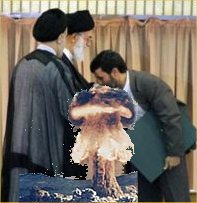
What Is It About Ahmadinejad and August 22?

Ahmadinejad has specified Tuesday, August 22 as the day he will give the US his answer about Iran's nuclear development.

The question is--why has Ahmadinejad picked that particular date?

A number of experts on Islam, such as Bernard Lewis and Robert Spencer have offered a possible answer. No one can know for sure, but thanks to Wikipedia, we can consider the full spectrum of possibilities. Here are some things that happened on August 22:
  • 565 - St. Columba reported seeing a monster in Loch Ness, Scotland
  • 1654 - Jacob Barsimson arrives in New Amsterdam. He is the first Jewish immigrant to what is later the United States
  • 1775 - King George III declares the American colonies to be in open rebellion
  • 1902 - Theodore Roosevelt became the first President of the United States to ride in an automobile
  • 1942 - World War II: Brazil declares war on the Axis powers (Germany, Italy and Japan)
  • 1969 - Elvis Presley begins performing live again in Las Vegas
  • 1979 - Led Zeppelin released their album, In Through The Out Door.
  • 1989 - Nolan Ryan strikes out Rickey Henderson to become the first Major League Baseball pitcher to record 5000 strikeouts.
Who can truly the pierce the unscrutable mind of Mahmoud Ahmadinejad?

"The Islamic Republic of Iran has made up its mind, and on the nuclear program and other issues it is up against it will continue powerfully on its path, putting its faith in God and with patience and perseverance, and it will obtain its sweet fruit".
Iran's Supreme Leader Ayatollah Ali Khamenei, state television, 21 August 2006

Update:
Pajamas Media notes
The date is significant not only to Islam followers, but also to Crusading Christians: “On August 22, 725 AD, the Bishop of Nantes became the martyred St. Emilian while leading the French against the invading muslims.”
Since Ahmadinejad denies the Holocaust, it is doubtful he will own up to the history of Moslems as one of the great occupying armies of all time.

Technorati Tag: and and .