Graphic images are being shared on social media to show how people have been affected by the renewed tensions between Israel and the Palestinians.Here is the BBC video:
Over the past week the hashtag #GazaUnderAttack has been used hundreds of thousands of times, often to distribute pictures claiming to show the effects of Israeli airstrikes on Gaza.
A #BBCtrending investigation has found that many of these images are not from the latest conflict and not even from Gaza. Some date as far back as 2009 and others are from conflicts in Syria and Iraq.
Showing posts with label Pallywood. Show all posts
Showing posts with label Pallywood. Show all posts
Monday, July 07, 2014
Videos: BBC Exposes Faked Images of Israel Attacks on Gaza -- Again
BBCtrending asks Are #GazaUnderAttack images accurate?


Monday, May 20, 2013
Nidra Poller on The Muhammad al-Dura Hoax
This Wednesday, the French Court of Appeal is expected to rule in the defamation case brought by France 2's Charles Enderlin against French media analyst Philippe Karsenty who accused Enderlin of fabricating the story of Mohammed Al-Durah.
In light of that, I am reposting the following 2011 article by Nidra Poller with permission of Middle East Media.
For more background information on the Al-Durah hoax, check out The Al-Durah Project, which gives you the opportunity to check out evidence -- including comparing raw footage of what happened with the edited version broadcast on France2.
On September 30, 2000, a day after Yasser Arafat launched his war of terror, euphemized as the al-Aqsa intifada, state-owned France 2 Television broadcast a news report, filmed by a Palestinian cameraman, of the fatal shooting of a 12-year-old Palestinian identified as Muhammad al-Dura. The dramatic voice-over commentary by the station's long-time Jerusalem correspondent, Charles Enderlin, described how the boy and his father Jamal were pinned down by Israeli gunfire at Netzarim Junction in the Gaza Strip. The father pleaded frantically with the soldiers to stop shooting, to no avail. "A last burst of gunfire," intoned Enderlin, "the boy is dead, his father critically wounded."
The bloodless images of Jamal and Muhammad al-Dura were instantly seared into the public mind. Distributed free of charge to international media, repeated endlessly like a raucous war cry, the Dura video provoked anti-Jewish violence in Israel and, on a scale not seen since the Holocaust, throughout Europe.[1] The recently-created al-Jazeera television—founded in 1996—was significantly boosted by exploiting the Dura death scene.
Recognized almost immediately as a staged scene by astute observers, denounced by others as an unfounded accusation against Israeli soldiers, the Dura video has been analyzed, investigated, dissected, exposed, taken to court, attacked, defended, exploited, and debated for almost ten years.[2]
In light of that, I am reposting the following 2011 article by Nidra Poller with permission of Middle East Media.
For more background information on the Al-Durah hoax, check out The Al-Durah Project, which gives you the opportunity to check out evidence -- including comparing raw footage of what happened with the edited version broadcast on France2.
On September 30, 2000, a day after Yasser Arafat launched his war of terror, euphemized as the al-Aqsa intifada, state-owned France 2 Television broadcast a news report, filmed by a Palestinian cameraman, of the fatal shooting of a 12-year-old Palestinian identified as Muhammad al-Dura. The dramatic voice-over commentary by the station's long-time Jerusalem correspondent, Charles Enderlin, described how the boy and his father Jamal were pinned down by Israeli gunfire at Netzarim Junction in the Gaza Strip. The father pleaded frantically with the soldiers to stop shooting, to no avail. "A last burst of gunfire," intoned Enderlin, "the boy is dead, his father critically wounded."

Despite a mountain of evidence disputing the charge of his intentional killing by Israeli soldiers in 2000, 12-year-old Muhammad al-Dura, seen cowering with his father, became the poster child of the "Second Intifada." As seen in this billboard, his image soon attained iconic status in the Arab world and helped refuel myths of bloodthirsty Jews.
|
Recognized almost immediately as a staged scene by astute observers, denounced by others as an unfounded accusation against Israeli soldiers, the Dura video has been analyzed, investigated, dissected, exposed, taken to court, attacked, defended, exploited, and debated for almost ten years.[2]
Thursday, November 15, 2012
Video: Pallywood Returns As Gaza Injuries Faked
If you're Hamas, how do you defend the fact that you have been deliberately targeting Israeli civilians with rockets for 12 years?
If you're a Hamas terrorist, what do you do when Israel targets you and there are too many of you to hide in the local hospital basement?
You make a distraction and change the topic: let's not talk about the 12,000 rockets Hamas fires into civilian areas -- let's talk about the Gazan civilians that we've neglected to build shelters for.
Better yet: let's make up stories about Gazan casualties:
Thursday, November 08, 2012
Shirley Temper -- The Latest Palestinian Star Of Pallywood
Israellycool has a number of posts exposing Palestinian child abuse, where children are instructed to taunt Israeli soldiers in the hope of provoking a response for the benefit of the eagerly awaiting media stationed nearby.
One of the better known children being manipulated for this purpose, Ahed Tamimi, is better known as Shirley Temper.
To see why, watch this video of Shirley Temper from Israelycool, enhanced by Elder of Ziyon:
One of the better known children being manipulated for this purpose, Ahed Tamimi, is better known as Shirley Temper.
To see why, watch this video of Shirley Temper from Israelycool, enhanced by Elder of Ziyon:
Tuesday, June 19, 2007
PALLYWOOD STILL GOING STRONG. Lisa Goldman's writes about her experience in Ramallah:
Technorati Tag: Pallywood and Media Bias .

On Friday afternoon in Manar Square, for example, I ran into Ohad Hemo, an acquaintance who covers Palestinian affairs for Israel’s Channel 1 news. By then there was finally some media-worthy action. A few dozen Fatah-aligned fighters had shown up in the square, most traveling on the back of pick up trucks. They wore combat-style uniforms, although some wore street shoes instead of army boots. Their faces were covered in ski masks and they brandished weapons in what the Times called a “a show of force by Fatah.” That sounds very dramatic, of course, but the reality was not very impressive: again, I felt as though I were watching a parody of machismo that seemed a bit silly, if not comic.
Other than stare into the camera and pose, the fighters didn’t do anything at all. It was all pure theatre: I listened and watched as the various foreign television reporters positioned themselves in front of the masked gunmen and spoke seriously to the cameras about the rising tension in Ramallah, trying their best to make it sound as if they were in the middle of a war zone. But if their cameramen had panned out for a wider shot they would have shown crowds of mostly young men hanging around, eating snacks, buying cold drinks from vendors, and taking photos with their mobile phones. There was no sense of fear or menace at all. I even saw one photojournalist, who works for an American newspaper, giggling a bit as she aimed her camera at a masked fighter who was posing as if he were having his portrait painted, his eyes stonily focused on the horizon.
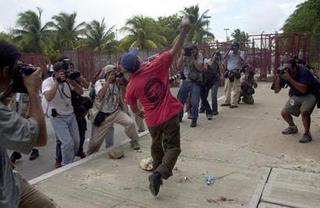 | Some things... |
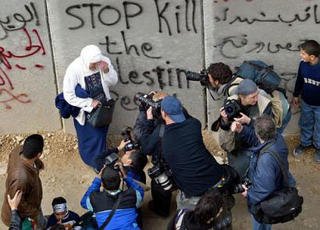 | ...Never change |

Friday, September 15, 2006
The Al Dura Trial In France
If you are following the Al-Dura Trial in France, you have to read what Nidra Poller has to say.
One question she asks is how France 2 could take the risk of a lawsuit against those who have come out saying that the Al-Dura incident is fake.
But she also touches on the open acknowledgement that the Palestinian Arabs regularly fake news events:
One question she asks is how France 2 could take the risk of a lawsuit against those who have come out saying that the Al-Dura incident is fake.
But she also touches on the open acknowledgement that the Palestinian Arabs regularly fake news events:
Many journalists who are unashamedly hostile to Israel admit that the Palestinians produce falsified news but they find nothing to deplore in this practice—it's simply propaganda, and everyone does it. A France 2 official acknowledged in the presence of news director Arlette Chabot, whose honor is allegedly sullied by Philippe Karsenty, that the Palestinians regularly enact fake battle scenes, some of which are reported as news in Western media.Another point she makes is the timing of the lawsuit itself. Given the background of the recent Israel-Hezbollah war--with the revelations of faked pictures, staged photographs and manipulation of the media--there is an interest in the proceedings that France 2 could not have anticipated, or wanted.
All of these people freely admit that some, much, or even most of the material contained in the 27-minute video shot by Talal Abu Rahmeh at Netzarim Junction in the Gaza Strip on that fatal day are in fact staged scenes. (French journalists admit in private that the al-Dura scene, too, was staged; they say everyone knows it, no one will ever admit it publicly, this sort of revelation is totally and absolutely impossible in France, and besides it's an old story and no one is interested.)
For four years Enderlin claimed to have absolute proof of the authenticity of the al-Dura report in the form of 27-minutes of footage, the golden outtakes, which he refused to make available for independent investigation. When Rosenzweig, Jeambar, and Leconte described, in articles and radio interviews, what they had seen, the golden outtakes were reduced, by reverse alchemy, to dross.
At the time when the lawsuits were brought against Karsenty, Lurçat, and Gouz, there was little reason to hope they would attract international attention. Nothing—not the initial investigation, not articles in known, unknown, and/or prestigious publications, not the lectures, meetings, books, videos, websites, letters, demonstrations, revelations—nothing had pierced the invisible wall that separated the truly fascinating documentation of a monumental hoax—with extremely grave and widespread repercussions—from the wall of indifference and confusion that blocked every attempt to bring the case to light and obtain some form of justice.Also take a look at Augean Stables, who besides covering the trial on his blog is also testifying at the proceedings as well.
Ah, but reality is stronger than any theory, and phlogiston stands as the symbol of imposed ignorance in the face of troubling evidence. The July –August Hizbullah war against Israel brought a windfall of staged news. From Pallywood to Hizbollywood with its cohort of fauxtography the blogosphere rapidly produced a wealth of documentation on a phenomenon that replicates everything we had observed in the al-Dura case. But this time, the results were immediate. Reuters dismissed fauxtographer Adnan Hajj and withdrew his photos from their archives. The information leaped from blogs to mainstream. CNN journalist Anderson Cooper admitted he had been manipulated by Hizbullah handlers. The NY Times wriggled out of its false pieta with a lame excuse, but lame is better than nothing. Pristine cuddly toys among the ruins; Green Helmet bouncing dead kids in the air; rescue workers becoming, by turns, bereaved fathers, distressed neighbors, and Hizbullah operatives; a grieving old lady performing in front of several different ruined homesteads, all of them 100% civilian, all of them hers, all of them source of unbearable sorrow; a wounded ambulance driver miraculously cured; press cars hit by missiles and resisting better than a Merkava tank… all of this and more available for analyses that yield a coherent picture of something beyond propaganda—a weapon, a type of warfare that I call "lethal narratives."
Technorati Tag: Israel and Al-Dura and France 2 and Pallywood and Palestinians.
Tuesday, August 29, 2006
Pallywoodland
The price of freedom is eternal vigilance
Thomas Jefferson
Caroline Glick has written a must-read article in the Jerusalem Post that puts gives the kind of perspective that you get blinded to when watching the mind-numbing media go through its paces.
Glick fleshes out the point made by Mere Rhetoric in reaction to the New York Times' gratuitous invocation that Centanni and Wiig "were released unharmed". As Mere Rhetoric responds:
Some say that the falling readership of the newspapers is a sign of this.
But what if that just means they are reading the same newspapers online?
Thomas Jefferson
Caroline Glick has written a must-read article in the Jerusalem Post that puts gives the kind of perspective that you get blinded to when watching the mind-numbing media go through its paces.
Glick fleshes out the point made by Mere Rhetoric in reaction to the New York Times' gratuitous invocation that Centanni and Wiig "were released unharmed". As Mere Rhetoric responds:
You idiot! You total blistering idiot! Being forced to convert is a harm. It might be the oldest harm short of death - being forced to renounce your faith and your god. Millions of people - literally millions - have died rather than deign to utter words that would force them to give up their faith. No wonder liberal journalists are utterly baffled by fully half of the United States - they don't think having to give up your religion is harmful. We are beyond certain that if Muslim prisoners at Gitmo were forced to convert away from Islam as a condition of their release, the New York Times would not be putting the phrase "released unharmed" into their lede. Way beyond certain.Glick also notes this myopia in the coverage of Centanni and Wiig, and it is not limited to the New York Times:
There's a deeper explanation for how paragraphs like this can get written. It's not really bias, as much as it is the blind spots imposed by any ideology. And within that dynamic are questions about the degree of myopia and the room for self-reflection that particular ideologies allow.
While their remarks were covered extensively, no one seemed to think that the fact that their first post-release statements were made at a Palestinian Authority sponsored media extravaganza in Gaza was significant. No one noted that the men were flanked by Palestinian "security forces," and stood next to Hamas terrorist leader and Palestinian Authority Prime Minister Ismail Haniyeh.But that was not the only item that was in the news that day. Reuters claimed that Israel had fired missiles at their reporter, Fadel Shada.
No mention was made of the fact that the two were initially kidnapped by just such PA "security officials," or that Haniyeh is one of the leaders of one of the most fanatical jihadist organizations in the world, an organization that the majority of the "beautiful, kind-hearted and caring" Palestinians voted into office last January.
That is, no mention was made of the fact that until the two men left Gaza, they remained unfree. No one asked whether they had been given the option of not giving a press conference in Gaza. And now that they have spoken, there can be little doubt that a second press conference by the two men, in Israel or the US where no one will force them to convert to Judaism or Christianity or threaten to kill them, will draw far less media interest. After their press conference, the two men became yesterday's news.
Yet it is unclear why anyone should believe either Shana or Reuters. Shana told Reuters that as he was driving to the battle scene, "I suddenly saw fire and the doors of the jeep flew open." He claims to have been wounded by shrapnel in his hand and leg. These are minor injuries for someone whose vehicle was just hit by a missile.
But then, the photographs taken of his vehicle after the purported missile attack give no indication that the car was hit by anything. There is a gash on the roof. The hood is bent out of shape. But nothing seems to have been burned. Cars hit by missiles do not look like they have just been in a nasty accident. Cars hit by missiles are destroyed.
Yet the glass on the windshield and the windows of Shana's vehicle isn't even shattered. In the photographs taken of Shana on the way to the hospital in Gaza, he lies on a stretcher, eyes closed, arm extended in full pieta mode. He is not visibly bleeding although there are some blood stains on his shirt, but then his undershirt is completely white.
I did not see these pictures in the media coverage of the purported IDF attack on the Reuters and Iranian cameramen. I saw them on Powerlineblog Web site [see here and here]. I did not see any questions raised from either the Israeli or the international media on the veracity of Shana's tale, which of course, provides a nice balance to the Centanni-Wiig hostage story.
All of this of course brings us back to the problem of the manipulation of the media by Hezbollah and Hamas, as well as the complete willingness of the media to be led by the nose in what information is available and how it should be presented.
AS IS the case with the Palestinian war against Israel, one of the most notable aspects of Hizbullah's latest campaign against Israel has been the active collaboration of news organizations and international NGO's in Hizbullah's information war against Israel. Like their rogue state sponsors, subversive sub-national groups like Hizbullah, Fatah and Hamas, see information operations as an integral part of their war for the annihilation of Israel and defeat of the West. And their information operations are more advanced than any the world has seen. As becomes more evident with each passing day, they have successfully corrupted both the world media and the community of NGOs that purportedly operate in a neutral manner in war zones.
Glick sees this as part of a wider problem.
It is not a coincidence that I saw the pictures of the Reuters' vehicle on Powerline and not in the media coverage of the purported attack. Both the global media and the international NGO community abjectly refuse to investigate themselves. As democratic governments and their militaries have proven incapable of dealing with the phenomenon (in part because they seek to curry favor with the media and the international NGO community), the blogosphere has taken upon itself the role of media watchdog.The role of the blogosphere in all this is helpful, but a citizenship that is more critical and skeptical of its media is essential.
Some say that the falling readership of the newspapers is a sign of this.
But what if that just means they are reading the same newspapers online?
Technorati Tag: Media Bias and Israel and Reutersgate and Centanni and Hamas and Hezbollah and Hizbollah and Pallywood and Hezbollywood.
Thursday, August 24, 2006
Hezbollywood Makes Pallywood Look Like B-Movie Producers
Pallywood is nothing like Hezbollywood.
The Palestinians orchestrate shootings...funerals.
Hezbollah orchestrated a war.
And it might be part of the reason that Palestinian terrorists have raised the bar by kidnapping Steve Centanni and Olag Wiig, the two Fox News journalists.
The Palestinians orchestrate shootings...funerals.
Hezbollah orchestrated a war.
Public diplomacy for any country, not just Israel, has gone global. While the conflict may be determined in local terms, such as Israel's fight against Hizballah, the ramifications of the action itself are global in nature. Therefore, public diplomacy must be geared toward the global scene.
Ever since 9/11, we have been in a different type of war. We were exposed for the first time to a global network of terrorist organizations, sort of a multi-national corporation of non-state actors.
On the Lebanese scene, through the careful manipulation of evidence, the theater of war has turned into a crime scene. Every action that Israel takes in Lebanon - with its densely populated villages that Israel must operate in because that's the only way that we can uproot the terrorists in them - creates an opportunity for the other side to use public diplomacy with global ramifications. Thus, instead of the war being about Israel's right of self-defense, Hizballah was able to turn it around so that the issue on the international agenda became Israel's destruction of Lebanon and Israel as the cause of world instability. The victim becomes the criminal.The Hezbollah production was quite an achievement.
For example, Nasrallah ordered his men to remove their uniforms and blend in and continue to fight from within the civilian population. In this way, when Israel attacks Hizballah, the scene is one of Israel moving against what appears to be civilians, even though rockets fired from these villages are striking Israel. Attacks on what looks like civilian targets can then be called "crimes against humanity" and "war crimes." In addition, by blending in with civilians, it's easier to fight the Israelis who exercise self-restraint when fighting near civilians.
Another way to change a theater of war into a crime scene is by building Hizballah positions in close proximity to those of UNIFIL. Then there is always an opportunity for a potential mishap where Israel will hit the UNIFIL position by mistake. Or Hizballah may provoke an Israeli attack by firing from a specific location and ensuring that a human shield of innocent civilians will be present at the site.
These are just some examples of how Hizballah uses public diplomacy and the media as a tool of war. They create changes on the ground so that later they can manipulate the situation, and once the crime scene is created, the media look for the villain and his smoking gun.
And it might be part of the reason that Palestinian terrorists have raised the bar by kidnapping Steve Centanni and Olag Wiig, the two Fox News journalists.
Technorati Tag: Israel and Pallywood and Hezbollywood.
Subscribe to:
Posts (Atom)